

The lowest transport rate can become the most expensive choice if it leads to missed deliveries, unused capacity or extra work elsewhere. A cost-effective transport strategy looks beyond the upfront quote, matching transport capacity, service requirements and operational controls to actual demand.
If transport spend is difficult to explain or compare, you’re not alone. Routes, load sizes and delivery deadlines can change, while an operating model built for yesterday’s needs may no longer fit. Cutting costs without checking the impact on reliability can create new problems rather than lasting savings.
This guide sets out a repeatable way to assess transport demand, map the costs involved and compare in-house operations with outsourced haulage and transport management. You’ll also learn how to choose measures that show whether a change is improving overall performance, not simply reducing one line of spend. The aim is a practical, balanced approach that supports service quality and operational continuity alongside cost control.
Key Takeaways
- Build a cost-effective transport strategy around the service outcomes, capacity and risks your business needs, not just the lowest quoted rate.
- Use your own records to separate regular, variable and exceptional transport activity before changing routes, schedules or providers.
- Compare in-house operations, contracted haulage and transport management against the same requirements to identify a suitable operating model.
- Test proposed changes on a defined activity first, with clear service safeguards, escalation routes and decision-making responsibilities.
- Consider whether transport consultancy, haulage or transport management support could help assess gaps and put improvements into practice.
What makes a transport strategy cost-effective for a business?
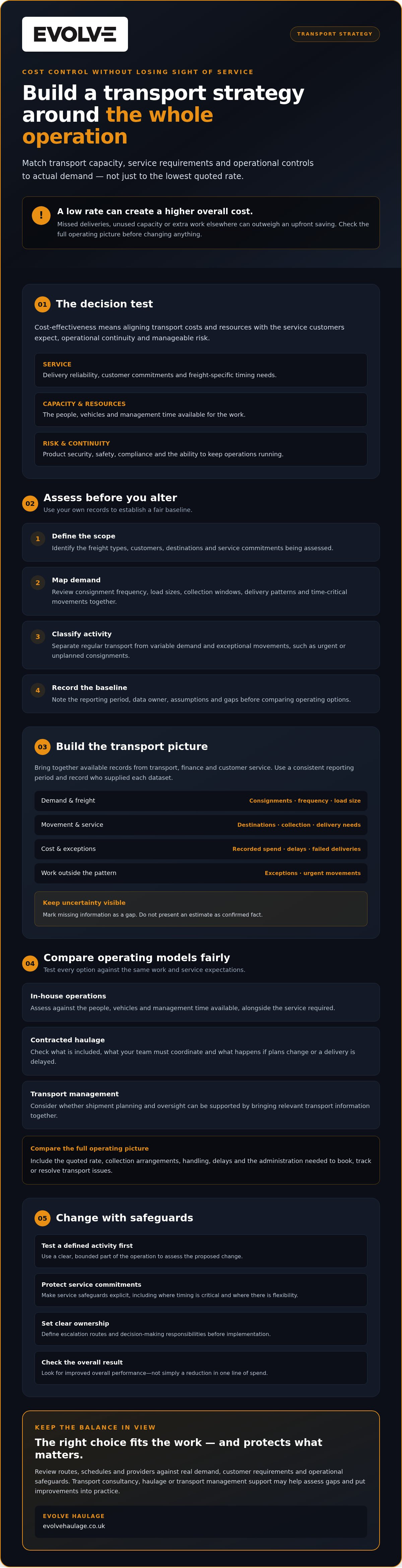
A cost-effective transport strategy balances the resources needed to move goods with the service customers expect and the risks the business needs to manage. Start by defining what is being transported, how often it moves, who receives it and which delivery commitments must be met. Without that scope, a cheaper arrangement on paper may not suit the work it needs to handle.
For example, regular planned freight and an urgent consignment have different service needs. A business may use dedicated full or partial loads for some movements, while other activity calls for a different arrangement. The right choice depends on freight characteristics, delivery patterns, customer requirements and available internal capacity, rather than a single rule applied to every journey.
Make the review repeatable, rather than treating it as a one-off search for a lower charge. A transportation management system can support shipment planning and oversight by bringing relevant transport information together. Its value depends on using reliable records and checking whether the operating model continues to match demand.
How is cost-effectiveness different from choosing the lowest transport rate?
A quoted rate is only one part of the operating picture. Collection arrangements, handling, delays and the administration needed to book, track or resolve transport issues can all affect the resources involved. A low rate may also depend on service conditions that don’t fit a consignment’s size, handling needs or delivery timing.
Compare options against the same activity and service expectations. Check what is included, what your team must coordinate and what happens if a delivery is delayed or the plan changes. A reduction in one charge is not a lasting improvement if it creates extra work, disrupts customer commitments or shifts cost and risk elsewhere.
Which business outcomes should the strategy protect?
Set the outcomes before assessing possible savings. Consider delivery reliability, customer commitments, product security and operational continuity. Priorities may differ by customer or freight type, so record where timing is critical and where there is flexibility. This makes trade-offs visible instead of leaving service expectations implicit.
Safety and compliance also belong in the assessment. Identify the requirements that apply to your operations and verify current guidance before treating any rule as a legal duty. Then assess proposed changes against those safeguards, as well as the people, vehicles and management time available.
Cost-effective transport is value achieved by aligning transport costs and resources with service requirements, operational continuity and manageable risk. Use that definition as a consistent test whenever you review routes, capacity or providers.
How to assess transport demand, costs and capacity before changing anything
Establish a baseline before altering carriers, routes or schedules. Use your business’s own records to understand what moves, how often it moves and what resources the current operation requires. This gives you a fair point of comparison and helps distinguish a genuine opportunity from a change that simply shifts work or risk elsewhere.
Work through the review in sequence:
- Define the scope: identify the freight types, customers, destinations and service commitments being assessed.
- Map demand: review consignment frequency, load sizes, collection windows, delivery patterns and time-critical movements together.
- Classify activity: separate regular transport from variable demand and exceptional movements, such as urgent or unplanned consignments.
- Record the baseline: note the reporting period, data owner, assumptions and gaps before comparing operating options.
What transport data should a business gather first?
Bring together the information available across transport, finance and customer service records. Useful measures include consignments, shipment frequency, load size, destinations, collection and delivery requirements, recorded transport spend, delays, failed deliveries and exceptions. Use a consistent reporting period across sources and record who supplied each dataset. If information is incomplete, mark the gap rather than treating an estimate as confirmed fact.
Separate recurring activity from one-off movements. This helps show whether the operation follows a stable pattern or is shaped by peaks and exceptions that may need a different response. Document assumptions too, such as how a delivery window or load category has been interpreted, so comparisons remain transparent.
How can route and load utilisation reveal improvement opportunities?
Compare planned routes and schedules with actual collection and delivery patterns. Look for signs of avoidable empty running, unused capacity or repeated urgent movements in the records. Treat these as prompts for investigation, not proof that a route or load should change. Delivery windows, freight characteristics and customer commitments may limit what can be combined or rescheduled.
Optimisation is only meaningful when you can compare it with a reliable picture of current demand, cost and service. Use that baseline to test a proposed change against the same measures, and check whether it improves the operation without weakening delivery performance.
If internal records are difficult to bring together, transport consultancy may help review the available information and test assumptions. You can find out more about transport consultancy support as one possible input to that assessment.
Which transport operating model best fits your cost and service needs?
Compare operating models against the same evidence: shipment patterns, required delivery service, available capacity, internal management time and the level of control your business needs. No model is automatically the least expensive. The right fit depends on how consistently transport demand uses available resources and what it takes to maintain service.
Transport management can sit alongside either internal operations or contracted haulage. It focuses on overseeing transport activity, so consider whether your business needs physical freight capacity, support coordinating transport, or a combination of the two.
| Model | Control and flexibility | Management effort | Potential service fit |
|---|---|---|---|
| Internal operations | Direct oversight of vehicles, schedules and day-to-day decisions; flexibility depends on available fleet and staff. | Requires internal capacity to plan and manage transport activity. | May suit consistent demand where the business has suitable fleet capability and management resource. |
| Contracted haulage | Less direct control over transport resources; arrangements and service expectations need to be clearly agreed. | Reduces the need to operate the contracted transport directly, but still requires coordination and performance review. | May suit movements where external freight capacity or a specific service arrangement better matches demand. |
| Transport management | Provides a management approach that can be used with internal or outsourced operations. | Can help organise and oversee activity, depending on the agreed scope. | May be relevant when planning, coordination or operational oversight is the main requirement. |
When might in-house transport or outsourced haulage be a better fit?
Review demand variability, fleet capability and management capacity using your own records. If loads and schedules are relatively consistent, assess whether internal resources can meet service needs without creating capacity gaps elsewhere. If demand fluctuates or particular movements require capacity the business doesn’t have, contracted haulage may supplement the fleet rather than replace it. Compare the full operational requirement, including coordination and contingency arrangements, before deciding.
How should businesses assess full loads, partial loads and urgent freight?
Match the freight arrangement to consignment size, timing and handling requirements. A dedicated full load may fit a consignment requiring its own vehicle movement; a partial load may be worth considering where the freight and delivery schedule can work within a shared arrangement. Neither option suits every shipment. Check the required collection and delivery windows, along with any handling constraints.
Same-day delivery belongs in the assessment when a consignment is genuinely time-critical, not as the default for routine freight. Compare it with planned movements and review the operational reasons behind repeated urgent requests. A dedicated-versus-shared freight comparison can help clarify the trade-offs before you select an arrangement for each type of load.
A cost-effective transport strategy may combine models across different activities. Assess each against your service commitments and operational capacity, then retain the arrangement that best fits the evidence.
How to implement a cost-effective transport strategy without disrupting service
Put proposed changes into practice in stages. Start with one clearly defined activity, such as a particular freight flow or delivery pattern, and agree what the trial is intended to improve. Set a review point before launch so the team can check the evidence and decide whether to adjust, extend or stop the change.
Protect service during the trial by agreeing delivery expectations, contingency arrangements and escalation routes in advance. Make sure everyone involved knows who can make operational decisions, who communicates changes and who responds to exceptions. This matters particularly when handovers between internal teams and external transport providers may affect collection schedules or customer updates.
Which measures show whether a transport change is working?
Select a small set of measures tied to the original objective. Depending on the change, these could include transport spend, on-time delivery performance, failed or delayed deliveries, exceptions, capacity use and relevant environmental data. Use consistent definitions, reporting periods and shipment types, then record factors such as unusual demand or disruption that may influence the result.
A transport change works only if it improves cost without weakening service or creating unmanageable operational risk. Compare like with like, and review the measures together rather than treating one improvement as proof of overall success.
How can businesses manage transition risks and compliance checks?
Before the change begins, plan communications, process handovers and contingency arrangements. Assign clear ownership for driver coordination, schedules, customer updates and applicable compliance processes. Verify current requirements for the operation rather than relying on assumptions, and keep a record of checks and decisions. For detailed compliance coverage, consult the planned UK haulage compliance management guide.
If internal capacity is limited, reviewing transport efficiency and compliance alignment with specialist support may help your team test the proposed approach and identify responsibilities that need clarification. Keep the trial within agreed service safeguards, and pause or revise it if the evidence shows reliability is being affected.
A cost-effective transport strategy should remain open to adjustment as demand and operating conditions change. Information about transport consultancy and management support may help you assess which type of support fits your requirements.
When transport consultancy or a haulage partner can support the strategy
External support can be useful when the business lacks the time or specialist perspective to assess its transport operation, or when internal assumptions need testing. An operational review may help identify gaps between demand, current capacity and service expectations. It should start by understanding how your business works, not by assuming a particular service is the answer.
Different types of support address different needs. Consultancy can help assess an operation and consider possible improvements. Transport management can support the organisation and oversight of transport activity. A haulage partner provides freight capacity for movements that fit the agreed requirements. These options may work separately or alongside existing internal resources. A cost-effective transport strategy should use only the support that addresses a clear operational need.
What should a business ask a transport consultancy or haulage provider?
Ask how they will assess your demand, customer commitments and operating constraints before recommending an approach. Clarify what information they need, how responsibilities will be divided, what reporting you can expect and how exceptions will be escalated. Agree how the arrangement will be reviewed, including which measures will be used to assess cost and service.
Be cautious of claims of guaranteed savings or performance that aren’t supported by evidence and agreed measures. A sound recommendation should explain its assumptions, identify any service trade-offs and show how outcomes will be monitored. You should also understand who makes operational decisions and how changes are communicated to the people affected.
What is a practical next step for improving transport efficiency?
Bring your baseline records together with the service outcomes that matter and the constraints a provider needs to understand. Then identify the immediate requirement: an operational assessment, support managing transport activity, or freight capacity for specific movements. This keeps an initial conversation focused and makes it easier to judge whether the proposed support fits your needs.
Evolve Haulage provides commercial road freight, transport management and logistics consultancy across the UK. Dedicated full and partial loads may suit different consignment requirements, while same-day delivery is an option to consider for genuinely time-critical freight. The appropriate service depends on your requirements and operating context.
To assess the options, review Evolve Haulage’s transport services alongside your demand, priorities and constraints.
Build a transport approach that works over time
A cost-effective transport strategy starts with a clear picture of demand, service commitments and the resources involved. Use that baseline to compare internal operations, haulage and transport management against the same requirements, rather than choosing on the lowest rate alone. Then trial suitable changes on a defined activity and monitor cost alongside delivery performance, exceptions and operational risk.
Keep reviewing the results. Demand can change, and an arrangement that fits one freight flow may not suit another. A measured review helps your business adjust capacity and service without losing sight of customer needs or continuity.
Evolve Haulage provides commercial road freight across the UK, including dedicated full and partial loads, alongside transport management and logistics consultancy. For genuinely time-critical consignments, 24/7 and same-day delivery solutions may also be relevant. The right support depends on your requirements. Discuss your business transport requirements with Evolve Haulage to take a considered next step towards improving your operation.
Frequently Asked Questions
How do you create a cost-effective transport strategy?
Start by defining delivery commitments, then review shipment, route, load and transport cost records to establish a baseline. Compare internal fleet capacity, outsourced haulage and transport management against the same service requirements. Before wider adoption, trial a suitable change on a defined activity, retain contingency and escalation processes, and review agreed measures. The right approach depends on your freight profile, resources and customer needs, so there’s no universal formula.
What does cost-effective transport mean for a business?
It means meeting transport requirements while managing total operating cost, service quality, risk and resources. The lowest quoted rate isn’t necessarily the best value if it doesn’t fit shipment size, delivery timing or capacity needs. Consider management effort and the effect of delays or exceptions, too. Define which outcomes matter most to your business, then compare providers and operating models using consistent evidence rather than price alone.
How can a business reduce transport costs without affecting service?
First, use a reliable baseline to identify where costs, delays or other service issues arise. Review load patterns, routes, schedules and recurring urgent movements before changing providers or delivery arrangements. Test a proposed change on a controlled part of the operation, with escalation and contingency processes in place. Monitor delivery performance alongside transport costs, and account for operating constraints. Don’t assume savings in advance; assess the results against your own records.
Is outsourcing transport always more cost-effective than running your own fleet?
No. Outsourcing may suit a business that needs external haulage capacity or additional transport management support, while an internal fleet may better fit other operating requirements. Compare both options using your own records, including total costs, control, flexibility, vehicle utilisation, internal workload and service commitments. A blended approach may also work, with internal resources handling some activity and contracted transport supporting other movements. The decision depends on your demand and available capacity.
When should a business use same-day freight delivery?
Consider same-day delivery when a consignment has a genuine time-critical need that the normal schedule can’t meet. Assess the consequence of waiting, whether the freight is ready for collection, any delivery constraints and the communication required. Compare it with planned transport based on the operational need, rather than making it the default for routine freight. Confirm feasibility and service details with the provider before relying on a time-critical movement.
Which KPIs should be included in a transport strategy?
Choose a concise set of measures that reflects your strategy’s objectives. Depending on the operation, these may include transport spend, delivery performance, delays, exceptions, capacity use and relevant emissions data where records are available. Define each measure consistently, note its data source and compare like-for-like shipment types and periods. A short scorecard that is reviewed and informs decisions is more useful than a long list of metrics that isn’t maintained.
How often should a business review its transport strategy?
Set a review frequency that fits your operation and the quality of its data, rather than applying a fixed interval to every business. Monitor performance often enough to spot emerging issues, and revisit the wider operating model when demand, capacity or service commitments change. Assign responsibility for reviews and agree what changes should trigger one. This helps ensure the strategy remains aligned with current requirements without reacting to isolated results.

