

A dedicated vehicle isn’t automatically the right choice just because timing matters, and shared freight isn’t automatically the best fit because a load is small. The decision in dedicated haulage vs shared freight depends on what the consignment needs: direct movement, fewer handling points, a particular delivery window or efficient use of vehicle space.
If you’re weighing exclusive capacity against possible extra handling or less predictable transit, start by considering the consequences of delay, the goods being moved and how much control your operation needs. Shipment size matters, but a simple price comparison may not reveal the full trade-off.
This guide compares the two freight models across control, handling, timing and shipment fit. It also explains what to share when discussing a transport requirement, from the consignment’s dimensions and collection and delivery needs to any time-critical constraints. Evolve Haulage provides dedicated full and partial freight loads, and can help businesses discuss an arrangement suited to their requirements.
Key Takeaways
- When choosing between dedicated haulage vs shared freight, assess timing, handling and control needs, not just the consignment’s size.
- Consider shared freight when the load can travel with other consignments and your schedule allows flexibility.
- Assess dedicated haulage when direct routing, a particular delivery window or greater control over the movement matters.
- Before choosing, clarify what you’re transporting, the load details, deadline, handling requirements and route needs.
- Evolve Haulage’s dedicated full and partial loads may suit different requirements; the right arrangement depends on the consignment.
Dedicated haulage vs shared freight: what is the difference?
Dedicated haulage assigns vehicle capacity to one customer’s consignment for a planned movement. Shared freight combines compatible consignments from different customers within available capacity. The key difference is how capacity is allocated, not simply whether a shipment is large or small. A dedicated movement may be arranged for a full or partial load. Shared freight can also take different forms, depending on the carrier’s network and operating model.
That distinction helps explain dedicated haulage vs shared freight without assuming that one option suits a particular shipment size. Providers may use terms such as “dedicated”, “groupage” and “less-than-truckload” differently. Confirm what the proposed arrangement means in practice, including how the consignment will move from collection to delivery.
What does dedicated haulage mean for a business shipment?
With dedicated haulage, a vehicle or a defined amount of its capacity is assigned to one customer’s goods. The consignment is planned for direct movement from collection to delivery, rather than being combined with other customers’ freight as part of a shared service. This describes the transport arrangement, not a guaranteed transit time. Timing depends on the agreed booking and operational requirements.
A dedicated full load uses the vehicle capacity for one customer’s consignment. A dedicated partial load assigns capacity to a customer even if the goods don’t fill the vehicle. Evolve Haulage provides dedicated full and partial freight loads for commercial clients. For background on full truckload terminology, see Truckload shipping. It’s one model of dedicated transport, not the definition of every dedicated movement.
How does shared freight combine consignments?
Shared freight brings compatible goods from multiple customers together to use vehicle capacity. Depending on the operator, freight may be consolidated, sorted or transferred as the carrier plans collections and deliveries. These arrangements can affect routing and handling, but shared freight doesn’t follow one fixed process. Check how a particular service operates rather than assuming that extra handling is involved.
In the UK, groupage commonly describes combining smaller consignments, while less-than-truckload (LTL) is also used for freight that doesn’t occupy a full vehicle. Terminology varies, and LTL is more common in some overseas markets. Ask the provider how your goods are allocated, whether they’ll be consolidated with other consignments and what collection-to-delivery plan applies. “Dedicated” doesn’t automatically mean a full vehicle, just as “shared” doesn’t specify one universal format.
How dedicated and shared freight affect timing, handling and control
Compare the transport plan with your operational constraints, rather than assuming one model is always faster or safer. A dedicated movement can be planned around one customer’s consignment, while consolidation may require the carrier to coordinate it with other freight. The effect depends on the service and booking.
| Factor | Dedicated haulage | Shared freight |
|---|---|---|
| Allocation | Capacity is assigned to one customer’s consignment; it need not fill the vehicle. | Capacity is shared between compatible consignments, subject to the operator’s model. |
| Routing | A direct collection-to-delivery movement may be planned. | Routing may need to accommodate other collections and deliveries. |
| Handling | Direct movement can reduce hand-offs. | Handling varies; consolidation may involve transfers, but not every shared shipment does. |
| Scheduling | May offer greater scope to plan around the consignment’s requirements. | Schedules may depend on coordinating multiple consignments. |
| Shipment fit | Worth assessing where control, direct routing or a defined window matters. | Worth assessing where freight is compatible and timing can be more flexible. |
Which option offers more control over timing and routing?
A direct movement may make it easier to plan around a fixed delivery window or collection deadline. With consolidation, the carrier may need to coordinate routes and schedules across several consignments, so flexibility can be important. If a delay could disrupt production, a customer booking or another part of your operation, explain that constraint early. Confirm the service commitments for the specific movement.
How can handling and cargo sensitivity change the choice?
Fragile, high-value, time-sensitive or otherwise handling-sensitive goods need careful consideration. Fewer transfer points may be relevant, but don’t assume that every shared load is transferred or handled more often. Describe any loading, securing or handling requirements before booking, then check that the proposed arrangement can accommodate them.
Confirm the handling plan and route with the carrier before booking, as both can vary by operator and consignment.
In the dedicated haulage vs shared freight decision, a fixed deadline or specific handling need may matter more than shipment size alone. Evolve Haulage provides dedicated full and partial loads, which businesses can discuss against their transport requirements via dedicated haulage options.
When does dedicated haulage or shared freight make better sense?
The better fit depends on what the consignment needs and what can remain flexible. A smaller load isn’t automatically suited to shared freight, just as a large load doesn’t automatically require an exclusive vehicle. Consider the deadline, route, handling requirements and whether the goods can travel alongside other compatible consignments. In the dedicated haulage vs shared freight decision, operational constraints matter at least as much as shipment size.
| Option | Potential advantages | Points to weigh |
|---|---|---|
| Shared freight | Can make use of capacity alongside compatible consignments, without requiring exclusive vehicle capacity. | Collection, routing and delivery plans may need to accommodate other freight. Check handling arrangements and the expected transit plan. |
| Dedicated haulage | Can support a direct movement and greater focus on one consignment’s timing or handling requirements. | Capacity is allocated to your goods, so assess whether that level of control is needed for a full or partial load. |
When should a business consider shared freight?
Shared freight is worth assessing for smaller or compatible consignments that don’t need exclusive vehicle capacity. For example, it may fit a replenishment load with a flexible delivery date, provided the freight can be combined appropriately. Flexibility around collection and delivery can support consolidation. Confirm how the goods will be handled, how the journey is planned and what delivery expectations apply.
When is dedicated haulage worth considering?
Consider dedicated haulage if a deadline is urgent, a direct movement matters or the cargo has specific handling requirements. It can be relevant for either a full or partial load; the vehicle doesn’t have to be filled for dedicated capacity to be useful. Evolve Haulage provides both dedicated full and partial loads, and offers same-day delivery for time-critical consignments. Discuss your requirements and confirm what can be arranged for the specific movement.
Neither model is universally cheaper or faster. Shared freight may suit a shipment with scheduling flexibility, while dedicated transport may better support a fixed deadline or greater control. Compare the arrangement with the operational impact of waiting, extra coordination or allocating capacity. Verify the proposed service details with the carrier before deciding.
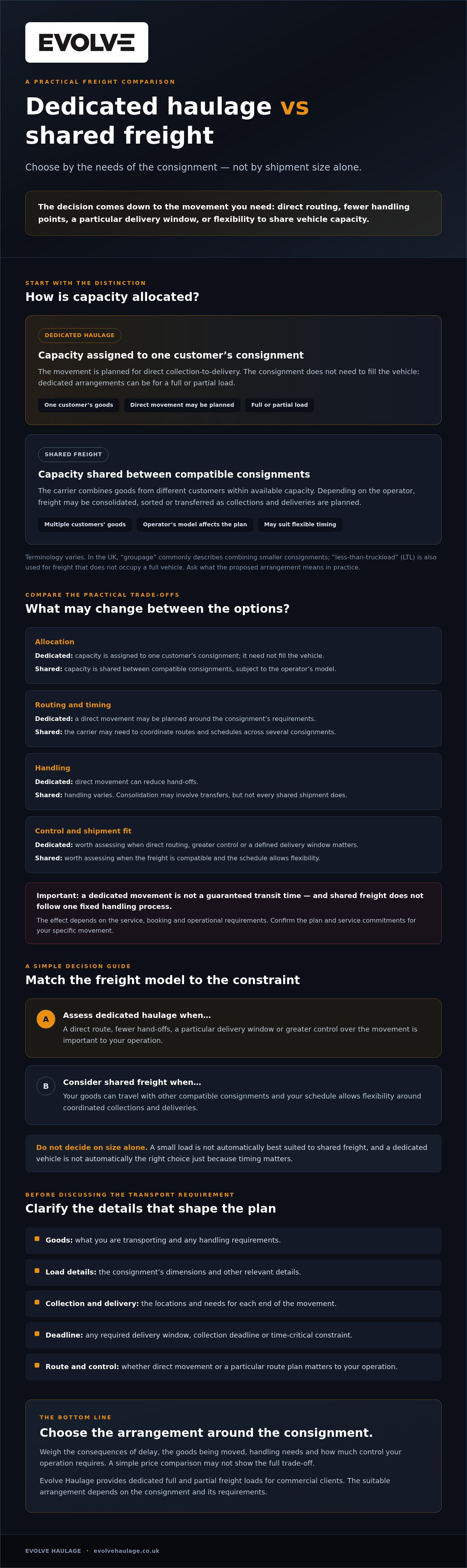
A practical checklist for choosing the right freight option
Before comparing transport arrangements, write down what the consignment needs and where flexibility is possible. This gives a haulage provider the information to assess suitable capacity and explain the service scope, rather than leaving the decision to a headline price or shipment size alone.
What shipment details should you assess before deciding?
Use this process to prepare the details of your load and delivery requirements:
- 1. Describe the goods. Note what they are, how many items or units there are, and any characteristics that affect how they should be moved.
- 2. Record the load. Provide the dimensions and weight of each item where relevant, along with the total quantity and any special loading or handling needs.
- 3. Set out the journey. Give the collection and delivery locations, including any access or site requirements that could affect the movement.
- 4. Classify the timing. Is delivery flexible, tied to a fixed window or time-critical? State collection deadlines too, and explain the operational impact if the consignment is delayed.
- 5. Identify route requirements. Flag any necessary route considerations or delivery sequence, and explain whether a direct movement is important.
This information helps clarify whether shared capacity could be considered or whether dedicated transport may better match the load’s constraints. In the dedicated haulage vs shared freight decision, timing and handling requirements can matter as much as dimensions or weight.
What should you confirm with a haulage provider?
Ask how the proposed arrangement plans the route, manages loading and handling, and communicates collection and delivery progress. Confirm what the service includes, what needs separate agreement and which terms apply to the specific movement. Don’t assume a general service description confirms the details of your booking.
Use this summary to make the discussion more focused: “We’re moving [goods and quantity], measuring [dimensions] and weighing [weight], from [collection location] to [delivery location] by [deadline or delivery window]; the load needs [handling requirements], and we’d like to confirm the route plan, delivery communication and applicable service terms.”
With those details ready, you can have a more focused conversation about the arrangement that fits your operational priorities. Discuss your transport requirements with Evolve Haulage.
Arrange dedicated haulage around your business requirements
The right arrangement matches the consignment’s capacity needs, required level of control, timing and handling requirements. A dedicated load may be worth discussing when direct movement or a defined delivery plan matters, but it isn’t automatically the best fit for every shipment. Weigh those priorities against the flexibility available and the service details confirmed by the provider.
Evolve Haulage provides dedicated full and partial loads for commercial clients. These are options to discuss against your requirements, not universal recommendations. If a consignment is time-critical, Evolve also offers same-day and 24/7 delivery. Confirm that the service is suitable for the specific movement and timing before making plans.
What to include when discussing a dedicated load
Give the provider a clear picture of the goods and the movement you need. Share the consignment’s dimensions, weight and quantity, alongside collection and delivery locations, preferred dates and any fixed delivery window. Explain relevant security, handling or communication expectations so they can be considered in the proposed arrangement.
Ask the provider to confirm the planned capacity, collection and delivery arrangements, and any applicable service terms. For time-sensitive goods, make the consequences of delay clear and check what timing commitments can be confirmed for that booking. A well-defined request helps both sides assess whether a dedicated full or partial load aligns with the job.
When transport management or consultancy may also help
A one-off freight movement is different from the ongoing work of coordinating a transport operation. Evolve Haulage also provides transport management and logistics consultancy for businesses with broader operational requirements. Transport management may be relevant to day-to-day coordination and compliance support, while consultancy can help a business review transport efficiency or strategy. Discuss the scope you need rather than assuming these services include particular processes or outcomes.
In the dedicated haulage vs shared freight decision, start with the needs of the shipment, then establish what the proposed service covers. If your requirement extends beyond one movement, outline that wider context too. This can help clarify whether the discussion should focus on a dedicated load, ongoing transport management or a review of logistics arrangements.
Have a dedicated movement to plan? Discuss a dedicated haulage requirement with Evolve Haulage and share the details needed to assess the arrangement.
Choose the freight arrangement that fits your operation
The choice between dedicated haulage vs shared freight comes down to the consignment’s requirements, not a blanket rule about load size or price. Consider how much capacity you need, whether direct routing or specific handling matters, and how fixed the collection and delivery timing is. Confirm the proposed route, handling plan and service terms with the provider before booking.
Evolve Haulage provides dedicated full and partial freight loads for commercial clients. For time-critical consignments, 24/7 and same-day delivery options are available. Confirm their suitability for the specific movement. If your needs extend beyond a single load, Evolve also offers transport management and logistics consultancy alongside haulage services.
Share details of your goods, load, collection and delivery requirements, deadline and handling expectations to make the discussion practical and focused. Discuss your dedicated haulage requirements with Evolve Haulage and explore an arrangement that supports your operational priorities. With clear information about your constraints, you can make a more informed decision.
Frequently Asked Questions
Is dedicated haulage faster than shared freight?
Dedicated haulage can allow a more direct route, but it doesn’t automatically mean faster delivery. In the dedicated haulage vs shared freight comparison, actual transit depends on the route, schedule, whether the goods are ready for collection and the provider’s commitments. Shared freight may require consolidation planning around other consignments. Ask the provider to confirm proposed collection and delivery times for your shipment rather than assuming either option guarantees a particular speed.
Is shared freight cheaper than dedicated haulage?
Shared freight can be suitable when your consignment doesn’t need exclusive vehicle capacity, but it isn’t always cheaper overall. The outcome depends on the goods, load details, service scope, handling requirements and how flexible your timing can be. To assess value, compare like-for-like proposals, including collection and delivery arrangements and any additional requirements. Check what the provider includes before choosing based on a headline price alone.
Can a small business use dedicated haulage?
Yes. A business doesn’t need to be large to consider dedicated haulage; suitability depends on the particular consignment and its requirements. A smaller organisation may value a dedicated movement if timing, direct routing or control matters for a delivery. Dedicated transport doesn’t necessarily require a full vehicle, either. Describe the goods, load and delivery needs, then ask the provider which arrangements are available for that shipment.
What is the difference between shared freight and groupage?
Both terms can describe freight combined with consignments from other customers, but providers may define and operate them differently. The label alone doesn’t tell you how a shipment will be consolidated or moved. Ask the carrier whether your goods will share capacity, how the route and collection schedule are planned, and whether handling or transfers are involved. Don’t assume groupage means an identical service across all UK haulage providers.
When should a business choose dedicated haulage?
Consider dedicated haulage if your consignment has a firm deadline, needs a direct movement, has particular handling requirements or calls for greater control. These are factors to assess, not automatic proof that dedicated transport is necessary. Set out what matters to your operation and compare it with the provider’s proposed service. Confirm the collection and delivery arrangements, handling plan and any timing commitments for the specific booking.
Does dedicated haulage always mean a full truckload?
No. “Dedicated” describes how capacity or a transport movement is allocated, while “full” or “partial” describes the load. Definitions and arrangements can vary between providers, so don’t assume an entire vehicle must be filled. Explain the consignment’s dimensions, weight and quantity, then ask whether a dedicated full-load or partial-load option is appropriate. Evolve Haulage provides dedicated full and partial freight loads for commercial clients.
What information should I provide when requesting dedicated haulage?
Share what the goods are, their dimensions, weight and quantity, plus the collection and delivery requirements and preferred timing. Include any deadline, site access constraints, handling instructions or security needs that may affect the movement. Clear details help the provider assess a suitable arrangement and confirm the relevant service terms. They don’t establish availability or an instant price, so ask the provider to confirm what can be arranged for your consignment.