

What if the best transport option for your business isn’t the largest vehicle or the fastest delivery, but the arrangement that fits the freight? Choosing commercial road haulage involves more than booking a collection. The load, schedule and delivery requirements all affect which option is suitable.
If you’re unsure what haulage services include, or how to coordinate collections, timings and compliance responsibilities, you’re not alone. Before comparing options, businesses need a clear picture of their freight requirements, whether they’re moving a full or partial load or arranging a time-critical delivery.
This guide explains what commercial road haulage covers in the UK and how a transport arrangement works. You’ll learn what to consider when matching a load to a service, how haulage, transport management and consultancy differ, and which practical details to prepare before discussing your requirements. With this information in hand, it’s easier to align transport with your operation and delivery needs.
Key Takeaways
- Understand how commercial road haulage differs from moving your business’s goods using your own transport operation.
- Prepare for a smoother booking by clarifying the consignment, collection and delivery details, timings and communication arrangements.
- Compare full loads, partial loads and urgent same-day delivery against your freight requirements and delivery priorities.
- Use a practical checklist of locations, dates, access details, contacts and handling requirements before discussing a transport need.
- Explore how Evolve Haulage’s UK-wide freight service, transport management and consultancy may support different business requirements.
What does commercial road haulage mean for UK businesses?
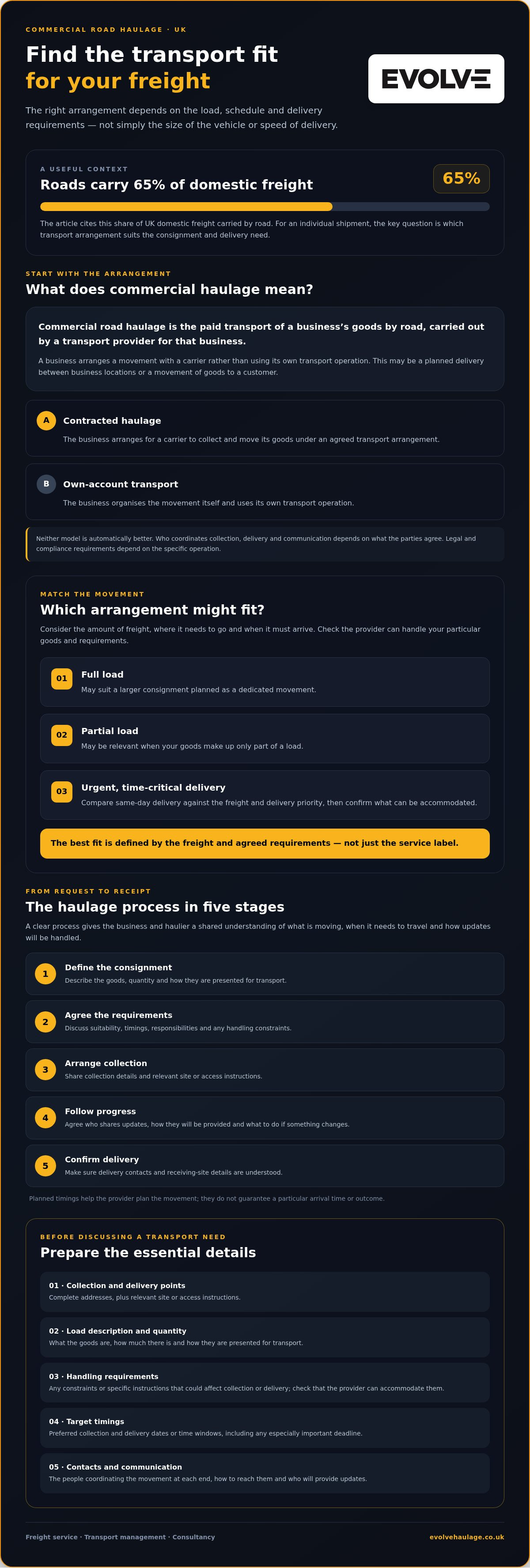
Commercial road haulage is the paid transport of a business’s goods by road, carried out by a transport provider for that business. In practical terms, the business arranges a movement with a carrier rather than using its own transport operation. This could be a planned delivery between business locations or a movement of goods to a customer.
Road freight is a central part of UK goods movement. Wikipedia’s overview of the transport network in the UK states that roads carry 65% of domestic freight. For a business arranging a shipment, the useful question is not only whether goods can travel by road, but which transport arrangement suits the consignment and delivery requirement.
This plain-English description explains the commercial arrangement, but it is not a complete legal definition. The term may be used broadly in business discussions, while legal and compliance requirements depend on the specific operation. If your transport requirement raises questions about operator licensing or driver compliance, check the current rules for your circumstances rather than assuming the everyday meaning covers them.
How is commercial haulage different from own-account transport?
With contracted haulage, a business arranges for a carrier to collect and move its goods under an agreed transport arrangement. With own-account transport, the business organises the movement itself and uses its own transport operation. For example, a supplier might contract a carrier to deliver goods to a customer, while another supplier might organise the delivery using its own resources. Neither model is automatically the better choice. Responsibilities, including who coordinates collection, delivery and communication, depend on what the parties agree.
What types of business freight can road haulage support?
Road haulage can support a range of business movements, from sending a consignment to a customer to transferring stock or materials between business locations. The suitable arrangement depends on the amount of freight, where it needs to go and when it must arrive. Don’t assume a provider can handle particular goods or requirements without checking first.
Load size can help guide the conversation. Evolve Haulage provides dedicated full and partial freight loads across the UK. A full load may suit a larger consignment planned as a dedicated movement, while a partial load may be relevant when the goods make up only part of a load. The right fit depends on the freight and agreed requirements, not just the label. Describe what is moving and discuss any specific constraints before confirming an arrangement.
How does commercial road haulage work from booking to delivery?
Commercial road haulage typically moves through five practical stages: define the consignment, agree the requirements, arrange collection, follow progress and confirm delivery. A clear process gives the business and haulier a shared understanding of what is being moved, when it needs to travel and how updates will be handled.
Start by describing the goods and providing the collection and delivery details. The haulier can then discuss whether the requested arrangement is suitable and confirm the details with you. Before agreeing to the movement, establish the planned timings, each party’s responsibilities and who to contact if something changes. Collection and delivery information helps the provider plan, but it does not guarantee a particular arrival time or outcome.
What information does a haulier need to plan a movement?
Prepare the essentials before requesting a transport arrangement. This helps the provider assess the requirement and identify questions to resolve before collection.
- Collection and delivery points: provide complete addresses and relevant site or access instructions.
- Load description and quantity: explain what the goods are, how much there is and how they are presented for transport.
- Handling requirements: flag any constraints or specific instructions that could affect collection or delivery, and check that the provider can accommodate them.
- Target timings: share preferred collection and delivery dates or time windows, and identify any deadline that is especially important.
- Contacts: name the people coordinating the movement at each end and agree how they can be reached.
How do communication and delivery updates support the process?
Agreeing contact points in advance helps the business, haulier and receiving site coordinate the movement. Confirm who will share updates, how they’ll be provided and what to do if access, timing or other arrangements change. Ask what progress information is available before dispatch instead of assuming live tracking or a particular reporting tool is included.
At delivery, clarify how completion will be confirmed and who at the receiving point is expected to acknowledge it. Agreeing these steps gives the business a clear record of the handover and a route for raising a query if the consignment or timing differs from the plan. For wider industry guidance, the Road Haulage Association provides information and resources for the UK road haulage sector.
For businesses reviewing how transport is organised alongside individual consignments, Evolve Haulage’s transport management support may be relevant.
Which commercial haulage arrangement fits the load and delivery need?
The right fit depends on the consignment and its delivery priority, not on one option being universally better. Consider how much freight is moving, how urgent the delivery is and how much coordination the arrangement may require. The Road Haulage Association provides further industry information, but your own load details are essential when discussing a suitable movement.
| Arrangement | Consignment size | Timing priority | Coordination and details to confirm |
|---|---|---|---|
| Dedicated full load | A consignment suited to a dedicated movement. | Agree collection and delivery timings to suit the shipment. | Confirm load requirements, access, delivery arrangements and who will coordinate each end. |
| Partial load | Freight that does not require a full load. | Confirm suitable timings for the consignment. | Discuss the goods, quantity, collection and delivery points, and any constraints that may affect planning. |
| Urgent same-day delivery | A time-critical consignment, subject to the provider confirming suitability. | High priority: explain the deadline and required collection timing. | Confirm availability, locations, load details, contacts and the communication plan. |
When might a dedicated full-load movement be appropriate?
Consider discussing a dedicated movement when the consignment is suited to using a full load. Before choosing it, weigh the load requirements against collection and delivery timings, site access and handover arrangements. A dedicated service is not automatically faster, safer or more economical. Its suitability depends on the shipment and the terms agreed with the haulier.
When might partial-load or same-day haulage be worth considering?
A partial load may be appropriate when your freight doesn’t require a full load. Evolve Haulage provides dedicated full and partial freight-load services across the UK, so businesses can discuss which arrangement fits the consignment. To compare options, explain the freight quantity, collection and delivery points, timing and any constraints that could affect planning.
Same-day delivery is an option to discuss when a consignment is time-critical, rather than a default for every shipment. Evolve Haulage also provides time-critical same-day delivery solutions. Share the deadline and collection details early so the provider can discuss whether the requirement can be met. Consider urgency alongside the load and coordination needs when deciding whether this service is suitable.
What should a business prepare before arranging commercial road haulage?
Good preparation helps the haulier understand the movement and gives both parties a clear basis for agreeing the arrangements. Before discussing commercial road haulage, gather the information below and flag anything that could affect collection, transport or delivery.
Which consignment and delivery details should be confirmed?
- Goods and quantity: describe what is being moved and how much there is, including how the consignment is presented if that affects handling.
- Collection and delivery points: provide complete addresses, site instructions and any access details the driver or transport provider may need.
- Dates and timing: state your preferred collection and delivery dates, any time windows and whether a deadline is critical.
- Access or handling constraints: disclose restrictions, site procedures or particular handling requirements before collection. Ask the provider to confirm whether they can accommodate them.
- Contacts at each end: identify who will coordinate the collection and who will receive the goods. Confirm how those contacts can be reached and who should be notified if arrangements change.
Be specific rather than relying on assumptions. For example, if access is limited or the receiving contact is available only at certain times, raise this during planning. Clear information helps the provider assess the requirement, but it doesn’t guarantee a particular delivery outcome.
How should businesses think about compliance and operational responsibility?
Compliance responsibilities can depend on the parties involved and the transport arrangement. Establish which responsibilities your business retains and what the provider has agreed to manage, rather than assuming that booking a carrier transfers every obligation. The goods and the way they are transported may also affect what needs checking.
Use this as a prompt to verify, not as a substitute for current advice. If the movement raises questions about operator requirements, vehicles or drivers, check the relevant official UK guidance for the specific circumstances before arranging transport. Don’t rely on a general explanation of haulage as a complete statement of legal duties.
Once you’ve assembled these details, share them with the provider and resolve any outstanding constraints before collection. A short, accurate brief can help clarify the movement’s scope, responsibilities and contact plan. To discuss a transport requirement, contact Evolve Haulage about your haulage needs.
How Evolve Haulage supports commercial road freight across the UK
Evolve Haulage provides commercial road freight transport across the UK, with dedicated full and partial loads for businesses moving goods. The suitable arrangement depends on the consignment. A full load may suit freight planned as a dedicated movement, while a partial load can be considered when the shipment doesn’t require a full load. Sharing the goods description, quantity, collection and delivery details helps clarify what support may fit.
For a shipment with a critical deadline, Evolve also offers 24/7 and time-critical same-day delivery solutions. These are options for urgent requirements, not the default for every consignment. Explain the deadline and discuss the delivery need before agreeing the arrangement, so timing expectations and responsibilities are clear.
These haulage services sit alongside Evolve’s transport management and logistics consultancy. They may be relevant when a business needs support beyond an individual movement, such as reviewing how transport activities, schedules and coordination are managed. Each service has a distinct role, so discuss the scope in relation to your operational requirements.
When might Evolve Haulage’s broader transport support be relevant?
Transport management may be worth discussing if your business wants support with day-to-day transport oversight, including driver coordination and schedules. Logistics consultancy offers a separate way to review transport compliance considerations, operational efficiency or wider transport strategy. The scope depends on the requirement. Discussing it directly helps establish which support is relevant, without assuming it forms part of a haulage booking.
For example, a business arranging occasional consignments may mainly need a suitable load movement, while an operation reviewing how transport is organised may also want to explore management or consultancy support. These services are not substitutes for freight transport, but can address broader operational needs.
What is a useful next step for a prospective customer?
Before making an enquiry, gather the consignment description and quantity, collection and delivery points, preferred dates, any critical deadline, access or handling constraints, and contact details for both ends. A clear brief gives Evolve a practical starting point for discussing the requirement. It doesn’t mean an online quote or a particular outcome is guaranteed. The next step is to talk through what the movement involves and which service may be suitable.
If you’re assessing commercial road haulage for your business, you can Discuss your commercial haulage requirements with Evolve Haulage.
Plan a freight arrangement that fits your business
Choosing commercial road haulage starts with matching the transport arrangement to the consignment, delivery priority and coordination required. A clear description of the goods, collection and delivery details, timing, and any access or handling constraints gives the provider a practical basis for discussing the movement.
Evolve Haulage provides UK-wide commercial road freight, including dedicated full and partial loads. For urgent requirements, its 24/7 and time-critical same-day delivery solutions may be relevant, while transport management and logistics consultancy can support broader operational needs. These services have distinct roles, so the right conversation depends on what your business needs to move and manage.
Have a freight requirement to discuss? Gather the key consignment details and delivery priorities, then discuss your commercial haulage requirements with Evolve Haulage. A considered starting brief can help you explore an arrangement that fits your operation.
Frequently Asked Questions
What is commercial road haulage?
Commercial road haulage is the paid movement of a business’s goods by road, arranged with a transport provider. It can cover a consignment going to a customer or goods moving between business locations. This differs from own-account transport, where a business organises the movement using its own transport operation. The term is a useful business description, but it isn’t a complete statement of legal responsibilities, which depend on the specific arrangement.
Is commercial haulage the same as freight transport?
The terms overlap, but freight transport is the broader idea of moving goods, while commercial haulage usually refers to goods carried by road for a business. Freight can move through different transport arrangements, so clarify what a provider means when discussing a service. For a road movement, confirm the goods, load size, collection and delivery points, timing and responsibilities. These details help identify an arrangement suited to the consignment.
Can a business use commercial haulage for a partial load?
Yes. A business can discuss a partial-load movement when its consignment doesn’t require a full load. Evolve Haulage provides dedicated full and partial freight-load services across the UK. To explore whether a partial load fits, describe the goods, quantity, collection and delivery details, and preferred timings. Flag any access or handling requirements in advance, too. The provider can then discuss the arrangement against the shipment’s needs.
How does commercial road haulage work?
Commercial road haulage typically follows five stages: define the consignment, agree the requirements, arrange collection, follow progress and confirm delivery. The business provides the load and location details, then agrees timings, responsibilities and communication with the provider. Before dispatch, clarify who to contact if plans change and what delivery confirmation will be provided. This gives both sides a shared plan without assuming a particular arrival time or outcome is guaranteed.
What information should I provide when arranging commercial haulage?
Provide a clear description of the goods, the quantity, collection and delivery addresses, and the dates or time windows you need. Explain any access restrictions, site instructions or handling requirements before collection. Identify the contacts coordinating at both ends and agree how they can be reached. If there’s a critical deadline, state it clearly. These details help the provider understand the movement and discuss a suitable transport arrangement with you.
Can commercial road haulage support an urgent delivery?
Yes, urgent road freight can be arranged when the consignment and service fit the required deadline. Evolve Haulage offers 24/7 and time-critical same-day delivery solutions for urgent requirements, rather than treating same-day delivery as necessary for every shipment. Share the collection and delivery details, deadline and any constraints as early as possible. Confirm the specific arrangements with the provider, including timings and communication, before agreeing to the movement.
How much does commercial road haulage cost?
The cost depends on the particular movement, so there isn’t one suitable figure for every consignment. Factors to discuss include the load’s size and quantity, collection and delivery points, timing priority, access needs and whether you require a full or partial load. Share these details with the provider to discuss the requirement and applicable pricing. Evolve Haulage doesn’t offer instant online pricing, so don’t assume a general industry estimate represents its charge.
