

In an urgent freight move, the right contact matters as much as the vehicle. Finding an emergency freight service in the UK starts with identifying a provider that covers both locations, then sharing the collection point, destination, delivery deadline and consignment details. A metro-area contact can make the first conversation more relevant, but availability still depends on the route, vehicle capacity and conditions on the day.
Holiday periods, peak demand and disruption can affect collection windows and journey plans, so clarity on coverage matters more than a headline claim of speed. This guide explains how to find emergency freight contacts across UK metro areas, what to include in an enquiry, and what to expect from round-the-clock or same-day services when schedules are under pressure. It also outlines how dedicated transport works and which practical details influence reliability, helping you move from an urgent requirement towards a workable transport plan.
Key Takeaways
- Start with a contact serving both the collection and delivery areas, then provide the deadline and consignment details to make the enquiry useful.
- Check how holiday cover and round-the-clock availability affect collection windows, route planning and delivery expectations.
- Use metro-area coverage to narrow your search; London has the largest concentration in the UK emergency freight company list.
- Assess reliability by understanding whether transport is dedicated and how disruption, vehicle capacity and route conditions could affect timing.
Holiday and round-the-clock availability
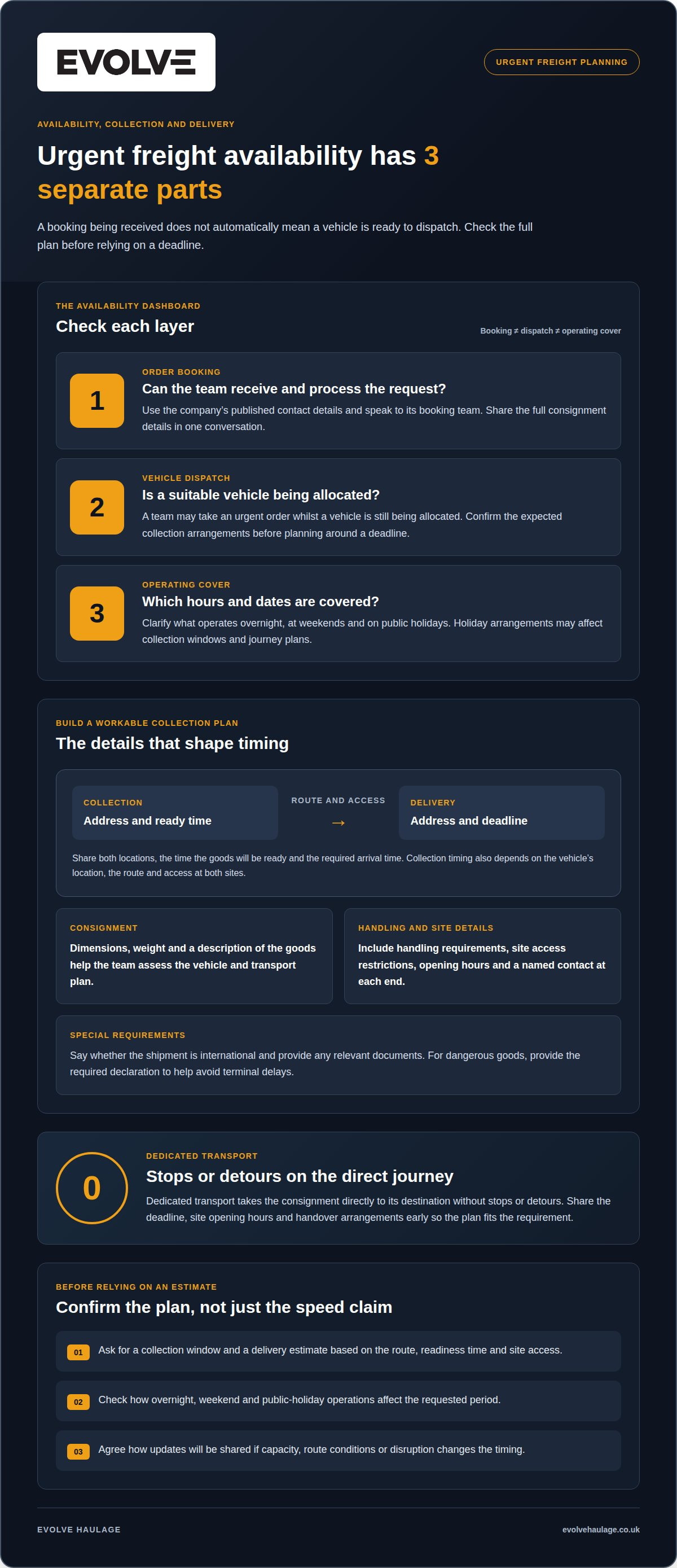
Booking access, vehicle dispatch and holiday operations are separate parts of urgent freight availability. Consider each when planning a critical consignment.
To arrange a UK collection, provide the collection and delivery addresses, the time the goods will be ready, the delivery deadline, and the consignment’s dimensions and weight. Include handling requirements, site access details and a named contact at each end. This helps the transport team assess the route, vehicle and collection plan.
Round-the-clock haulage availability
Round-the-clock haulage is about whether a vehicle can be dispatched, not simply whether someone can take an order. Clarify which parts of the service operate overnight, at weekends and on public holidays. A booking team may receive an urgent request while a suitable vehicle is being allocated, so confirm the expected collection arrangements before planning around a deadline.
Order booking availability
Order availability means when a provider can receive and process a booking. Use the freight company’s published contact details and reach its booking team, rather than relying on an old saved number. Give the full consignment details in one conversation, including whether the shipment is international. Ask what collection and delivery arrangements the provider can commit to for the requested period.
Collection and delivery timing
Collection timing depends on whether the consignment is ready, the vehicle’s location, the route and access at both sites. Request a collection window and delivery estimate based on those details, particularly during holidays when operating arrangements may differ. For dangerous goods, provide the required declaration to help avoid delays at the terminal.
For urgent shipments, dedicated transport takes the consignment directly to its destination without stops or detours. Share the deadline and site opening hours early so the collection and arrival plan fits the actual requirement. Include any handover arrangements or access restrictions in the booking details.
Emergency freight companies by UK metro
Metro-area listings can help identify freight contacts, but a provider’s coverage of both collection and destination matters more than its base. The UK emergency freight company list averages 9.8 tracked contacts per company as of Nov 6, 2026. Use those details to find a relevant contact, then confirm the route and service required.
Compare providers by asking how they handle collection timing, delivery updates and insurance for your specific consignment. Check which risks are covered, what exclusions apply and how liability limits work. A clear comparison should consider the complete transport plan, not just a headline estimate or the provider’s nearest listed office.
Provider coverage and route options
Coverage can vary between well-connected locations and remote collection or delivery points. For an international journey, ask which route stages the provider coordinates and whether another carrier handles a handover. Share both postcodes, the deadline and consignment details. Dedicated transport or a courier arrangement may suit different loads, from an urgent component to freight supporting a wider supply chain.
For oversized freight, dimensions, weight, loading access and route constraints shape the transport plan. Dangerous goods require suitable documentation, including a dangerous goods declaration to help avoid terminal delays. Requirements depend on the goods and journey, so include relevant handling and documentation details when arranging transport.
Speed, tracking and insurance
Compare the collection window and delivery plan with your actual deadline, rather than relying on a general speed claim. Ask how progress updates are shared and which journey milestones are reported. Review the booking terms for covered risks, exclusions, liability limits and the process for reporting damage or loss, so you understand what protection applies to the consignment.
Emergency freight costs depend on the case and are provided after a quote request; urgency, route, vehicle requirements, dimensions and handling needs affect the price. Freight can range from a small critical component to larger goods, subject to vehicle capacity and safe loading. Provide addresses, readiness time, deadline, weight, dimensions, goods description and relevant documents. For route planning, explore UK haulage options.
Reliability during busy periods and disruptions
Peak demand can reduce vehicle capacity and tighten collection windows, while disruption may affect a planned route. Reliability depends on a clear operating plan, timely updates and decisions that reflect the goods’ priority. A sensitive component needed to restart production, for example, may need different handling and delivery coordination from routine stock.
Explain the operational impact of delay when arranging transport. Give the required arrival time, site opening hours and whether the goods can travel with other freight. This helps the logistics team assess urgency and plan suitable transport. During a busy period, agree a collection window and how changes will be communicated instead of relying on a broad delivery estimate.
Disruption can arise from traffic, severe weather, access restrictions or delays at a collection or delivery site. A practical response plan identifies the next decision: reroute, revise the arrival estimate or arrange a new handover. If a site closes earlier than expected, for example, the recipient’s contact details and alternative receiving arrangements can help prevent a failed delivery.
For shipments travelling across the UK, route dependencies can add complexity. Establish who coordinates each journey stage and how updates reach the sender and recipient. If an interruption affects one leg, clear responsibility supports faster decisions across the supply chain. Account for consignment readiness, loading access and handling needs so teams can keep goods moving safely.
Before dispatch, align the response process with the consequences of delay. A production-critical item may need an agreed escalation contact, while less time-sensitive freight may allow a revised arrival slot. Record the recipient, delivery instructions and acceptable alternatives in the booking details. Track specific milestones, from collection confirmation to delivery acknowledgement, rather than relying on a general assurance of speed.
How quickly can emergency freight be collected and delivered in the UK?
Collection and delivery timing depends on the route, consignment readiness and vehicle availability. A same-day request needs a vehicle able to reach the collection point, load the goods and complete the journey within the required window. The destination’s access hours matter too: if the vehicle arrives after the site closes, delivery may not go ahead as planned.
For a useful estimate, the transport planner needs the collection and delivery postcodes, when the goods will be ready and the required arrival deadline. Include the consignment’s dimensions, weight and handling needs. A pallet ready at a staffed warehouse, for example, may be simpler to collect than fragile equipment awaiting preparation at a restricted site.
With those details, the transport team can assess distance, route conditions, loading time and any scheduled handover. Dedicated transport can help limit extra handling, but delivery timing still depends on the journey and site access. An urgent delivery on a short route and one crossing several regions need different plans.
Build the delivery window around the recipient’s actual arrangements. Name the person accepting the goods, provide site instructions and allow time for unloading. If the consignment is not ready at the agreed collection point, dispatch timing may shift. Keep the transport team updated about readiness so it can coordinate vehicle arrival with the deadline.
For time-critical freight, distinguish the collection estimate from the expected arrival time. Ask for both, along with the milestones used to communicate progress. A delivery plan should account for the entire journey, not just the vehicle’s departure. To discuss a same-day delivery requirement, share the route, readiness time and deadline.
Evolve Haulage
Evolve Haulage can help businesses coordinate urgent UK freight when a delayed consignment risks disrupting operations or supply. Its haulage service supports transport requirements, whilst transport management helps organise day-to-day logistics. For urgent movements, 24/7 and same-day delivery solutions provide options when standard schedules do not fit the deadline.
Share the collection and delivery locations, consignment details, readiness time and required arrival window so the transport team can understand the operational need. If route planning or logistics processes need attention beyond one shipment, Evolve Haulage’s consultancy service can support a broader review. The right starting point depends on the urgency, route and level of transport coordination required.
For help planning an urgent freight movement, contact Evolve Haulage.
Make your next urgent movement easier to coordinate
Prepare a simple freight brief before disruption occurs: record who can authorise an urgent dispatch, which sites can receive goods and the operational impact of delay. This helps your team explain priorities clearly and make timely decisions when a consignment becomes critical. Assess an emergency freight service in the UK against the actual business need, not speed alone.
Evolve Haulage can help businesses organise transport around urgent requirements and wider logistics needs. Share the route, timing and consignment details to start a practical conversation about the right approach. Contact Evolve Haulage to discuss your freight requirements and take the next step with confidence.
Frequently Asked Questions
How can I contact emergency freight providers in the UK?
Contact Evolve Haulage’s freight team and state that the movement is urgent. Include your business name, a suitable callback contact, the operational reason for the deadline and who can authorise the booking. Explain whether a production line or scheduled customer delivery depends on the consignment, for example, so the team understands the consequences of delay.
What is emergency freight service in the UK?
Emergency freight is transport arranged for a time-critical business consignment that cannot follow routine delivery schedules. It may involve a dedicated road vehicle or another suitable freight arrangement, depending on the goods, route and required arrival time. A replacement machine part needed to restore operations is one example. The service coordinates transport around the shipment’s urgency and handling needs.
Which UK couriers offer 24/7 emergency freight and same-day delivery?
Evolve Haulage provides 24/7 and time-critical same-day delivery solutions across the UK. The business offers road haulage for commercial freight, so its service is relevant when a consignment needs urgent transport rather than a small-parcel courier option. Share the goods’ details and required timing to discuss how the transport requirement can be approached.
What UK rules apply to transporting dangerous goods or oversized freight urgently?
For dangerous goods, provide suitable documentation, including a dangerous goods declaration, to help avoid terminal delays. For oversized freight, give the dimensions and weight, loading access and route constraints so the provider can plan suitable transport. Requirements depend on the goods and journey.
What risks, exclusions and compensation limits should I check before booking emergency freight?
Before booking, check which risks are covered, what exclusions apply, how liability limits work and how to report damage or loss. Assess these terms against your specific consignment.


