

What if the biggest transport savings come from improving the process before a vehicle leaves the depot? A transport efficiency consultant can review each step, from planning and carrier decisions to delivery, and use operational data to identify where routing, loads and handovers could work better. The goal is to align transport activity with business priorities, not optimise one part of the operation in isolation.
Transport costs, service levels and fleet performance are closely connected, so changing one can affect the others. A structured review can uncover avoidable expense and friction, giving teams a clearer basis for practical improvements.
This article explains how to design end-to-end transport processes, what a consultancy assessment can cover and how fleet analytics can support better operations. It also outlines the factors that shape transport costs and how professional consultancy can turn findings into a workable transport management approach.
Key Takeaways
- Align transport decisions with wider business priorities to build a strategy that supports service, cost control and resilience.
- Design processes across planning, handovers and delivery, then measure outcomes to identify where operational changes make a difference.
- Use fleet and transport data to understand performance, capacity and the factors affecting day-to-day operations.
- Review routing, shipment consolidation, vehicle fill and transport rates to uncover practical opportunities for cost optimisation.
How can a transport efficiency consultant develop and implement successful strategies for transportation, logistics & infrastructure?
A transport strategy works best when its decisions support wider business and supply chain goals. A consultant connects operational requirements with the transport structure, infrastructure and service model needed to deliver them.
Transportation Strategy and Business Models
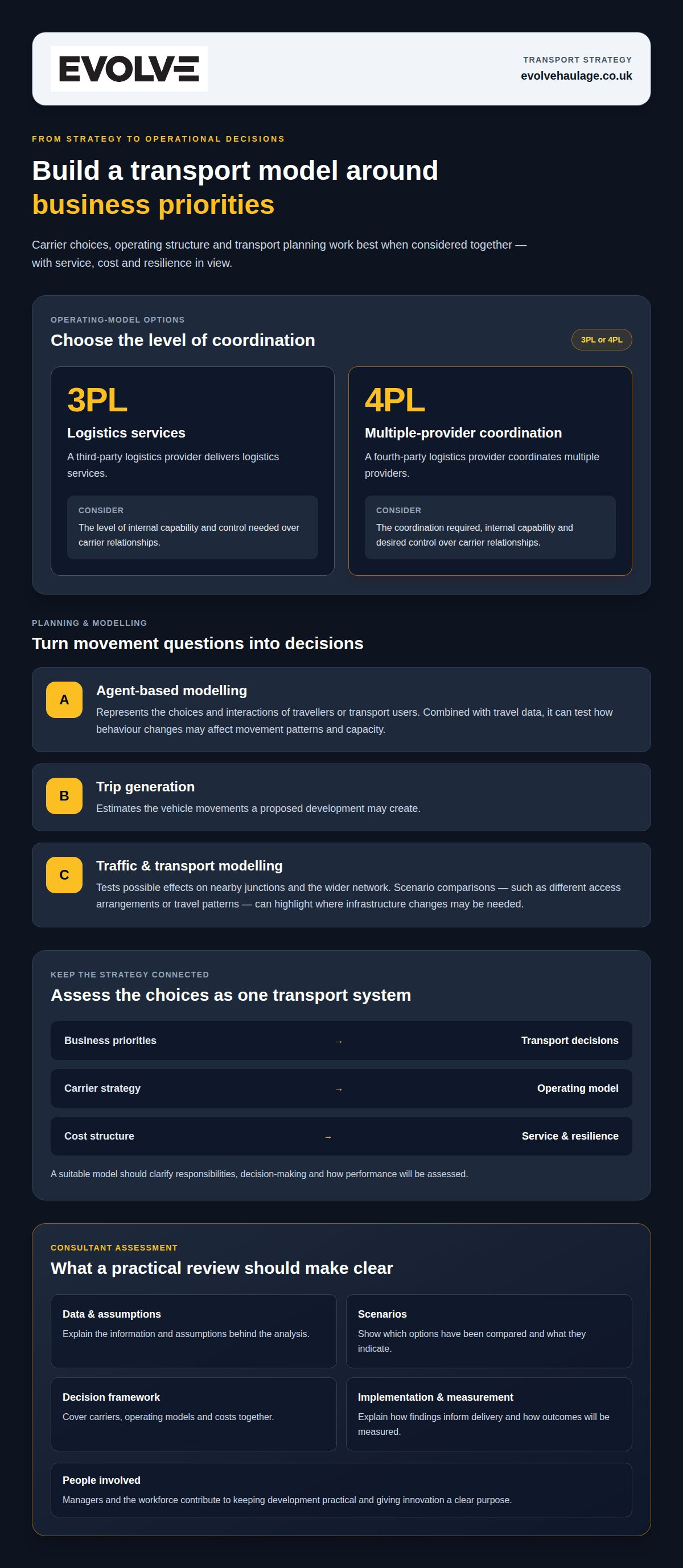
Start by linking business priorities to transport decisions. A consultant can assess carrier strategy, operating model and cost structure together, showing how each choice affects service and resilience. For example, a business with variable demand may need a different capacity approach from one with predictable delivery patterns. The resulting model should clarify responsibilities, decision-making and how performance will be assessed.
Operating-model choices include using a third-party logistics provider (3PL) for logistics services or a fourth-party logistics provider (4PL) to coordinate multiple providers. The right structure depends on the required level of coordination, internal capability and control over carrier relationships. Agent-based modelling can represent the choices and interactions of different travellers or transport users. Combined with travel data, it helps test how changes in behaviour may affect movement patterns and capacity.
For a proposed development, trip generation estimates the vehicle movements it may create. Traffic modelling tests how those movements could affect nearby junctions and the wider network. Transport modelling can compare scenarios, such as different access arrangements or travel patterns, and identify where infrastructure changes may be needed. Consultants may also coordinate assessment scopes with local highway authorities, National Highways, public transport operators and planning officers.
Choosing a UK Transport Efficiency Consultant
Choose a transport efficiency consultant who links strategy to operational decisions, rather than treating modelling as a standalone exercise. Look for clear explanations of the data, assumptions and scenarios used, plus a decision framework covering carriers, operating models and costs. The consultant should explain how findings inform implementation, how outcomes will be measured and how managers and the workforce contribute. This keeps development practical and gives innovation a clear purpose.
How can a transport efficiency consultant develop and implement successful strategies for transportation, logistics & infrastructure?
A transport strategy works best when its decisions support wider business and supply chain goals. A transport efficiency consultant connects operational requirements with the transport structure, infrastructure and service model needed to deliver them.
Transportation Strategy and Business Models
Start by linking business priorities to transport decisions. A transport efficiency consultant can assess carrier strategy, operating model and cost structure together, showing how each choice affects service and resilience. For example, a business with variable demand may need a different capacity approach from one with predictable delivery patterns. The resulting model should clarify responsibilities, decision-making and how performance will be assessed.
Operating-model choices include using a third-party logistics provider (3PL) for logistics services or a fourth-party logistics provider (4PL) to coordinate multiple providers. The right structure depends on the required level of coordination, internal capability and control over carrier relationships. Agent-based modelling can represent the choices and interactions of different travellers or transport users. Combined with travel data, it helps test how changes in behaviour may affect movement patterns and capacity.
For a proposed development, trip generation estimates the vehicle movements it may create. Traffic modelling tests how those movements could affect nearby junctions and the wider network. Transport modelling can compare scenarios, such as different access arrangements or travel patterns, and identify where infrastructure changes may be needed. Consultants may also coordinate assessment scopes with local highway authorities, National Highways, public transport operators and planning officers.
Choosing a UK Transport Efficiency Consultant
Choose a transport efficiency consultant who links strategy to operational decisions, rather than treating modelling as a standalone exercise. Look for clear explanations of the data, assumptions and scenarios used, plus a decision framework covering carriers, operating models and costs. The consultant should explain how findings inform implementation, how outcomes will be measured and how managers and the workforce contribute. This keeps development practical and gives innovation a clear purpose.
Transport management systems and fleet analytics
A transport management assessment reviews transport structures, processes, cost drivers, systems and the wider IT landscape. A transport efficiency consultant can identify whether available information supports operational decisions or leaves gaps between planning and fleet activity. The assessment can prioritise analysis, define relevant measures and set practical actions, such as improving capacity planning or clarifying how transport information flows between teams.
Fleet analytics can combine journey, vehicle and delivery information to reveal patterns behind delays or unused capacity. Tachographs record driving time, speed and rest periods; analysing those records helps assess compliance with drivers’ hours rules. Specialist tools such as Tachomaster and TruTac can process tachograph data. A transport efficiency consultant should connect this analysis to operational decisions, rather than produce reports without clear actions.
Where an operator has no suitable in-house Transport Manager, a CPC-qualified consultant can act as an External Transport Manager. This provides transport management oversight, shaped by the operator’s requirements and existing processes. The consultant can assess whether this support suits the organisation and explain the responsibilities involved before implementation.
Transport management also uses demand and capacity information to support service planning. Predictive analysis can help anticipate mobility and transport demand, while multimodal platforms and mobility hubs offer potential ways to connect travel options. For freight, real-time information about delays and available capacity can help teams respond to changing conditions. A transport efficiency consultant can build a business case that assesses expected savings, efficiency gains, service improvements and resilience through quantitative and qualitative analysis.
Assess whether the proposed system supports the decisions teams need to make and whether its outputs fit day-to-day operations. A sound business case links system requirements to operational priorities, then explains how performance will be reviewed after implementation.
Transport cost optimisation
Start cost optimisation by separating transport spend into decisions teams can influence. A specialist review can compare routing, shipment consolidation, vehicle fill rates and transport rates. For example, several smaller consignments travelling similar routes may be suitable for consolidation. Assess these options against delivery requirements: a cheaper arrangement that disrupts service may undermine wider business objectives.
Route optimisation can reduce unnecessary distance and avoidable idling, potentially lowering fuel use and associated vehicle emissions. A consultant assesses journey patterns, delivery windows, vehicle capacity and operational constraints together. The best route is not always the shortest: a longer route may use existing capacity better or meet customer commitments more reliably. Weigh the total operating impact, not distance alone.
Vehicle utilisation is another practical cost lever. Comparing load patterns across routes can reveal vehicles leaving with unused space, while dispatch analysis may identify consignments that could travel together. Assess these options against collection deadlines, delivery windows and handling requirements. Reviewing the same measures across a network helps distinguish a local adjustment from a change affecting multiple routes or customer commitments.
Cost analysis should account for trade-offs between transport rates, service performance and environmental objectives. Changing a carrier or operating model may affect costs, capacity and control. A consultant can model alternative scenarios, document assumptions and compare likely effects before implementation. This helps decision-makers distinguish measures that address recurring inefficiencies from those that merely shift costs elsewhere.
For example, a business with regular journeys between the same locations could assess route sequencing, consolidation and vehicle allocation as one coordinated change. Monitoring cost, delivery performance and vehicle use after implementation shows whether the change works in practice. If you’re reviewing transport spend and operating processes, discuss transport management support as a practical next step.
Evolve Haulage: Transport Management
Evolve Haulage provides consultancy for businesses that need a professional review of their transport processes or support improving their operations. Its consultants can assess current arrangements and shape recommendations around your transport requirements.
Evolve Haulage also provides transport management to help businesses coordinate day-to-day logistics and maintain compliant operations. Its haulage service supports commercial road freight requirements, including dedicated full and partial loads. These services suit organisations seeking support to connect operational decisions with the movement of goods.
Contact Evolve Haulage to discuss transport management or consultancy for your operation.
Build transport improvements into the next decision
Efficiency work has lasting value when recommendations become part of everyday decision-making. As routes, volumes and customer requirements change, regular operational reviews help keep transport arrangements aligned with business priorities. A transport efficiency consultant can connect analysis with practical implementation, making improvement an ongoing discipline rather than a one-off exercise.
Start by identifying the operational decision that needs attention. It might be a recurring delivery challenge, changing capacity needs or a process that no longer fits the business. A focused discussion can establish the context, clarify priorities and shape a proportionate way forward. It also gives teams a shared starting point for deciding what should change and how to assess progress.
If you’re ready to discuss a practical approach for your operation, contact Evolve Haulage. A clear first conversation can help turn your priorities into considered next steps.
Frequently Asked Questions
How can a transport efficiency consultant design efficient end-to-end processes for the transportation ecosystem?
A consultant can trace a consignment from order placement to proof of delivery, identifying who owns each handover. They can define how exceptions, such as a missed collection or changed delivery requirement, are recorded and escalated. This creates a consistent process across departments and partners. A useful design also clarifies which decisions can be made locally and which require wider coordination.
What do transport consultants actually do?
Transport consultants examine how an organisation plans and manages the movement of goods, then develop recommendations suited to its operating needs. Their work can include reviewing workflows, assessing performance information and discussing constraints with relevant teams. They can also turn findings into an implementation plan with clear responsibilities and measures for reviewing progress. The focus is on practical decisions, not simply producing an assessment document.
What do sustainable solutions for the transportation ecosystem look like?
Sustainable solutions make better use of existing transport capacity and consider the environmental effects of movement choices. A business could assess whether compatible consignments can be combined or whether different transport modes suit particular journeys. The right option depends on delivery requirements, available infrastructure and the goods being moved. Reviewing these factors together connects environmental aims with workable operations.
What does a transport efficiency consultant do?
A transport efficiency consultant turns operational challenges into a structured review of processes, performance and decision-making. For instance, if recurring delivery exceptions affect customer service, the consultant can trace where information or responsibility breaks down. They can then recommend changes to roles, procedures or reporting. Their value lies in connecting evidence to actions that fit the organisation, rather than treating each problem as a standalone issue.
What services do UK transport efficiency consultants offer?
Transport support can include consultancy, transport management and road freight operations. Evolve Haulage offers consultancy to help businesses assess and improve transport efficiency, alongside transport management for day-to-day logistics. Its haulage service and time-critical delivery solutions support commercial freight requirements. The right service depends on whether a business needs strategic advice, operational coordination or transport for consignments.
How can businesses measure transport efficiency and fleet performance?
Assess performance using measures tied to business priorities, such as on-time-in-full delivery, schedule adherence, vehicle utilisation and transport costs. Compare results across equivalent routes or operating periods, then investigate exceptions to understand what drove changes. Combining numerical measures with feedback from drivers and operations teams can reveal issues that system data alone may miss. Review the measures regularly to guide decisions.


