

A same-day courier collects an urgent consignment and transports it to its recipient for delivery that day. For same day delivery for businesses, arranging collection as early as possible gives more time to plan the journey and meet the deadline. The right option depends on the goods, destination and urgency.
When a customer is waiting, stock needs moving or a time-sensitive item must reach its destination, speed matters, but so does choosing a service that fits the job. You’ll learn what same-day couriers do, how delivery options differ and how to manage bookings online.
Retail, food and medical businesses can have different handling and delivery needs. Match the delivery plan to the consignment and its recipient before dispatch.
Key Takeaways
- Choose a delivery option by balancing urgency, route requirements and how directly the consignment needs to travel.
- Set clear collection and delivery details, then use tracking and proof of delivery to support dispatch and recipient handover.
- Match the delivery plan to your sector, including the handling and timing needs of retail, food or medical consignments.
- Assess coverage using both collection and destination postcodes, as route requirements shape which same-day option fits.
What couriers do same day parcel delivery services?
A same-day courier collects an urgent parcel and carries it to its recipient that day. Tracking, delivery time slots and proof of delivery help businesses monitor the handover.
Comparing delivery approaches
Same-day courier services suit urgent consignments that cannot wait for next day delivery. An in-house driver can work well for regular local routes, whilst a courier provides a separate delivery option when your own vehicle or team is unavailable. Compare the collection point, destination, deadline and route. For example, a parcel needed at a customer’s site today calls for a different plan from routine replenishment.
Choosing a delivery provider
Check that the service can handle the route between the collection and delivery postcodes, then confirm the collection window and required arrival time. Ask what tracking updates and proof of delivery are provided, and how recipients are notified. A named recipient, delivery timestamp or signature can document the handover when available. Check that the vehicle and handling arrangements suit the parcel’s dimensions, packaging and contents. This makes it easier to compare options against the actual delivery need, not speed alone.
Collection times and restricted goods
Collection and arrival times depend on when the goods are ready, the route, traffic and the recipient’s access arrangements. Book as early as possible to allow more time for planning. Tracking updates help dispatch teams follow progress, while delivery reporting records the final status. Provide accurate collection instructions and a working contact number to reduce avoidable delays.
Carriage terms and handling requirements determine which goods can be transported and how. Dangerous, fragile, temperature-sensitive or unusually valuable items may need specific arrangements or may be excluded. Describe the contents accurately and provide handling instructions before booking, so the transport plan can account for the consignment’s needs.
Standard, priority and direct same-day delivery options
Same-day delivery options differ according to urgency, collection time and how the consignment travels. Choose a service that fits the deadline, route and vehicle requirements.
Delivery speed options
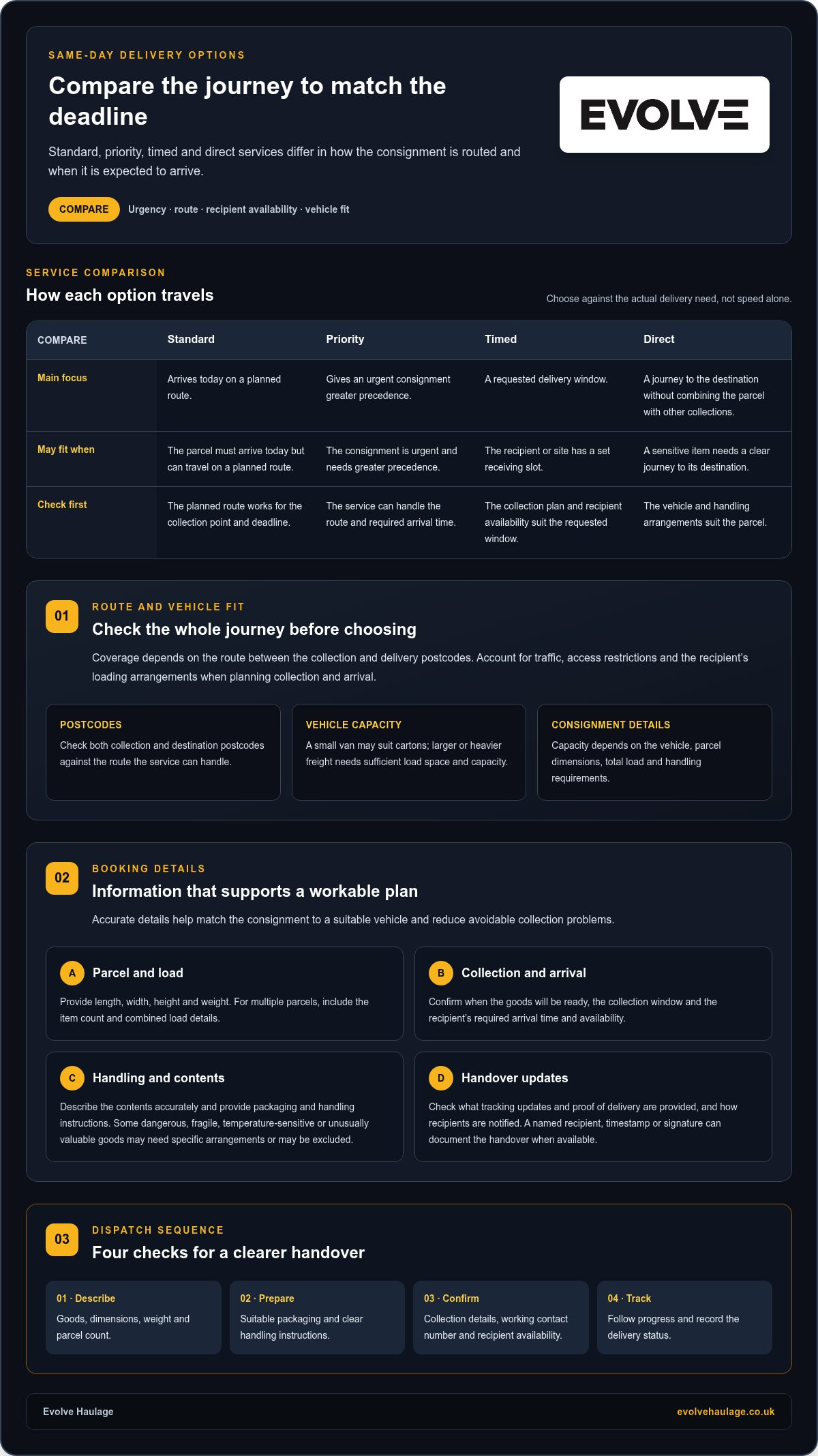
Standard same-day delivery suits a parcel that must arrive today but can travel on a planned route. A priority service gives an urgent consignment greater precedence, while a timed service focuses on a requested delivery window. A direct journey takes the parcel to its destination without combining it with other collections. More flexible routing may suit consignments with less restrictive timing.
Before booking, match the service to the recipient’s availability and the collection point. For example, a timed delivery suits a site with a set receiving slot, while direct transport may fit a sensitive item needing a clear journey. Compare same-day delivery options against the route and handling needs.
Route planning across the UK should account for traffic, access restrictions and the recipient’s loading arrangements. A busy street may require different timing from a delivery to a site with straightforward vehicle access. Vehicle choice matters too: a small van may suit cartons, while larger or heavier freight needs sufficient load space and capacity. Give accurate parcel details when arranging collection.
Protect the goods with suitable packaging and provide clear collection and delivery instructions. For example, mark fragile cartons and explain who can receive the consignment. A dedicated vehicle can reduce extra handling in transit, and the vehicle must suit the parcel’s dimensions and weight.
Parcel size and weight limits
There is no single size or weight limit for every same-day business delivery. Capacity depends on the vehicle, parcel dimensions, total load and handling requirements. Provide the length, width, height and weight when requesting a booking. These details help match the consignment to a suitable vehicle and avoid problems at collection.
For multiple parcels, include the item count and combined load details, not just the measurements of one parcel. A bulky, lightweight item can take up more vehicle space than a compact, heavier package. Accurate information supports practical planning for collection, loading and delivery.
Delivery services for retail, food and medical businesses
Retail, food and medical consignments have different delivery priorities. Match the same-day service to the package, recipient and handling requirements before dispatch.
Retail businesses can use same-day delivery to move replacement items, urgent customer orders or stock between branches. A shop sending a sold-out size, for example, should label the package clearly and provide the recipient’s opening hours and delivery point. Plan collection and arrival around the customer’s availability. If the item can wait, next-day delivery may be more suitable than an urgent journey.
Food deliveries require careful attention to packaging, handling and time in transit. A bakery sending a decorated cake should secure it against movement and explain that it must remain upright. For chilled or temperature-sensitive goods, plan for the required conditions throughout the journey. Use a same-day service only when its vehicle and handling arrangements meet those needs.
Medical businesses may send documents, equipment, samples or supplies, each with its own handling requirements. Before dispatch, identify the contents, package them appropriately and provide accurate collection and delivery instructions. A clinic sending equipment to another site, for example, should name the receiving department and an authorised recipient. Proof of delivery can help record who received the package and when.
Use a dispatch checklist for every sector: describe the goods, confirm the packaging, check the recipient’s availability and note any handling instructions. Then choose a service based on urgency and the consignment’s needs. A retail parcel may need a convenient customer handover, while food or medical goods may require particular handling. Clear booking information helps align the vehicle, route and delivery process with the job.
Which UK areas and postcodes do same-day couriers cover?
There is no single postcode list that defines every UK same-day delivery route. Check both collection and delivery postcodes, because the journey between them determines whether the deadline is workable.
Start with the full postcode for each address, rather than a town or district alone. A journey between two urban postcodes differs from one connecting an urban centre with a rural destination. Distance, collection time, traffic, access and the delivery deadline all shape the route plan. A destination name alone cannot show whether same-day arrival is practical.
Coverage also depends on access at both ends of the route. A town-centre address may have loading restrictions or limited access, while an industrial site may have a designated receiving point. Provide the business name, full address, postcode, contact number and entry instructions. Include the recipient’s available delivery window to support handover planning.
For a UK-wide requirement, assess the actual journey rather than assuming every postcode has identical service conditions. A long cross-country journey brings different distance and timing considerations from a local run. The vehicle, parcel dimensions and urgency also affect the plan. Provide these details together when arranging the booking.
Use this postcode-checking sequence before dispatch:
- Enter the complete collection postcode and confirm the pickup address.
- Enter the recipient’s full delivery postcode and receiving location.
- Share access details, opening hours and the required delivery time.
- Compare the planned route with the parcel’s urgency and handling needs.
Sharing route constraints early gives the courier practical information for planning. For repeat consignments, record regular collection and delivery postcodes, site instructions and recipient details in one dispatch procedure. Update the records when a branch or receiving point changes, so each booking starts with accurate information.
Evolve Haulage: Haulage Service
Evolve Haulage provides dedicated road haulage for businesses moving freight across the UK. Its 24/7 and time-critical same-day delivery solutions support urgent consignments when next-day transport won’t meet the operational deadline.
For businesses managing regular logistics alongside urgent loads, Evolve Haulage’s Transport Management supports day-to-day transport operations. Its Consultancy Service can help businesses review their logistics arrangements. Start by outlining the consignment, collection and delivery locations, timing and handling needs. This gives the discussion a practical focus, whether you need one urgent movement or wider transport support.
To discuss your haulage or same-day delivery requirements, contact Evolve Haulage.
Build a delivery plan that supports what comes next
Use each urgent consignment to refine your process: record what must travel, who will receive it and the operational deadline. This helps your team decide when same day delivery for businesses is the right fit and when planned transport arrangements are more suitable.
For broader freight requirements, Evolve Haulage provides a Haulage Service, Transport Management and Consultancy Service. These services support individual freight movements and day-to-day logistics planning. Share your business requirement and the outcome you need to achieve to make the next step relevant to your operation.
Discuss your business delivery requirements with Evolve Haulage and take the next step towards a clearer transport plan.
Frequently Asked Questions
How much is same-day delivery?
The price depends on the consignment and is provided after a quote request. Key factors include the route, vehicle required, load dimensions and weight, and booking urgency. Prepare the full addresses and parcel details to support a clear quotation. A dedicated journey and a delivery with flexible routing have different operational requirements.
How does same-day delivery work?
When arranging a booking, provide the collection and delivery details, consignment information and required timing. The delivery can then be planned around the load and journey, while the sender prepares the goods for collection. A manufacturer sending a replacement component, for example, can include its order reference and the receiving department’s details. This helps connect the delivery with the right job at each end.
What same-day courier services are available for urban business deliveries?
Direct, priority and timed services can suit urban deliveries where access and receiving windows shape the plan. A direct journey is useful for a consignment that should travel without additional collection stops; a timed service suits a recipient with a defined receiving period. Include site access instructions, loading arrangements and the recipient’s contact details in the booking so the delivery plan reflects the destination.
Which UK same-day delivery services cater to businesses?
Evolve Haulage provides same day delivery for businesses with time-critical freight, alongside commercial road haulage. Its Transport Management supports day-to-day logistics operations, while its Consultancy Service helps businesses review transport arrangements. A company with an urgent consignment and wider coordination needs can consider the delivery alongside its ongoing transport setup. The right service depends on the operational task.
How much does same-day business delivery cost in the UK?
The price of same day delivery for businesses depends on the consignment and is provided after a quote request. Describe whether the goods are a single load or part of a wider freight movement, and note any specific handling arrangements at collection or delivery. These details help define the work involved. Keep the goods description, addresses and required timing together to support a clear quotation request.
What business account, volume discounts and payment options do same-day couriers offer?
Business account terms, volume discounts and payment methods vary between courier arrangements. Commercial considerations can include consolidated invoicing, agreed billing contacts, payment terms and how repeat bookings are recorded. Before setting up a process, decide who can authorise consignments and how invoices should be matched to purchase orders or delivery records. Evolve Haulage’s Transport Management can support wider operational coordination.


