

The most effective Contract Logistics arrangement may be the one that includes less, not more. For some UK businesses, the term suggests a complete logistics operation. In practice, the right scope depends on which activities need managing and where external support adds value. Clear boundaries between haulage, transport management and wider logistics outsourcing help avoid including services your operation doesn’t need.
Start with your day-to-day requirements. Decide which transport activities to outsource, which responsibilities stay in-house and how performance will be measured and reviewed. For example, if your team sets customer priorities but needs help coordinating freight movements, make that division explicit. A defined scope gives everyone a shared set of expectations.
This guide explains what contract logistics can cover and how to match transport support to your operation. It looks at contracted full or partial loads, transport management and consultancy, then shows how to define responsibilities, performance measures and review processes. These practical steps can help keep an arrangement useful as demand and priorities change.
Key Takeaways
- Define whether your agreement covers road transport only or a broader set of logistics responsibilities.
- Compare spot haulage, contracted transport and transport-management support by the continuity, coordination and control each provides.
- Use load types, movement patterns, delivery windows and changes in demand to shape a practical Contract Logistics brief.
- Clarify who plans movements, coordinates drivers and oversees delivery activity before agreeing the service scope.
- Consider how full or partial freight loads and transport-management support can meet your business’s transport requirements.
What does contract logistics mean for a UK business?
Contract Logistics is an arrangement in which a business and a provider agree which logistics responsibilities the provider will manage and how the work will be carried out. The scope might be focused on arranging road-freight movements or cover several connected activities. There is no single package that suits every business.
The distinction matters because the term can sound as if an entire logistics operation is being outsourced. A business may keep its own facilities, customer service and stock processes while getting external support with transport execution or day-to-day coordination. The agreement should identify the tasks being handed over, what stays in-house and how both sides will manage changes.
Businesses may consider contracted support when freight demand fluctuates, delivery requirements become harder to coordinate or operational oversight is spread across teams. For instance, a company with regular deliveries and occasional urgent movements may need a clearer way to align schedules, drivers and load requirements. That doesn’t automatically call for a larger outsourcing model. A defined set of transport responsibilities may be enough to connect activity already taking place.
Which business needs can contract logistics address?
Contract logistics can suit organisations managing recurring freight movements alongside changing delivery windows, volumes or priorities. A business might arrange some loads internally and use separate haulage for others, leaving no one with a clear view of how the work fits together. Agreeing who coordinates each part can close gaps in responsibility and make planning more consistent. The appropriate scope depends on the operation, not a standard template.
Does contract logistics always include warehousing?
No. Warehousing may form part of some logistics arrangements, but it isn’t an automatic requirement. Storage and fulfilment involve holding and preparing goods, while road haulage moves freight and transport management can coordinate drivers, schedules and related activity. A transport-led agreement can focus on specified road-freight responsibilities. Evolve Haulage supports business transport requirements through commercial haulage, full and partial freight loads, and transport management.
Think of the arrangement as a service framework, not a promise of a particular result. Its value depends on whether the agreed tasks reflect the real operation and responsibilities are clear. If the main challenge is moving freight, adding unrelated functions could create complexity without addressing the need. A focused scope can bring haulage and transport coordination together, with consultancy to assess operational efficiency and transport strategy where appropriate.
Before defining the service, map the movements that need support. Note what goods travel, how often, where handovers occur and what changes during busy periods. This gives both parties a practical starting point for agreeing the work and identifying where internal oversight remains necessary. Next, break the possible services into clear components and compare how different arrangements allocate planning and control.
What can a contract logistics arrangement include?
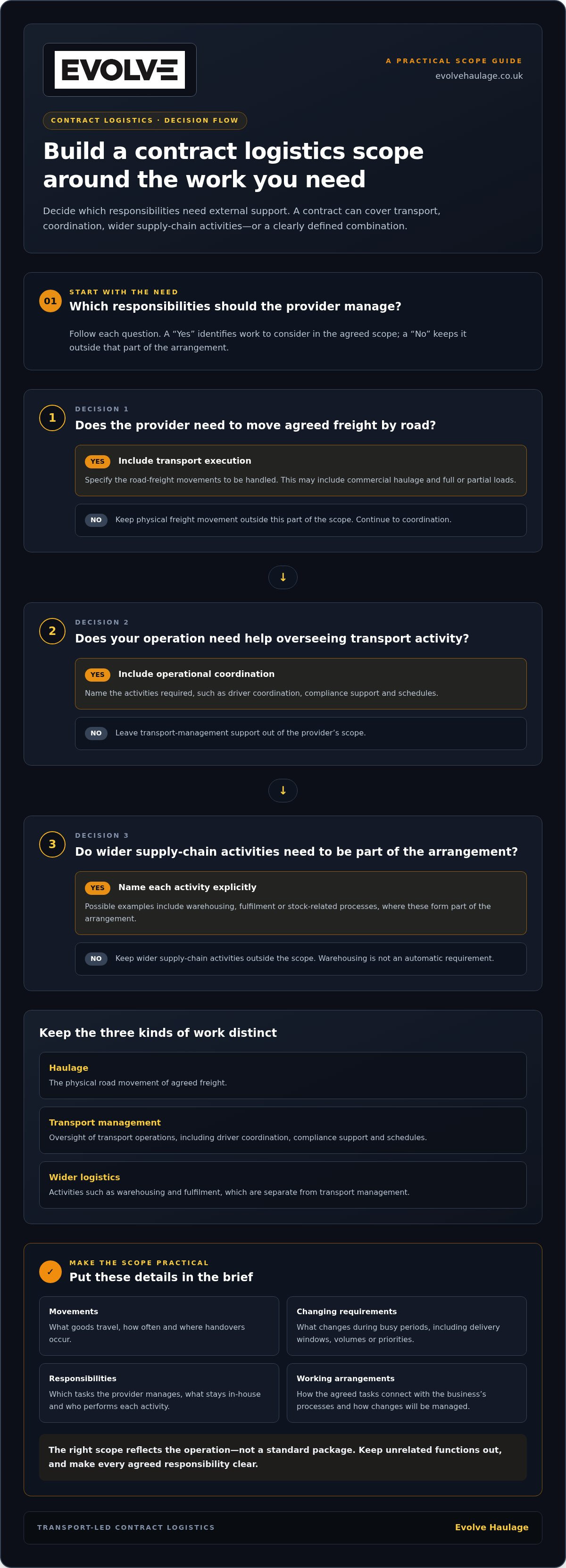
The scope can be organised into three broad areas: moving freight, coordinating transport activity and managing wider supply-chain tasks. A business might agree support for one area or combine several, depending on how its operation works. The label alone doesn’t explain what is included. Contract terms should name each responsibility, identify who performs it and explain how it connects with the business’s own processes.
- Transport execution: the physical movement of agreed freight by road, including full or partial loads.
- Operational coordination: oversight of transport activity, such as driver coordination, compliance support and schedules.
- Wider supply-chain activities: services such as warehousing, fulfilment or stock-related processes, where these form part of the arrangement.
These categories distinguish the work itself from the systems and facilities that may support it. For example, a contract could explain how movements are requested and coordinated without transferring responsibility for other parts of the supply chain. Make each responsibility explicit rather than assuming facilities, systems or additional services are included. For wider UK sector context, see Logistics UK Industry Insights.
Transport, transport management and wider logistics
Haulage is the physical road movement of agreed freight. Transport management concerns oversight of transport operations, including driver coordination, compliance support and schedules. The functions can work together, but they aren’t interchangeable: a business could contract for freight movements, management support or both. Warehousing and fulfilment are separate activities involving goods held or prepared for onward distribution, not other names for transport management.
For a transport-led arrangement, specify which freight movements are handled, how transport activity is coordinated and what information the business supplies. Evolve Haulage’s commercial road haulage, full and partial loads, transport management and consultancy can be tailored to agreed business transport requirements. Consultancy can also help assess operational efficiency and transport strategy. A clear division of tasks helps prevent duplicated effort and overlooked responsibilities.
How contract logistics relates to 3PL
Third-party logistics, or 3PL, describes logistics services provided by an external party. Contract logistics puts the emphasis on the service arrangement agreed between the business and provider. The terms often overlap in use rather than describing universally separate categories. Both can refer to outsourced support, and neither term alone defines which tasks are covered. A guide to third-party logistics (3PL) explains the terminology in more detail.
To keep the scope workable, specify who plans movements, coordinates drivers, oversees agreed delivery activity and handles changes to the plan. Evolve Haulage can align commercial haulage and transport-management support with those requirements. Explore Evolve Haulage’s transport support as you consider which responsibilities belong in your arrangement.
How to compare contract logistics models and scope
The right model depends on how often freight moves, how much coordination your team needs and which decisions you want to retain. Spot haulage can address an individual movement. Contracted transport can provide a defined basis for recurring work, while transport-management support adds coordination across operations. None is automatically cheaper or more effective. The fit comes from matching responsibilities to demand and existing working arrangements.
Use this comparison as a starting point. Set out the actual duties in the agreement, including how changes and exceptions will be handled.
| Model | Planning movements | Driver coordination | Delivery oversight |
|---|---|---|---|
| Spot haulage | The business requests an individual movement | Typically arranged for the agreed haulage job | Focused on the specified movement |
| Contracted transport | Business and provider agree recurring requirements | Set out for the contracted transport activity | Defined around agreed movements and expectations |
| Transport-management support | Provider can coordinate schedules within agreed priorities | May include ongoing driver coordination | Can cover wider oversight of agreed transport activity |
Which operating model fits recurring freight movements?
Regular volumes, repeat routes or established delivery schedules may benefit from ongoing transport support because responsibilities can be planned around a continuing requirement. Occasional loads or urgent, one-off movements may need a more limited response rather than a wider operating arrangement. Evolve Haulage handles full and partial freight loads, so the agreed transport scope can reflect the size and pattern of a business’s freight demand.
If you’re considering a wider change in responsibilities, a guide to outsourcing transport operations can help frame the operating-model decision. First distinguish a need for transport capacity from a need for ongoing planning and coordination.
How much operational control should remain in-house?
Businesses often retain decisions shaped by customer commitments, such as which orders take priority, delivery promises and changes in demand. A provider may then coordinate agreed transport activity or carry out delivery movements. Define the handover: who supplies priorities, who adjusts schedules, how exceptions are raised and who communicates changes internally. This preserves business oversight while assigning transport tasks deliberately.
Contract Logistics works best when the written scope makes that division practical, rather than simply naming a service model. Reviewing the in-house versus outsourced transport comparison can help clarify where control should sit. Evolve Haulage can tailor commercial haulage and transport-management support to agreed requirements. See Evolve Haulage’s transport services to explore transport support.
How to define a practical contract logistics brief
A useful brief turns broad operational needs into tasks that can be planned, measured and reviewed. For a transport-led arrangement, provide enough detail to show what moves, how requirements change and where responsibility should sit. This helps shape a Contract Logistics scope around the operation rather than a generic service package.
- Map freight demand. Describe load types, collection and delivery requirements, movement patterns, delivery windows and expected variation. Note regular movements as well as seasonal peaks, urgent requests or other changes that affect planning.
- Set the scope. Identify the transport tasks required, such as haulage, scheduling or driver coordination. Separate essential services from optional or future needs to keep the initial brief focused.
- Allocate responsibilities. State which activities remain in-house and which are delegated. Cover who provides priorities, coordinates schedules, communicates changes and oversees agreed delivery activity.
- Define performance measures. Select measures tied to the agreed work, such as delivery performance, schedule adherence or the frequency and content of operational reports. Define how each measure is calculated and who supplies the information.
- Agree review and change control. Set out how either party can raise a change, who assesses its operational impact and how revised requirements are recorded. Schedule review points to check whether the scope still reflects demand.
What information belongs in the scope?
Describe freight characteristics and anticipated movement patterns in practical terms. For example, state whether loads are full or partial, how frequently movements occur and which delivery windows apply. Then specify responsibilities for scheduling, driver coordination, compliance support and communication, as relevant to the agreed service. Distinguish current requirements from possible future additions so changes can be considered deliberately rather than assumed.
Be precise about handovers. If your team sets customer priorities while a provider coordinates transport, record how priorities are shared and who communicates adjustments. A clear brief also identifies what information each party needs to do its part. Evolve Haulage can tailor commercial haulage and transport-management support to the requirements set out in the scope.
How should performance and changes be managed?
Choose measures that both parties can interpret consistently. Define what counts as meeting a delivery window, how schedule adherence is recorded and what an operational report should contain. Agree reporting frequency, ownership and a process for raising issues. If demand or service requirements change, record the decision, its effective date and any revised responsibilities. A practical UK transport management guide provides wider operational context for setting up clear processes.
A well-structured brief gives both sides a shared reference point without locking the operation into assumptions that no longer fit. Discuss a tailored haulage and transport-management scope with Evolve Haulage.
How Evolve Haulage supports transport-led contract logistics
Evolve Haulage provides commercial road haulage and transport-management support for businesses across the UK. This transport-led approach can bring freight movement and day-to-day coordination into a clearly agreed service scope without treating every logistics function as part of the arrangement. The scope is tailored to the business’s transport requirements, load profile and operational priorities.
Full and partial freight loads provide options for different consignment requirements. For time-critical consignments, 24/7 and same-day delivery can support urgent transport needs. Set out which movements require these services, how priorities are communicated and how the agreed work fits with the business’s delivery commitments.
Combining road haulage with transport management
Haulage covers the physical movement of agreed freight; transport management can support the coordination around those movements. Depending on the agreed scope, this can include coordinating drivers and schedules, supporting day-to-day transport operations and helping with compliance-related processes. Bringing these activities together makes it clearer who is managing each part of the transport task.
For example, a business might use haulage for planned full or partial loads and transport-management support for scheduling and driver coordination. The business can retain decisions about customer priorities and provide requirements for each movement, while defining delegated tasks in the scope. Clear communication and responsibilities help the arrangement work alongside existing operational oversight, without uncertainty about who needs to act.
Support is shaped around the agreed work, not assumed to cover every transport responsibility. Setting out movements, schedules, coordination tasks and communication points gives both parties a practical basis for managing activity. It also clarifies where the business retains oversight and where Evolve Haulage’s transport-management support contributes.
When transport consultancy can help shape the arrangement
Sometimes the first step is understanding how transport activity currently operates. Evolve Haulage’s logistics consultancy can help businesses assess operational efficiency and transport strategy, then relate that assessment to practical requirements such as freight patterns, scheduling and coordination. This can help clarify whether the priority is haulage capacity, management support or a combination of the two.
Consultancy can also help shape a scope around current operational needs and identify where changing demand may call for a review. The aim is a practical transport arrangement with responsibilities and expectations that make sense for the business, rather than a standard package or guaranteed outcome.
If you’re planning transport support or reviewing an existing setup, discuss your transport requirements with Evolve Haulage. Start with a clear view of your freight movements, delivery priorities and coordination needs to shape a suitable service scope.
Turn your transport brief into a workable plan
Test your proposed scope against the way work moves through the business. Use a representative operating period, including routine movements and exceptions, to check that responsibilities, handovers and review points are clear. This can reveal gaps that a high-level service description may miss, such as who communicates a changed priority or how a variation is recorded. A practical Contract Logistics arrangement should give teams a shared reference while allowing room to adapt as requirements evolve.
Bring together the people who set delivery priorities and those who manage transport activity. Agree what must remain under your control, where external support fits and what information will help both sides review the arrangement. Set review points to reflect how quickly demand or priorities can change, so the scope stays relevant as the operation develops.
These decisions keep the conversation focused on operational fit rather than an assumed package. Plan your transport scope with Evolve Haulage and take the next step with a clear brief.
Frequently Asked Questions
Is contract logistics suitable for small and medium-sized businesses?
Yes, it can suit a small or medium-sized business when the agreed responsibilities address a specific operational need. A business might outsource regular deliveries while keeping order priorities and customer communication in-house. Identify where time or coordination is being stretched, then define the support needed. A focused arrangement can be more practical than a broad logistics model that doesn’t match the operation’s scale or structure.
Can contract logistics cover transport without warehousing?
Yes, an arrangement can focus on road transport without including warehousing. A business that holds and prepares its own goods, for example, could agree support for freight movements and related transport coordination. Keep the distinction clear in the scope: specify the transport activities included and leave storage or fulfilment outside the arrangement if they aren’t required. The service should reflect agreed responsibilities, not assumptions attached to the term.
How does contract logistics differ from freight forwarding?
Freight forwarding generally centres on arranging the movement of consignments, often by coordinating transport between locations or carriers. Contract Logistics is a broader description of an agreed outsourced service arrangement, which may include road haulage and transport management. The terms can overlap, but they don’t automatically describe the same scope. For a UK business moving freight by road, focus on the actual tasks, handovers and responsibilities, not the label alone.
What should a contract logistics service-level agreement cover?
A service-level agreement should make operational expectations measurable and responsibilities easy to follow. Define the services and movements covered, how delivery performance and schedule adherence are assessed, and who records and reports results. Include how issues are escalated, how changes are approved and when performance is reviewed. For example, agree how a revised delivery window is communicated and documented, so both teams follow the same process when plans change.
Can contract logistics adapt to seasonal changes in demand?
Yes, the arrangement can include a process for handling predictable peaks and quieter periods. Share expected changes in freight volume or delivery patterns early, then agree how updates are provided, who assesses their effect and how revised requirements are recorded. Avoid treating variable demand as an informal exception. A planned review and change process helps the business and provider discuss adjustments against the agreed scope and operational priorities.
How much of a business’s logistics should be outsourced?
Outsource only the responsibilities that external support can manage in line with your operational priorities, while retaining decisions that depend on internal knowledge. A business might delegate transport coordination but keep control of customer commitments, order priorities and demand planning. Map tasks individually rather than transferring an entire function by default. This makes ownership clearer and allows the scope to change as business needs evolve.


