

What if haulage compliance slips not because a duty is unknown, but because its owner, deadline or evidence is buried in a different system? For UK operators, keeping on top of haulage compliance management can be difficult when delivery pressures compete with checks, records and follow-up actions. Responsibilities depend on the operation, so it is essential to understand what applies and who owns each task.
Compliance works best as part of coordinated transport operations, with routine checks and records connected to day-to-day decisions. This guide covers the main areas operators need to manage, including operator licensing, drivers’ hours, tachographs and vehicle maintenance. It also explains how to assign responsibilities, organise repeatable checks and follow up on issues before they get lost among competing priorities. Finally, it looks at how structured transport management and consultancy can support operational oversight and compliance guidance, keeping essential duties visible alongside the work of moving goods.
Key Takeaways
- Manage haulage compliance as a continuous operational cycle, not a collection of separate paperwork tasks.
- Identify which responsibilities apply to your operation, then make ownership clear across the team.
- Build a repeatable routine for scheduling checks, keeping evidence and following up on exceptions.
- Use a proportionate review process to prioritise urgent safety or regulatory gaps and track actions through to closure.
- Understand how transport management can coordinate daily operations, while consultancy can assess processes and guide improvements.
What haulage compliance management means for a transport operation
Haulage means moving goods by road, as outlined in this general overview of Haulage. For an operator, meeting relevant requirements is not a single task to complete and file away. Responsibilities cover vehicles, drivers and operational activity, so they need to be organised in a way that makes actions easy to assign, complete and evidence.
Haulage compliance management is the ongoing organisation of responsibilities, controls, evidence and follow-up across transport operations. It connects each task with its owner, due date and record of completion. A document folder may hold useful evidence, a training course may develop knowledge, and an audit may identify gaps. None of these alone provides the continuing oversight needed to keep responsibilities visible as the operation changes.
Think of compliance as a working system, not a one-off event. A check produces information; management determines what happens next. For example, if a vehicle check identifies a concern, the finding needs to reach someone who can assess it, decide on the appropriate next step and record the outcome. Linking detection to follow-up helps prevent findings becoming isolated notes with no clear owner.
The approach should reflect the operation. The vehicles in use, the work being carried out and how responsibilities are shared all affect what needs oversight. A process that works for a small team may need clearer handovers as more people, vehicles or schedules are involved. The aim is not to create paperwork for its own sake, but to make relevant duties manageable within normal transport activity.
How is compliance management different from a compliance check?
A compliance check is a point-in-time review of a particular record, process or condition. Compliance management is the recurring oversight around that check: deciding when it should happen, reviewing the result and assigning any follow-up. If a check reveals a gap, record the action, its owner and a suitable deadline, then track it until completion is documented. A check can identify an issue, but it cannot guarantee that every requirement is met or every breach avoided.
Why does a structured approach matter to haulage operators?
Clear ownership reduces the risk of tasks being overlooked between office, workshop and operational teams. It also gives decision-makers a more useful picture when planning work, because they can see relevant checks, outstanding actions and evidence rather than relying on memory. Reliable records help show what was reviewed and when. They support aims such as safer operations, continuity and greater regulatory confidence, without guaranteeing any particular outcome.
In practice, a structured process needs to work under day-to-day pressure. Responsibilities are visible, records can be found, and exceptions prompt action rather than disappearing into a folder. This creates a stronger basis for the controls and review routines covered in the next sections.
Which UK haulage compliance responsibilities need managing?
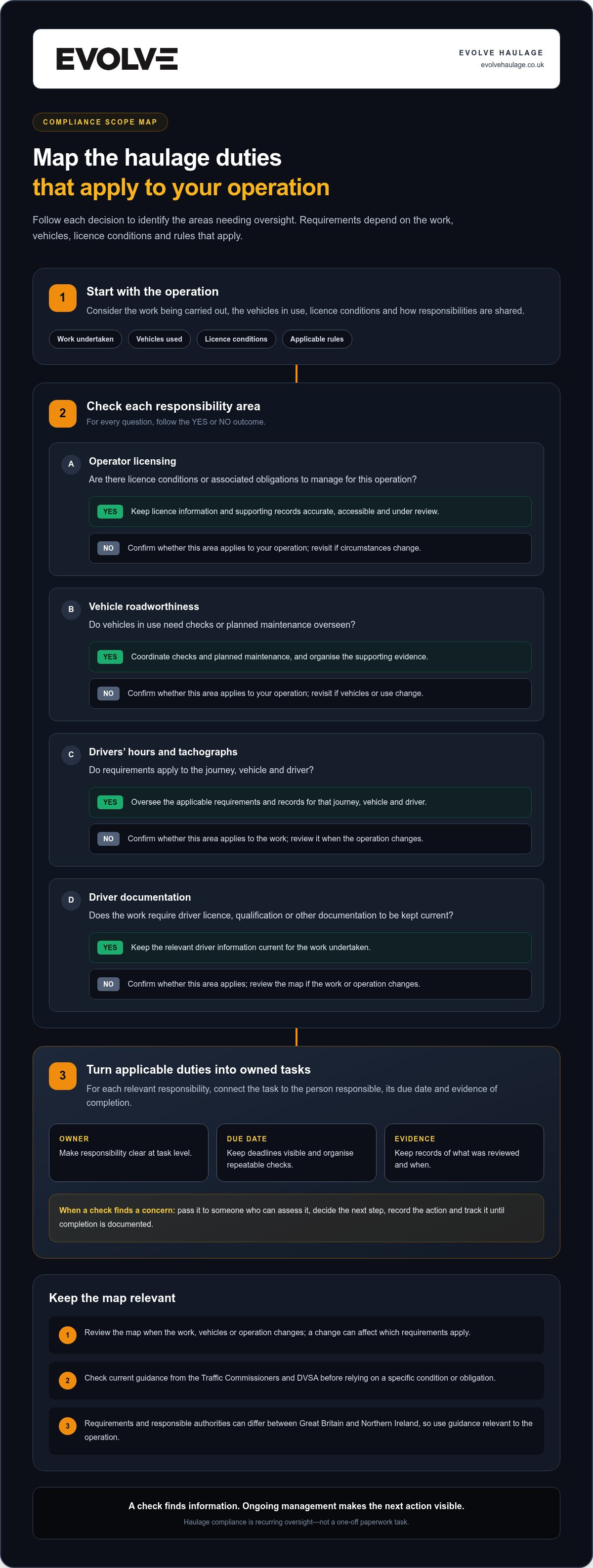
The responsibilities an operator needs to manage depend on the work being carried out, the vehicles used, licence conditions and the rules that apply. Start by mapping the main areas, then identify the tasks, records and people connected to each one. This turns broad compliance responsibilities into a practical view of what needs oversight.
Haulage compliance brings together operator licensing, vehicle roadworthiness, drivers’ hours, tachograph records and the driver documents relevant to the work. These areas interact. A planned journey, for example, depends on suitable vehicle condition, driver eligibility and applicable hours requirements. A change in vehicle use or operation can also change which requirements apply, so review the map when circumstances change rather than treating it as permanent.
- Operator licensing: understand the licence held, its relevant conditions and the records needed to support associated obligations.
- Vehicle roadworthiness: coordinate checks and planned maintenance, keeping the supporting evidence organised.
- Drivers’ hours and tachographs: oversee the requirements and records that apply to the journey, vehicle and driver.
- Driver documentation: keep relevant licence, qualification and other required information current for the work undertaken.
How does operator licensing shape haulage compliance?
An operator licence sets the basis on which the relevant operation can be conducted, including conditions the licence holder must manage. Keep licence information and supporting records accurate, accessible and under review, so the people handling day-to-day tasks can work to the applicable requirements. Before relying on a specific condition or obligation, check current guidance from the Traffic Commissioners and DVSA. Requirements and responsible authorities can differ between Great Britain and Northern Ireland, so use guidance relevant to the operation.
Make responsibility clear at task level. One person may coordinate vehicle records, another may review driver-related information, and a manager may oversee deadlines and exceptions. Assigning duties makes ownership visible, but it does not transfer the operator’s overarching accountability for meeting applicable licence obligations. Make escalation straightforward if an owner is absent, a record is missing or a concern needs a decision.
What driver and vehicle controls belong in the compliance picture?
Bring driver and vehicle controls into the same operational view. Depending on the work, this may include drivers’ hours, tachograph records, vehicle checks, planned maintenance, and checks of a driver’s licence or qualifications. Define who gathers each record, who reviews it and how an exception is raised. Do not assume one checklist fits every vehicle or journey. Confirm relevant requirements against current official guidance.
Keep the map current by reviewing it when the operation changes, such as when introducing a different vehicle type or taking on work with different requirements. For operators who need more coordinated day-to-day oversight, Evolve Haulage’s transport management support brings compliance, driver coordination and schedule execution into the same operational picture.
How to manage haulage compliance through everyday operations
A practical routine makes compliance part of running the transport operation, rather than a separate exercise competing with live work. The aim is to move from knowing which duties apply to ensuring each has an owner, a suitable schedule, a record and a clear route for resolving exceptions. This is the working cycle behind effective haulage compliance management.
Start with a responsibility register that teams can use. For each applicable duty, record who is responsible for completing it, how often it needs attention, where evidence is kept and who reviews it. Keep delegated tasks distinct from overall operator accountability: an individual can complete or monitor a control, while management retains oversight of whether the system is working.
- Identify duties: list the controls that apply to the operation and note what triggers them, such as a planned interval or a change in circumstances.
- Assign owners: name the role responsible for each task and a suitable person to handle cover or escalation.
- Schedule controls: use a shared calendar, system or other consistent method to make upcoming and overdue tasks visible.
- Record evidence: capture what was completed, when, by whom and any issue that needs follow-up.
- Review exceptions: check incomplete or overdue work, assign an action and track it through to recorded closure.
Build the routine around existing operational planning points, such as preparing work and reviewing vehicle or driver availability. This helps checks inform decisions without creating a duplicate dispatch process. Keep procedures concise enough for people to use during live operations, with clear instructions on where to record a result and how to raise a concern.
How should a haulage business organise compliance tasks?
Make the register practical, not just comprehensive. Use plain language, consistent task names and a reliable location for records, so staff can find information without searching across disconnected files. Set reminders before due dates where useful, and define who receives an escalation if a task is late, incomplete or cannot be resolved by its owner. Revisit the register when responsibilities or operations change.
How can managers turn records into useful oversight?
Collecting records is only the starting point. Managers should review completion and exceptions, then look for repeated issues that may point to unclear instructions, capacity pressures or a process that needs adjustment. Give each corrective action a named owner and target date, and record the outcome. This shows what remains open and whether the response has addressed the underlying problem.
Keep access proportionate to role. Store and share driver details and commercially sensitive information in ways that limit access to people who need it for their work. Use a consistent approach to naming, filing and retrieving records, so evidence can be found when required without creating unnecessary exposure.
Compliance routines are part of wider operational planning. The UK transport management guide offers broader context on coordinating transport responsibilities, people and schedules.
Reviewing Haulage Compliance and Addressing Gaps
A review is useful when it tests whether controls work in practice, not simply whether documents exist. Set the scope using current requirements and the operation’s own risks, then sample relevant records and compare them with how work is actually carried out. This can reveal missing evidence, overdue actions and differences between written procedures and day-to-day practice.
A recorded finding becomes a tracked corrective action when it has a clear impact, an accountable owner, a proportionate remedy, a completion date and a verification step. That connection is central to haulage compliance management: a review should lead to decisions and follow-up, not end with a list of observations.
What should a haulage compliance review examine?
Choose a sample that reflects the operation, rather than attempting to review everything at once. The scope may include operator licence records and relevant conditions, vehicle maintenance evidence, driver documentation, and processes for handling tachograph records. Compare the records with what staff actually do. For instance, check whether a documented process is understood and followed, and whether recorded completion can be linked to the work it describes.
Use current official requirements to shape the review, alongside operational risk. The specific scope depends on the vehicles, work and arrangements in place. Note what was sampled, the period covered and any limitations, so the findings have context and the next review can build on them.
What should happen when a compliance gap is found?
First, assess urgency. A concern that may affect immediate safety or create an urgent regulatory issue needs prompt attention through the appropriate operational and escalation routes. Distinguish this from a lower-priority improvement, such as making a filing process clearer. Prioritising helps direct attention where it is most needed while keeping routine improvements in view.
For each finding, record the issue in plain language, the evidence behind it and its potential operational impact. Name the person responsible for coordinating the response, set a proportionate remedy and completion date, then state how the result will be verified. The action owner may arrange the work or gather evidence, while the appropriate manager retains oversight and confirms whether the gap has been addressed.
Closure needs evidence too. Record what changed, when it was completed and who verified the outcome. If the remedy is still in progress, keep the action open and note the next step rather than marking it complete prematurely. This makes unresolved risks visible and gives managers a reliable view of progress.
Look for patterns across findings. Repeated omissions may indicate that instructions need simplifying, responsibilities are unclear or staff need further guidance. Use those observations to improve procedures, communication or training, then consider whether the next review should check that the change has taken hold. Audit readiness comes from consistent, accessible records and routine follow-up, not a last-minute search for paperwork.
If you need support assessing compliance processes and operational efficiency, Evolve Haulage’s consultancy service can help.
How transport management and consultancy support haulage compliance
Some operators have established compliance routines but need more day-to-day capacity to coordinate them. Others may be reviewing how responsibilities, driver activity and schedules fit together. Transport management and consultancy support different needs: transport management helps oversee ongoing operations, while consultancy assesses arrangements and advises on improvements.
When can transport management support be useful?
Transport management support is useful when internal capacity is stretched, coordination is complex or routine oversight has become inconsistent. Evolve Haulage provides day-to-day operational control of road transport activities, including support with regulatory compliance, driver coordination and schedule execution. When work plans change, keeping responsibilities and operational information aligned helps the team maintain visibility of relevant tasks alongside delivery requirements.
This is ongoing operational support, not simply a review of paperwork. It helps coordinate the work and oversight that keep transport activity organised. The right arrangement depends on an operator’s needs, existing roles and the responsibilities it retains internally. External support can contribute to the management system, but it does not transfer the operator’s own accountability or guarantee a regulatory outcome.
When can haulage consultancy help improve compliance processes?
Consultancy focuses on examining how existing processes work and identifying opportunities to improve them. An assessment might consider how responsibilities are allocated, how information moves between people and whether procedures are practical for the operation. Evolve Haulage’s consultancy provides compliance guidance and assesses operational efficiency, helping businesses consider improvements to their transport strategy.
Before choosing a support approach, define the challenge as clearly as possible. Is the difficulty a lack of time for routine coordination, uncertainty about how a process works, or repeated gaps in how tasks are completed? A specific starting point makes it easier to distinguish between a need for regular operational management and a need for assessment and improvement advice. In some cases, the two forms of support can address different parts of the same operational challenge.
Keep the operator’s own controls and decision-making responsibilities clear whichever approach is used. Agree who handles day-to-day tasks, who reviews progress and how concerns are raised. This helps integrate external support with existing roles rather than creating a parallel process that leaves ownership uncertain.
Compliance is closely connected to the wider organisation of transport activity. For related freight-partner context, the road haulage company selection guide explores how transport needs fit into a broader business relationship.
If you’re assessing where additional oversight or process guidance could help, explore Evolve Haulage’s transport management and consultancy support.
Make your next compliance step practical
Choose one point in your operation where ownership or follow-up could be clearer, and use it to strengthen how responsibilities are managed. A focused improvement is easier to embed than a broad change with no defined starting point. From there, build a routine that fits the operation and can adapt as its needs change.
Where additional capacity would help, Evolve Haulage’s transport management support brings day-to-day operational oversight together with driver coordination and schedule execution. If the priority is to examine existing arrangements, its consultancy provides compliance guidance and assesses opportunities to improve operational efficiency. These services can complement internal controls while leaving operator accountability where it belongs.
Decide which challenge needs attention first, then explore the support that best fits it. Explore Evolve Haulage’s transport management and consultancy support to discuss a practical way forward. With a clear next step, haulage compliance management can become a more consistent part of running your transport operation.
Frequently Asked Questions
What is haulage compliance management?
Haulage compliance management is the organised oversight of regulatory duties, operational controls, records and follow-up across a haulage business. It goes beyond filing paperwork or commissioning a one-off audit. A useful record should show which task was completed, who handled it and whether anything remains outstanding. The controls needed depend on the operation, vehicles, licence conditions and current requirements.
Does every haulage business need an operator licence?
No, licensing requirements are not identical for every operation. Whether a licence is required can depend on the vehicles, transport activity and any applicable exemptions, so fleet size alone is not a reliable test. Before starting a new type of work or changing vehicle use, check the circumstances against current DVSA and Traffic Commissioner guidance. This helps avoid relying on assumptions that may not fit the specific operation.
Who is responsible for compliance in a haulage business?
Different people may handle specific controls, such as a transport manager coordinating records or a driver completing an assigned check, but delegating tasks does not automatically remove the operator’s responsibilities. Make handovers clear: document the task owner, who reviews completion and how issues are escalated if that person is unavailable. Confirm any role-specific legal duties against current guidance and the conditions attached to the operator’s licence.
How often should haulage compliance records be reviewed?
There is no single review interval that suits every record or operation. Follow applicable requirements and licence conditions, and consider how changes in work or risk affect the oversight needed. A review calendar can show the owner and review point for each record type. For instance, a manager can use a regular review to identify missing information, then verify retention periods and prescribed intervals against current official guidance.
What happens if a haulage operator finds a compliance gap?
Record what is missing or not working, assess its urgency and operational impact, then assign a proportionate action to an owner. Set a completion date and retain evidence of the resolution. If the issue may present an immediate safety or regulatory concern, follow the relevant procedures and seek appropriate professional guidance. If similar gaps recur, consider whether instructions, communication or staff training need to change.
Can a haulage business outsource transport management and remain responsible for compliance?
A business can use external transport management support, but should not assume this transfers every operator responsibility. Set out how day-to-day tasks, information sharing, oversight and escalation will work alongside the business’s existing arrangements. The operator still needs to understand its obligations and maintain appropriate oversight. Check current requirements for transport manager responsibilities and the specific operator licence, as applicable duties can depend on the circumstances.


