

Does a large consignment automatically need a dedicated vehicle? Not necessarily. Full load haulage UK may suit goods that need dedicated capacity, must travel together or benefit from a direct journey. But choosing it simply because a shipment looks substantial may not be the most practical option.
When comparing a dedicated load with a part-load arrangement, start with the details that affect planning: the goods’ dimensions and weight, how they need to be handled, the access available at each site and the collection and delivery windows. Sharing accurate information helps a transport provider assess the movement and flag potential constraints before collection.
This guide explains when full load haulage makes sense, what to prepare before booking and how to assess a provider’s approach to coordinating dedicated freight. It also covers when transport management or logistics consultancy may help with wider planning. Evolve Haulage provides dedicated full and partial freight transport for commercial clients across the UK, so businesses can discuss an arrangement that fits the consignment.
Key Takeaways
- Assess whether your consignment needs dedicated capacity or could travel as part of a shared load before choosing full load haulage UK.
- Consider shipment volume, handling needs and whether the goods need to travel together when selecting a transport arrangement.
- Prepare accurate dimensions, weight, collection and delivery windows, and site access details to support effective planning.
- Compare providers by asking how they manage communication, scheduling and delivery completion for consignments like yours.
- Check applicable operator and driver compliance credentials, and confirm current requirements before arranging transport.
What full load haulage in the UK means for your freight
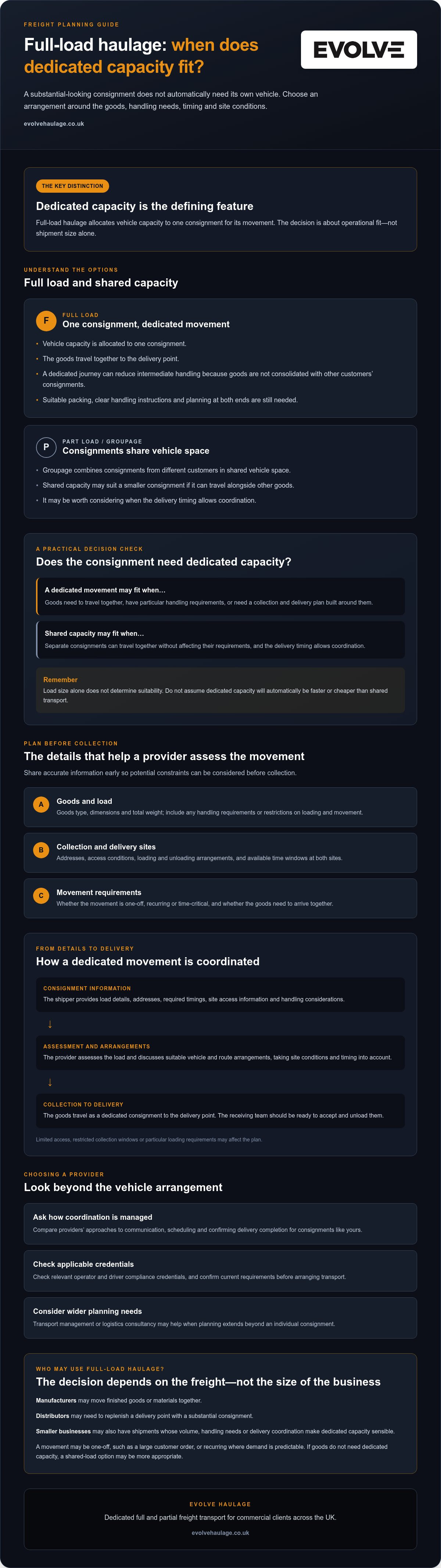
Full load haulage allocates vehicle capacity to one consignment for its movement. Groupage, by contrast, combines consignments from different customers in shared vehicle space. The defining feature is dedicated capacity, not simply the size of the shipment. A business might choose a full load because the goods need to travel together, have particular handling requirements or need a collection and delivery plan built around them.
For a general introduction to the terminology, Truckload shipping describes the principles of full truckload and less-than-truckload transport. In practical UK freight planning, the right arrangement depends on the consignment’s volume, weight, handling needs, timing and collection arrangements. Accurate details allow a provider to assess how to organise the movement and whether the proposed vehicle and sites are suitable.
A dedicated journey can reduce intermediate handling because the goods are not consolidated with other customers’ consignments or transferred as part of a shared-load network. This may simplify coordination, but it does not replace suitable packing, clear handling instructions or planning at both ends.
How a dedicated full-load movement works
Planning usually begins with the shipper providing consignment details, collection and delivery addresses, required timings, site access information and any handling considerations. The provider can then assess the load and discuss suitable vehicle and route arrangements. Once collected, the goods travel as a dedicated consignment to the delivery point, where the receiving team should be ready to accept and unload them.
The exact arrangements depend on the freight and the sites involved. Limited access, restricted collection windows or particular loading requirements may affect the plan. Unlike shared transport, the vehicle capacity is allocated to one consignment rather than coordinated around several customers’ goods.
Which businesses use full-load haulage?
Manufacturers may use it to move finished goods or materials together, while distributors may need to replenish a delivery point with a substantial consignment. It can also suit smaller businesses when a shipment’s volume, handling requirements or delivery coordination make dedicated capacity a sensible option.
Full loads can be used for one-off movements, such as a large customer order, or recurring freight where demand is predictable. The decision should be based on the shipment and operational requirements, not the size of the business. If the goods do not need dedicated capacity, a shared-load option may be more appropriate.
How to assess whether UK full load haulage suits your shipment
Load size alone does not determine whether a full load is suitable. Consider how the consignment uses available capacity, whether the goods need to stay together and how collection and delivery must be coordinated. Assess the operational fit first rather than assuming dedicated capacity will automatically be faster or cheaper than shared transport.
Start with the goods and their requirements. A shipment that needs to arrive together, has specific handling requirements or requires a tightly coordinated delivery may favour a dedicated movement. If separate consignments can travel together without affecting their requirements, shared capacity may be worth considering. Collection windows and delivery deadlines matter too, so check that the proposed arrangement fits the times both sites can release or receive the goods.
What shipment details affect suitability?
Prepare a clear consignment profile for the transport provider to review. Include:
- Goods type, dimensions and total weight.
- Any handling requirements or restrictions on how items can be loaded and moved.
- Loading and unloading arrangements, access conditions and available time windows at both sites.
- Whether the movement is one-off, recurring or time-critical.
Site details can affect what is practical. A restricted delivery window or limited access, for example, may influence the vehicle and scheduling arrangements available. Share these constraints early so the provider can assess the load against the collection and receiving requirements. For broader context on UK transport and freight, the Department for Transport’s Transport Statistics Great Britain collection provides official sector data.
When might another freight arrangement fit better?
A smaller consignment may be suitable for part-load or other shared-capacity transport, particularly if it can travel alongside other goods and its delivery timing allows coordination. There is no universal size threshold. What a provider can accommodate depends on the consignment, available service and vehicle capability, so confirm this directly.
Compare the options against your handling, timing and collection requirements rather than assuming one will save money. If you are still weighing the alternatives, the related part-load guide can help you explore the differences in more detail. Evolve Haulage offers dedicated full and partial freight transport across the UK. Businesses can discuss their freight requirements to explore an arrangement for their consignment.
Full load haulage compared with part-load transport
The main difference is how vehicle capacity is allocated. Full loads provide dedicated capacity for one consignment, while part-load services share space between consignments. Neither arrangement is automatically faster, cheaper or safer. The better fit depends on what you are moving, how it needs to be handled and how collection and delivery can be coordinated.
| Factor | Full load | Part load |
|---|---|---|
| Capacity | Capacity is dedicated to one consignment. | Vehicle space is shared with other consignments. |
| Handling | A direct movement may reduce intermediate handling, depending on the agreed service. | Coordination with other freight may involve additional handling or transfer points. |
| Scheduling | Collection and delivery arrangements are planned around the consignment. | Timing may need to accommodate the shared movement and other deliveries. |
| Typical fit | Goods that need to travel together or suit dedicated capacity. | Consignments that can share space and accommodate coordinated transport. |
Compare capacity with your shipment’s needs
Consider whether the goods use enough capacity to make a dedicated movement appropriate, or whether they can travel with other freight without affecting handling or delivery requirements. A consignment that must arrive together may point towards full load haulage UK; a smaller load with more flexible timing may suit shared capacity. Routes, handling and schedules depend on the service agreed with the provider, so confirm the details instead of assuming how either option will work.
For broader professional context on the transport sector, The Chartered Institute of Logistics and Transport (CILT) is a UK professional body for logistics and transport. Make your decision using shipment-specific criteria rather than general claims about one service model.
Plan differently for one-off and recurring movements
For a one-off movement, define the consignment, collection window, delivery requirement and handling plan. For recurring loads, consider whether volumes and timings are consistent enough to support a repeatable schedule. In both cases, assess the operational fit first, then discuss commercial terms with providers. For a deeper look at cost and risk considerations, consult the related guide to dedicated haulage versus shared freight.
Planning full-load haulage from collection to delivery
A clear plan starts before a vehicle is assigned. Accurate consignment information helps the provider assess the movement, while confirmed site arrangements can prevent avoidable delays at collection and delivery. Use this sequence to organise full load haulage UK around the freight and the people receiving it.
- Confirm the consignment. Record the goods type, dimensions, total weight, packaging and any handling requirements. Flag changes or uncertainties early, as these details inform vehicle and route planning.
- Agree responsibilities. Confirm who will prepare and load the goods, what equipment is available and who is responsible for unloading. Make sure the consignment will be ready within the agreed collection window.
- Check both sites. Share access restrictions, entry instructions, loading arrangements and receiving-site requirements. Confirm that the delivery team can accept the goods during the proposed window.
- Set communication expectations. Name a contact at each end and agree how operational changes will be shared. Ask the provider what progress updates or tracking information, if any, are available for the agreed service.
- Review delivery completion. Confirm what delivery evidence or acknowledgement will be provided, and whom to contact if the goods arrive late, a site cannot receive them or another exception occurs.
Before collection, confirm the goods’ type, dimensions, weight, handling and loading requirements, site access, named contacts, collection and delivery windows, and the process for updates or exceptions.
Prepare the consignment and both delivery sites
Check that the goods are ready and packaged for the agreed movement, and make loading responsibilities clear. At both locations, verify access conditions and the availability of any required loading or unloading equipment. Share practical instructions with the relevant teams, including where the driver should report and who can authorise changes. A named contact at each site gives everyone a clear point of contact for questions.
Coordinate timing, updates and delivery confirmation
Agree collection and delivery windows with the provider and receiving team. Do not assume a universal transit time. Confirm how progress will be communicated and whether tracking information is part of the agreed service. Set out delivery requirements in advance, then agree how to respond if timings change or access is unavailable. After arrival, check that the goods have been received as expected and record any outstanding issues.
For a dedicated movement planned around your collection, site and delivery requirements, discuss your full-load requirements with Evolve Haulage.
Choosing a UK full-load haulage partner and working with Evolve Haulage
A suitable provider should explain how its service can work for your consignment, not just describe general capabilities. Use your shipment details to find out how clearly the provider can address vehicle suitability, site requirements, scheduling and communication. A discussion before confirming full load haulage UK can help identify gaps while there is still time to resolve them.
Questions to ask before agreeing a full-load movement
- Load suitability: How will you assess whether the proposed vehicle and service suit the goods’ dimensions, weight and handling needs?
- Collection and delivery sites: What access, loading or unloading information do you need, and who is responsible for each activity?
- Scheduling: Which collection and delivery windows can be agreed, and how will you be told if timings change?
- Communication: What progress updates or tracking information are available for this service, and who is the operational contact?
- Delivery and exceptions: What confirmation will be provided at delivery, and how are delays, access issues or other exceptions handled?
- Credentials and terms: Which operator and driver compliance credentials apply to the movement, and can you check them? Confirm the service scope and commercial terms directly before proceeding.
Check compliance credentials against current requirements for the proposed operation rather than relying on a general assurance. Requirements can depend on the movement, so do not assume one set of documents covers every circumstance.
Where Evolve Haulage can support freight operations
Evolve Haulage provides dedicated full and partial freight transport for commercial clients across the UK. Its service information also lists 24/7 and same-day solutions for time-critical consignments. These options are not a substitute for confirming feasibility. Discuss the goods, collection and delivery requirements to establish whether a particular arrangement is suitable and available.
Businesses with broader coordination needs can also consider Evolve Haulage’s transport management and logistics consultancy services. These may be relevant when shipment planning needs to connect with wider freight operations rather than being treated as a single movement.
Once you have gathered the consignment details and considered the questions above, discuss your full-load requirements with Evolve Haulage. An outline of the load, site arrangements and timing needs gives the provider a practical basis for discussing a suitable service and its terms.
Make your next freight movement easier to plan
The right transport arrangement depends on more than the size of a consignment. Consider whether the goods need dedicated capacity, how they should be handled and whether collection and delivery requirements can be coordinated. Clear dimensions, weight, site access details and timing help a provider assess the movement and agree practical arrangements.
For full load haulage UK, compare dedicated and shared transport based on operational fit rather than assuming one option will always be faster or more cost-effective. Ask providers how they will manage communication, scheduling and delivery confirmation, and check relevant compliance credentials for the proposed movement.
Evolve Haulage provides dedicated full and partial freight services for commercial clients across the UK. Time-critical consignments may be considered for 24/7 or same-day options, subject to the requirements. Transport management and logistics consultancy can also support wider freight planning.
Ready to discuss your shipment? Discuss your full-load requirements with Evolve Haulage and take the next step towards a well-coordinated movement.
Frequently Asked Questions
What does full load haulage mean?
Full load haulage means one consignment uses dedicated vehicle capacity for its movement. Unlike part-load transport, where vehicle space is shared with other consignments, a full load is planned around one shipment. This can suit goods that need to travel together or have specific handling and delivery requirements. Dedicated capacity does not guarantee a particular journey time or prevent damage, so agree the service details with the provider.
When should a business use full load haulage?
Consider full load haulage when your consignment suits dedicated capacity, needs to remain together or has collection and delivery requirements that are easier to coordinate as one movement. Check the goods’ dimensions, weight, handling needs, site access and timing before deciding. Choose full load haulage UK for its fit with the shipment’s operational needs, not simply because the consignment appears large.
Is full load haulage better than part-load transport?
Neither option is always better. Full loads allocate capacity to one consignment, while part loads share vehicle space and may suit smaller shipments that can accommodate coordination with other freight. Compare the options against your goods’ handling needs, timing, collection arrangements and delivery requirements. Ask the provider how the agreed service affects routing, handling and scheduling rather than assuming one option is always faster, cheaper or safer.
How do I prepare goods for full-load collection?
Prepare accurate details of the goods, including their dimensions, total weight, packaging and any handling requirements. Confirm that the consignment will be ready during the agreed collection window, and clarify who is responsible for loading and unloading. Share access instructions, equipment arrangements, delivery windows and named site contacts with the provider. Agree how operational changes will be communicated and how delivery completion or exceptions will be recorded.
Can full load haulage handle urgent deliveries?
Urgent freight may be suitable for a dedicated movement, but feasibility depends on the consignment, collection and delivery requirements, and the provider’s confirmed arrangements. Explain the deadline and any site time windows when making an enquiry, then confirm what timing can be supported. Evolve Haulage offers 24/7 and same-day solutions for time-critical consignments. Discuss the specific shipment to check which option may fit.
What should I check when choosing a full-load haulage company?
Ask how the provider assesses vehicle suitability, site access and handling requirements for your goods. Clarify who will communicate progress, what delivery confirmation is provided and how delays or access problems are handled. Confirm the service scope and commercial terms directly. Check applicable operator and driver compliance credentials for the proposed movement, and verify current requirements rather than relying on broad assurances.
Does Evolve Haulage provide full load haulage across the UK?
Yes. Evolve Haulage provides dedicated full and partial freight transport for commercial clients across the UK. The company also offers transport management and logistics consultancy for businesses seeking support with wider freight operations. For time-critical consignments, 24/7 and same-day delivery solutions are available, subject to the specific requirements. Share the goods’ details, collection and delivery arrangements, and timing needs to discuss a suitable service.


