

Nationwide coverage has practical limits: nationwide road freight logistics describes the intended UK service area, not guaranteed access to every postcode or a fixed transit time. Each movement must be planned around the cargo, collection and delivery requirements, and route capacity.
A UK-wide service may suit your shipment, but “nationwide” alone does not confirm whether a collection point, delivery window or load can be accommodated. Share clear details at the outset so the vehicle and fleet schedule can be planned around the job, location and site conditions.
This guide explains what to include in a transport brief, how cargo details affect vehicle planning, and how fleets are scheduled around readiness, urgency and route conditions. It also explains why some locations need an individual review, helping you prepare a practical request and understand the planning process.
Key Takeaways
- Build a transport brief around cargo readiness, collection and delivery windows, site access, and clear handover contacts.
- Share the load’s dimensions, weight, handling needs and loading arrangements so vehicle planning reflects the cargo.
- Understand how urgency, lead time, route conditions and capacity influence fleet allocation and scheduling.
- Plan for location-specific limits: remote areas, islands and restricted sites may need an individual route and capability review.
Information required for a transport brief
A clear transport brief connects cargo details with collection, delivery and site requirements. For nationwide road freight logistics, include the timing, access and handover information needed to plan each movement.
Transport brief details
Describe the cargo, including whether it is restricted, regulated, fragile, temperature-sensitive or unusually valuable. Add the number of pieces, dimensions, weight and loading requirements. These details help planners assess the shipment before considering a suitable vehicle and route.
State when the cargo will be ready, your collection window and the latest acceptable delivery time. Include collection and delivery addresses, site opening hours, named contacts, reference numbers and escalation details. For residential collections, explain parking and vehicle access, who will load the goods, and how handover will take place safely.
For a multi-depot movement, list each depot as a separate collection or delivery point. Match each location with its cargo, reference, contact, opening hours and required time window. For example, specify which pallets are collected at each depot and where they must go. This avoids confusion when several sites are part of one movement.
Nationwide transport costs
The price depends on the shipment and is provided after a quote request. Relevant factors include the number of pieces, dimensions and weight, as well as access and loading requirements. A difficult loading arrangement or limited vehicle access can affect the plan, so include these details in your initial brief.
Timing and route conditions also affect the cost. State when the cargo will be ready, your collection window and delivery deadline, and explain any urgency. For multi-depot movements, list every stop and the cargo assigned to it. This gives the quote request a clear scope, covering the route, handling requirements and schedule.
Provide accurate details from the outset and flag any changes to the cargo, access or timings. A revised load description or delivery window may affect the planned movement. A complete brief lets the transport planner assess the route, vehicle requirements and schedule together.
Vehicle planning based on cargo details
Vehicle choice depends on the load, access and handling requirements, not distance alone. Planning nationwide freight starts with accurate cargo measurements and realistic route conditions.
Check the dimensions, weight and number of pieces, then note any loading equipment or special handling needs. Bulky cargo may need a different vehicle arrangement from compact, stackable freight. Restricted, fragile, temperature-sensitive or unusually valuable cargo also requires specific planning.
UK road freight vehicle planning considers cargo quantity, dimensions, weight, access and loading requirements before confirming a solution. Islands, remote locations, restricted sites and specialist cargo need an individual route and capability review. Describe site restrictions, such as a narrow entrance or limited turning space, when explaining access.
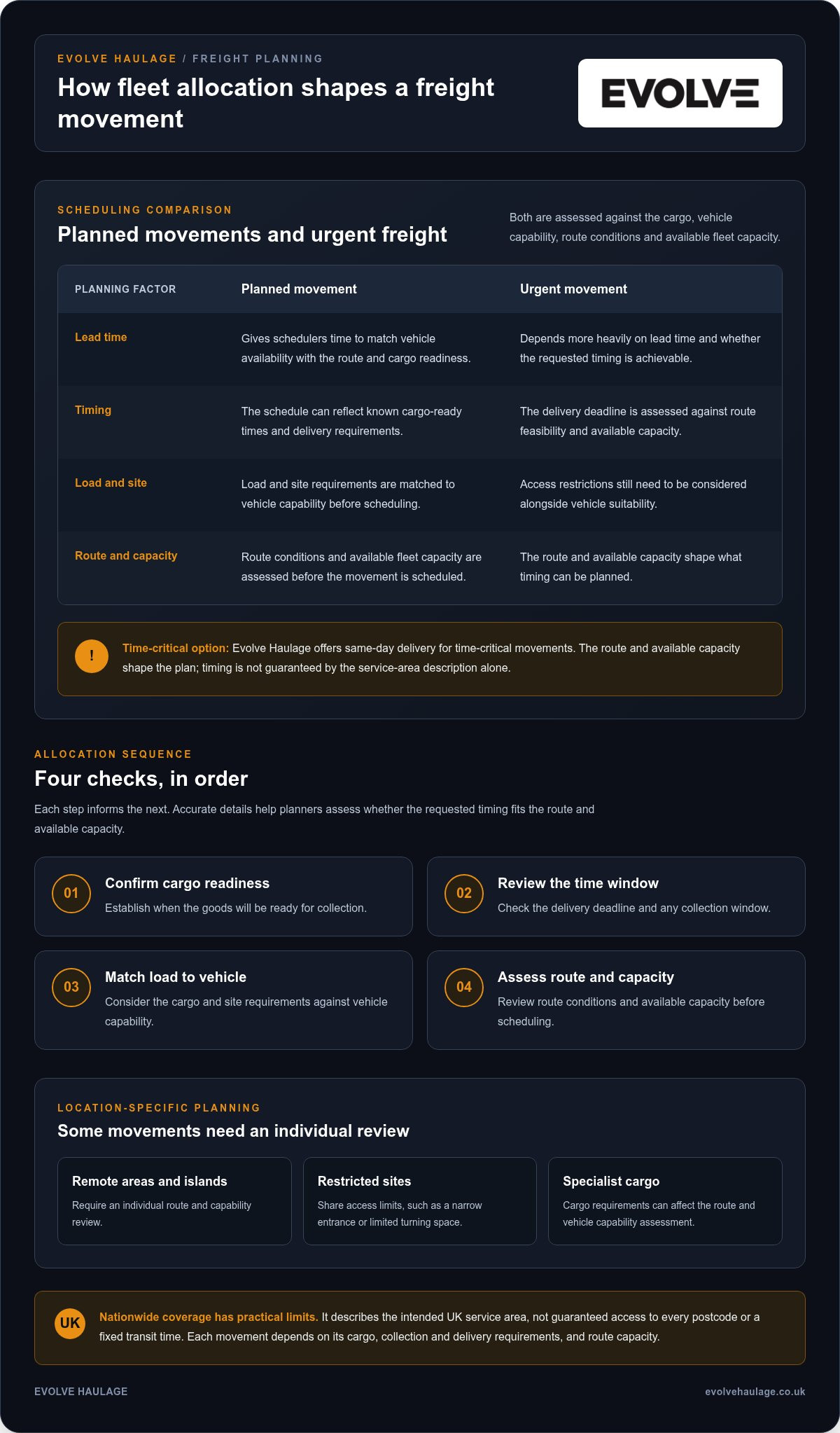
Planned movements give fleet schedulers time to match vehicle availability with the route and cargo readiness. Urgent freight depends more heavily on lead time, capacity and achievable delivery timing. Evolve Haulage offers same-day delivery for time-critical movements, with the route and available capacity shaping the plan.
Route planning considers collection and delivery points, road access, site restrictions and any intermediate stops. A load going to a remote location, for example, may need a different route assessment from one going to an accessible town centre. The route must suit both the cargo and the vehicle.
UK road freight operators must plan around applicable operator licensing, vehicle weight limits and drivers’ hours rules. Requirements depend on the vehicle and operation, so planners account for them when allocating a suitable movement.
Insurance and liability cover depend on the policy, shipment details and applicable carriage terms. Check how the cargo’s declared value, handling requirements and policy exclusions affect the protection provided.
Road freight prices depend on the shipment and route, including distance, weight, pallet dimensions, access and urgency. Delivery timing and service level depend on lead time, route conditions and available capacity; no single transit time applies to every UK movement.
Delays can arise from route disruption, access constraints or changes to collection readiness. Damage risks relate to handling and load security, while theft is a cargo security consideration. Accurate cargo details and clear handling instructions help planners account for these risks. For complex route or cargo requirements, haulage consultancy support can help shape the movement plan.
Fleet allocation and scheduling
Fleet scheduling matches each movement with available capacity, a suitable vehicle and a workable route. Planners consider cargo readiness and urgency alongside route conditions, site access, and the time required for collection and delivery. This approach is tailored to the freight movement, rather than treating it like a parcel-network round.
Allocation starts with the movement requirements. Planners can use this sequence:
- Confirm when the cargo will be ready for collection.
- Review the delivery deadline and any collection window.
- Match the load and site requirements to vehicle capability.
- Assess route conditions and available capacity before scheduling.
Each step affects the next. A ready load with a tight delivery window, for example, needs a different scheduling assessment from freight with flexible timing. If a collection site has access restrictions, planners must consider them alongside vehicle suitability. Accurate details help determine whether the requested timing fits the route and available capacity.
Planned movements allow schedules to reflect known cargo-ready times and delivery requirements. Urgent movements depend more on lead time, route feasibility and available capacity. A same-day request, for instance, depends on whether a suitable movement can be arranged within those constraints. Urgency informs allocation but does not remove route or vehicle limitations.
For multi-stop journeys, list each collection and delivery in the required order. This gives planners a route sequence to assess, rather than just an origin and destination. Changes to cargo readiness, access or delivery timing may affect the schedule, so share updates promptly. Planners can then account for the revised requirements.
During transit, progress can be shared at agreed milestones through to delivery, along with available completion information. These updates give the transport team and receiving site a shared reference point. For example, the delivery contact can use milestone updates to prepare for handover. Clear scheduling links fleet allocation, route planning and communication throughout the movement.
Nationwide service-area limitations
“Nationwide” describes the intended UK service area, not guaranteed access to every postcode or fixed transit times. A remote address and a restricted industrial site have different route and access considerations. Treat coverage as a planning scope, then assess the actual collection point, destination and cargo requirements for each movement.
Some locations need an individual route and capability review. Remote roads or restricted sites can affect vehicle access and the practical journey. If a site has a narrow entrance, include that constraint in the location details. A postcode alone cannot establish whether the route, vehicle and delivery window suit the movement.
Nationwide UK road freight differs from rail, courier and parcel services in how loads are planned and handled. Rail freight uses rail routes and terminals, while road freight plans around vehicle access to collection and delivery sites. Courier and parcel networks are designed for parcels moving through their networks; road freight planning considers the specific cargo and vehicle requirements.
Choose a transport approach based on the shipment, not simply the word “nationwide”. A business moving a large or specialist load between two sites needs a plan that considers dimensions, handling, access and timing. A small parcel may suit a parcel-network model better. For mixed requirements, compare the cargo, delivery points and handover needs before deciding.
To prepare for a location review, provide the full postcode, site access conditions, operating hours and delivery restrictions. Include the required collection and delivery windows, plus details of any specialist cargo. Flag a remote destination or restricted industrial entrance early. This gives route planning a clear basis and shows how access or timing may shape the movement.
If your UK shipment involves a remote destination, restricted site or specialist load, discuss your haulage requirements to plan around its route and access needs.
UK road freight has no fixed transit time or guaranteed access to every postcode. Delivery timing and service depend on the route, site access, cargo requirements and agreed collection and delivery windows. Some movements need an individual route and capability review.
Evolve Haulage: Haulage Service
Evolve Haulage provides road haulage for businesses moving cargo across the UK. Use its Haulage Service when your shipment needs a transport plan tailored to its cargo, route and delivery requirements.
For day-to-day logistics coordination, Transport Management supports the organisation of transport operations. Consultancy Service can help businesses review logistics requirements and identify practical planning considerations. Time-critical shipments can also be served through 24/7 and same-day delivery solutions across the UK.
Share the cargo details, collection and delivery locations, access conditions and required timings to define the movement clearly. This information helps align the transport plan with the shipment’s needs and the route.
To discuss a UK freight movement, contact Evolve Haulage.
Build a freight plan that can adapt
Make transport planning part of your wider operational review, rather than treating every shipment as an isolated task. As supply patterns, customer commitments or delivery locations change, revisit how freight requirements align with business priorities. This helps guide future movement decisions and keeps transport planning connected to everyday operations.
Effective nationwide road freight logistics depends on coordination between transport and the teams responsible for goods, schedules and delivery sites. Evolve Haulage’s Haulage Service, Transport Management and Consultancy Service can support these needs, from arranging cargo movements and managing day-to-day logistics to reviewing transport requirements.
For your next movement, bring the operational priorities into the conversation alongside the shipment itself. That gives you a useful starting point for discussing a transport approach suited to your business. Contact Evolve Haulage about your freight and take the next step with a clear plan.
Frequently Asked Questions
What does nationwide road freight logistics include in the UK?
In the UK, nationwide road freight logistics means planning and moving commercial cargo by road across the intended national service area. It can involve dedicated full or partial freight loads, with arrangements shaped around the shipment and its delivery needs. For businesses, this means coordinating a movement from collection to delivery, not assuming a standard parcel-network process.
Which UK road freight services are available, including full loads, part loads and groupage?
UK road freight can be arranged for full or partial loads, depending on how much cargo needs moving. Evolve Haulage provides dedicated full and partial freight loads. Groupage generally combines consignments for transport, unlike a dedicated load arrangement. The suitable format depends on shipment size, handling needs, collection and delivery requirements, and the transport plan.
Which UK regions, towns and postcodes are covered by nationwide road freight carriers?
“Nationwide” describes the intended UK service area, but it does not mean every postcode has the same access or transit times. Site restrictions, remote access or an island journey can all affect route planning. Provide the full collection and delivery postcodes, along with any site entry instructions. This helps assess the actual journey rather than relying on a broad national label.
What vehicle and load options are available for UK freight transport?
Vehicle suitability depends on the consignment, site access and loading method. A transport plan considers dimensions, weight, number of pieces and specialist handling needs before selecting a suitable option. Bulky cargo and compact goods, for example, may require different vehicle arrangements. Provide accurate measurements and explain how loading and unloading will work at both ends.
How do businesses book and prepare a nationwide UK road freight shipment?
Start by describing the cargo and the collection and delivery requirements. Add handling instructions, site access details and timing constraints, then provide contact information for both handovers. Keep a record of the shipment reference and share changes promptly, especially if cargo readiness or site access changes. This gives the transport team consistent details for coordinating the movement.


