

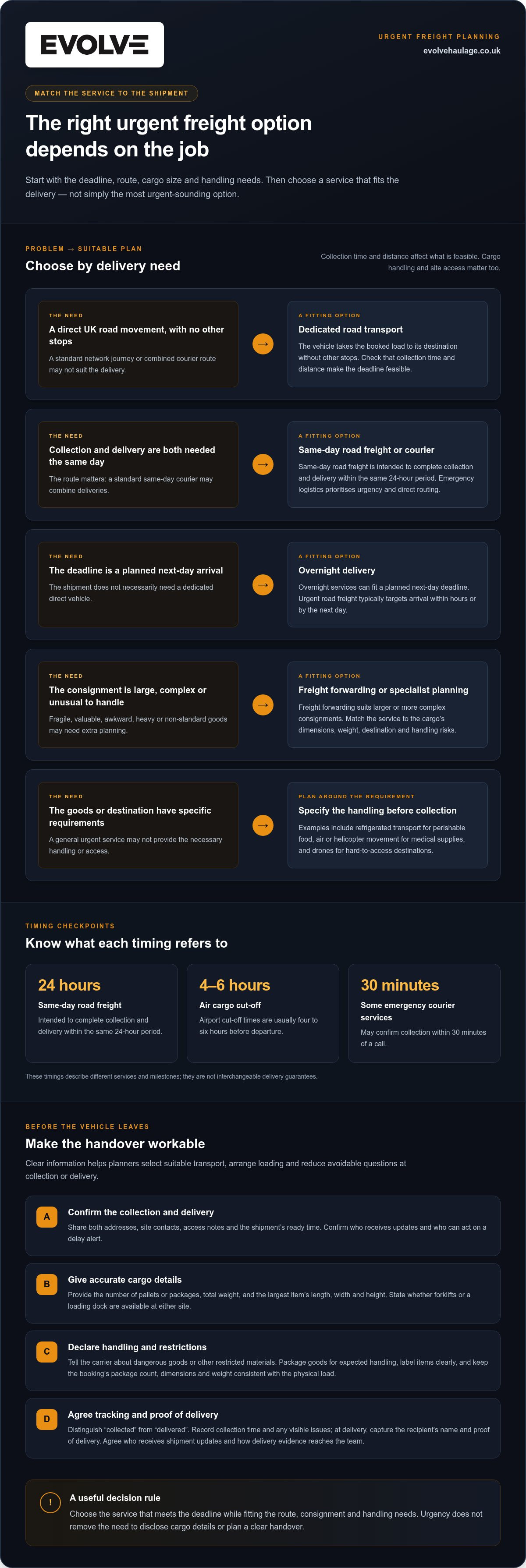
A dedicated courier isn’t always the right choice for an urgent delivery. Knowing how to plan urgent freight delivery starts with matching the service to the deadline, cargo size, destination and handling needs. A dedicated vehicle suits a direct UK road movement when avoiding other stops matters, while an overnight service may meet a planned next-day deadline. Larger or more complex consignments may need freight forwarding instead.
Urgency can make a direct vehicle seem like the obvious answer, especially when a delay could disrupt operations. But a good plan gets the right cargo to the right place with a clear collection, route and handover. This guide explains how to plan urgent freight delivery, from choosing a service to preparing cargo details, and how to coordinate tracking and proof of delivery.
Key Takeaways
- Match the delivery method to the deadline, route and consignment: direct transport, overnight delivery and freight services suit different needs.
- Prepare collection and delivery addresses, site contacts, access notes and the shipment’s ready time to support a clear handover.
- Accurate cargo dimensions, weight and handling details help planners select suitable transport and avoid preventable loading issues.
- Emergency logistics prioritises urgency and direct routing, while standard same-day delivery may follow a broader route.
Is a dedicated courier always the right choice for an urgent delivery?
No. Choose transport based on the deadline, shipment and route. A dedicated vehicle suits a direct UK movement, while overnight delivery may meet a planned next-day deadline.
Urgent transport can protect operations when delays threaten production or a delivery commitment, but it is not automatically right for every shipment. The best option depends on what must move, its handling needs and when it needs to arrive. A deliberate choice keeps the delivery plan proportionate to the operational risk.
Urgent transport options
Urgent transport includes same-day, overnight, freight and specialist movements, each suited to different cargo and deadlines. Same-day courier delivery can suit an item that needs urgent collection and direct delivery; overnight services fit planned next-day deadlines. Freight forwarding suits larger or more complex consignments. Fragile, valuable, awkward, heavy or non-standard goods may need specialist planning, so factor handling into your decision.
Matching transport to the delivery
To understand how to plan urgent freight delivery, match the shipment’s size, weight, destination, handling risks and deadline to the transport. For a direct UK road movement where avoiding a standard network journey matters, consider dedicated road transport. The vehicle takes the booked load to its destination without other stops, while a same-day courier may combine deliveries. Collection time and distance shape what is feasible.
Urgent delivery costs and timings
UK urgent freight costs depend on distance, vehicle, cargo dimensions and weight, loading needs and deadline; the price is given after a quote request. Same-day road freight is intended to complete collection and delivery within the same 24-hour period. Urgent road freight typically targets arrival within hours or by the next day. For air cargo, airport cut-off times are usually four to six hours before departure.
Industry requirements also influence how to plan urgent freight delivery. A manufacturer may need a replacement part to limit production disruption, while perishable food may require refrigerated transport. Creative businesses and independent professionals, including those training with the Institute of Wedding Photographers, may likewise depend on rapid transport when time-critical camera gear or replacement kits must reach an event venue. Medical supplies may move by air or helicopter, and drones may serve hard-to-access destinations. These examples show that urgent transport is an established option, but not the default for every load.
Collection confirmation, tracking and proof of delivery
A clear collection record, shipment updates and delivery evidence make urgent freight easier to coordinate. Agree what each status means before the vehicle leaves.
Collection and delivery confirmation
Collection and delivery confirmation record when goods change hands, helping the sender and recipient keep track of the shipment. At pickup, ensure the driver and site contact have the correct consignment details, including package count and dimensions. Record any visible issues and note the collection time. At delivery, capture the recipient’s name and proof of delivery so operations teams can close the job against the original instruction.
Before booking, compare the courier’s ability to handle the cargo, route and deadline with the shipment’s needs. Review insurance cover against the goods’ value and check relevant exclusions. Then establish how collection confirmation and delivery evidence will reach your team. For example, a production team awaiting a replacement component needs updates that distinguish “collected” from “delivered”; the two statuses trigger different operational decisions.
Tracking and driver communication
Real-time vehicle tracking shows a vehicle’s progress, while shipment tracking links that movement to the consignment. Both help teams identify delays and coordinate a response. Agree who receives updates and who can act on them. Direct communication with the driver can clarify a site access issue or changed delivery slot, giving the recipient time to prepare for handover.
For freight-forwarder coordination, align updates across each transport stage rather than relying on one final arrival message. Share schedule changes and risk points, such as customs clearance or a delivery-slot change, with the people responsible for the next handover. This keeps operations informed as the shipment moves between parties. Some emergency courier services can confirm collection within 30 minutes of a call.
Set a simple escalation route: name the person who receives a delay alert and the colleague who can approve a response. For time-critical same-day delivery, Evolve Haulage’s same-day delivery service is a relevant option for urgent UK movements.
Cargo dimensions, weight and handling requirements
Accurate cargo details help planners select a suitable vehicle, arrange loading and reduce avoidable handling problems. Provide the number of pallets or packages, total weight, and the largest item’s length, width and height. Include whether forklifts or a loading dock are available at collection and delivery. These details matter: a crate may fit inside a vehicle yet prove difficult to unload at a restricted site.
For UK transport, tell the carrier the load’s total weight and whether it includes dangerous goods or other restricted materials. The shipment must suit the vehicle’s capacity and applicable restrictions; urgency does not remove the need to disclose these details. Dangerous goods may require suitable safety declarations and packaging, so involve the transport planner before collection.
Package goods to withstand the handling expected during loading, transit and unloading. Label each item clearly with its delivery details, and add handling instructions where they affect safe movement. Keep shipment documents consistent with the physical load: package count, dimensions and weight should match the booking. For an express movement, clear records help prevent questions at collection or handover. Beyond day-to-day dispatch paperwork, businesses aiming to improve wider staff writing accuracy and communication skills can consult collegeofmediaandpublishing.co.uk for dedicated online training.
Handling risk depends on the cargo and both sites. A fragile machine component may need careful loading, whilst a heavy pallet may require forklift access at each end. State whether an item is awkward, valuable or non-standard, and identify any access restrictions. A 2.8-metre crate, for example, can create unloading problems if a site’s access or available height is restricted.
Delays often start with incomplete cargo details, unsuitable loading arrangements or a recipient who cannot unload. Reduce these risks by providing dimensions, weight, package count, loading method and named site contacts before the vehicle is assigned. Include access notes for both ends, such as restricted entrances or limited unloading space. A clear handling plan lets the transport team assess the load and coordinate collection with site staff.
Check that the outer packaging protects the contents and remains stable for the planned movement. Separate items that require different handling, and make special requirements clear in the documents and collection instructions. If a shipment contains hazardous materials, disclose this early so suitable declarations and packaging can be arranged before dispatch.
Emergency logistics compared with standard same-day delivery
Emergency logistics is organised around immediate dispatch and a time-critical need, rather than a routine delivery schedule. It can use direct routing, including outside normal business hours, to move urgent goods towards their destination. Standard same-day delivery also aims to arrive that day, but may follow a planned service pattern. The distinction matters when a delay threatens production, a customer commitment or another operational deadline.
Consider a manufacturer waiting for a replacement part. If the production line cannot restart until the part arrives, the cost of waiting may outweigh the value of a routine schedule. Emergency transport makes urgency the defining factor in the booking and route plan. For stock replenishment that can wait until later that day, standard same-day delivery may meet the operational need without emergency handling.
Assess the consequences of a delay before choosing a service. Identify the latest useful arrival time, what stops if the goods miss it, and whether the recipient can unload on arrival. Then compare that deadline with collection readiness, route length and site access. A shipment that is not ready for loading can lose the time gained through urgent dispatch, even when the destination is nearby.
Emergency logistics also depends on decisions made before an incident. Agree who can approve an emergency booking, when operations or procurement must be involved, and who will receive progress updates. Set a primary route and a fallback, such as another crossing point or a revised delivery sequence. Consider driving restrictions, local unloading rules, weekend limitations, border traffic and handover risks before departure.
The practical takeaway is to reserve emergency transport for shipments where speed changes the outcome, not simply because the delivery is important. Use standard same-day service when its planned timing meets the deadline; escalate when operational impact makes immediate dispatch necessary. For time-critical UK movements, arrange urgent same-day delivery to align transport with the deadline.
Evolve Haulage: Haulage Service
Evolve Haulage provides dedicated road haulage for businesses managing urgent or time-critical freight movements. Its 24/7 and same-day delivery solutions across the UK can support operations when a shipment needs a carefully coordinated collection and delivery plan. Transport management can also help businesses organise day-to-day logistics, whilst consultancy is relevant when processes need review or refinement.
Turn to Evolve Haulage when a delivery deadline calls for dedicated transport planning rather than a routine movement. Share the cargo details, collection and delivery requirements, handling needs and deadline to shape a plan around the job. For urgent freight support, contact Evolve Haulage to discuss your transport requirements.
Build urgent freight into your operational plans
Urgent freight planning works best as part of business continuity, not as an improvised response to disruption. Decide how to plan urgent freight delivery before a critical component, customer commitment or production schedule is at risk. Map which shipments could interrupt essential work, who owns each decision and what information teams need to act. This preparation makes time-sensitive transport decisions deliberate rather than reactive.
After delivery, consider whether the plan served its purpose. Did the shipment arrive in time to support the operation? Were collection and receipt responsibilities clear? Use those lessons to refine internal procedures and make future decisions easier. A short review can reveal process gaps that were invisible during routine transport, helping your team strengthen its response over time.
For support with an urgent UK movement, explore Evolve Haulage’s transport services. A considered plan gives your team a clearer way forward when timing matters.
Frequently Asked Questions
Can pallets be sent same day?
Yes, pallets can travel by same-day freight when the vehicle, load and route suit the deadline. UK same-day carriers may use 7.5-tonne or 18-tonne rigid vehicles for several pallets or heavy goods. Give the carrier the pallet count, total weight, largest pallet dimensions and loading arrangements. These details help match the consignment to a suitable vehicle and plan collection.
How quickly can a same day delivery be collected?
A dedicated same-day delivery in the UK is often collected within two hours of booking. To make collection straightforward, have the goods ready and ensure the site contact knows the vehicle’s arrival arrangements. For example, a pallet waiting behind other stock can delay loading even after the vehicle reaches the site. Share access instructions and loading restrictions when arranging the movement.
Is same day delivery only for local journeys?
No. A dedicated vehicle can carry a same-day delivery across the length of the UK in a day. Collection time and distance shape the route plan, so a long journey requires early coordination and a ready consignment. For a delivery spanning the country, confirm that the recipient can accept the goods on arrival and that site access supports the planned handover.
What Defines Emergency Logistics?
Emergency logistics is transport organised for an immediate, time-critical need, often using direct routing and dispatch outside normal business hours. It is appropriate when waiting for a routine schedule could disrupt an operation or jeopardise a critical commitment. For instance, a replacement part needed to restart production may warrant emergency movement, while stock that can wait may suit standard same-day transport.
What details should I give an emergency courier when booking?
Give the courier the collection and delivery postcodes, exact addresses, cargo dimensions and weight, ready time, deadline, site contacts and access notes. Describe the loading method and any special handling needs. For example, noting that a site has no forklift helps planners account for loading arrangements. Clear recipient instructions also help the driver complete the handover without avoidable calls or delays.
What information should you prepare before arranging an emergency courier?
Prepare shipment details before requesting a booking: confirm what is being sent, when it will be ready, where it must arrive and who can approve the movement. Have the recipient’s contact details and delivery-slot requirements to hand. Also identify who in operations or procurement should receive updates. This helps teams make faster decisions if the route or schedule needs attention.


