
What if the delivery date is agreed, but the load, access arrangements or day-to-day coordination do not fit the plan? The most useful questions to ask a haulage company go beyond the vehicle and arrival time. They help you establish whether the service suits your freight and how collection and delivery will be managed.
Before committing a consignment, get clear answers about the load, collection and delivery arrangements, compliance support and communication. This makes it easier to compare the proposed plan with your business’s actual requirements.
Use this checklist to prepare for a focused conversation, whether you need to move a full or partial freight load or are considering wider transport management support. Have the load details, collection and delivery postcodes, timing requirements and site constraints ready. A concise brief helps you discuss the movement clearly and identify a practical plan.
Key Takeaways
- Use questions to ask a haulage company to clarify the freight, collection and delivery details that shape a suitable transport plan.
- Separate routine scheduled movements from time-critical consignments so you can set clear delivery priorities.
- Agree who will coordinate collections, schedule changes and communication with delivery sites.
- Ask how compliance guidance and day-to-day transport management could support your wider operational needs.
- Prepare a concise brief to distinguish a one-off movement from recurring haulage or broader transport support.
Questions to ask a haulage company about your freight requirements
Start with the essentials: what needs moving, from where, to where and by when? Share the collection and delivery postcodes, preferred dates and any fixed timing requirements, then describe the goods. Include dimensions, total weight, packaging and handling needs. This gives the transport discussion a practical foundation and helps shape a plan around the actual consignment, rather than assumptions.
Useful questions to ask a haulage company include: “What details do you need to plan this movement?” and “How will the load’s size, weight and handling requirements affect the arrangements?” These details matter across the road transport industry, where both the freight and the journey inform the operational plan.
What details should you share about the consignment?
Prepare the collection and delivery postcodes, preferred dates and site access information. Describe the freight’s dimensions, total weight and packaging, and flag handling considerations such as fragile items or goods that need to remain in a particular position. Be precise: a bulky, lightweight item may need different arrangements from a compact, heavy one.
Explain what will happen at each end of the journey. Are there restricted access points, limited loading areas or set opening hours? Is loading or unloading limited to a particular window? Share these constraints early so they can be considered alongside the schedule and site arrangements.
Does the job need a full load, part load or dedicated delivery?
Ask how the size and requirements of your consignment affect the transport arrangement. A full load generally uses the vehicle’s capacity for a larger consignment, while a partial load uses only part of that capacity. The right fit depends on the freight and your operational priorities, not simply on the label.
Evolve Haulage provides dedicated full and partial freight loads for different consignment requirements. Clarify whether the goods need a dedicated movement and what that means for collection, the journey and delivery. For example, a consignment with particular handling needs or a fixed delivery schedule may need a different plan from freight with more flexible arrangements. Explain which details are essential, then discuss how they shape the transport solution.
Before the conversation, bring together the freight description, postcodes, dates and site constraints. This concise brief helps turn an initial enquiry into a focused discussion about the movement and the service that fits it.
Questions to ask about haulage coverage, timing and urgent deliveries
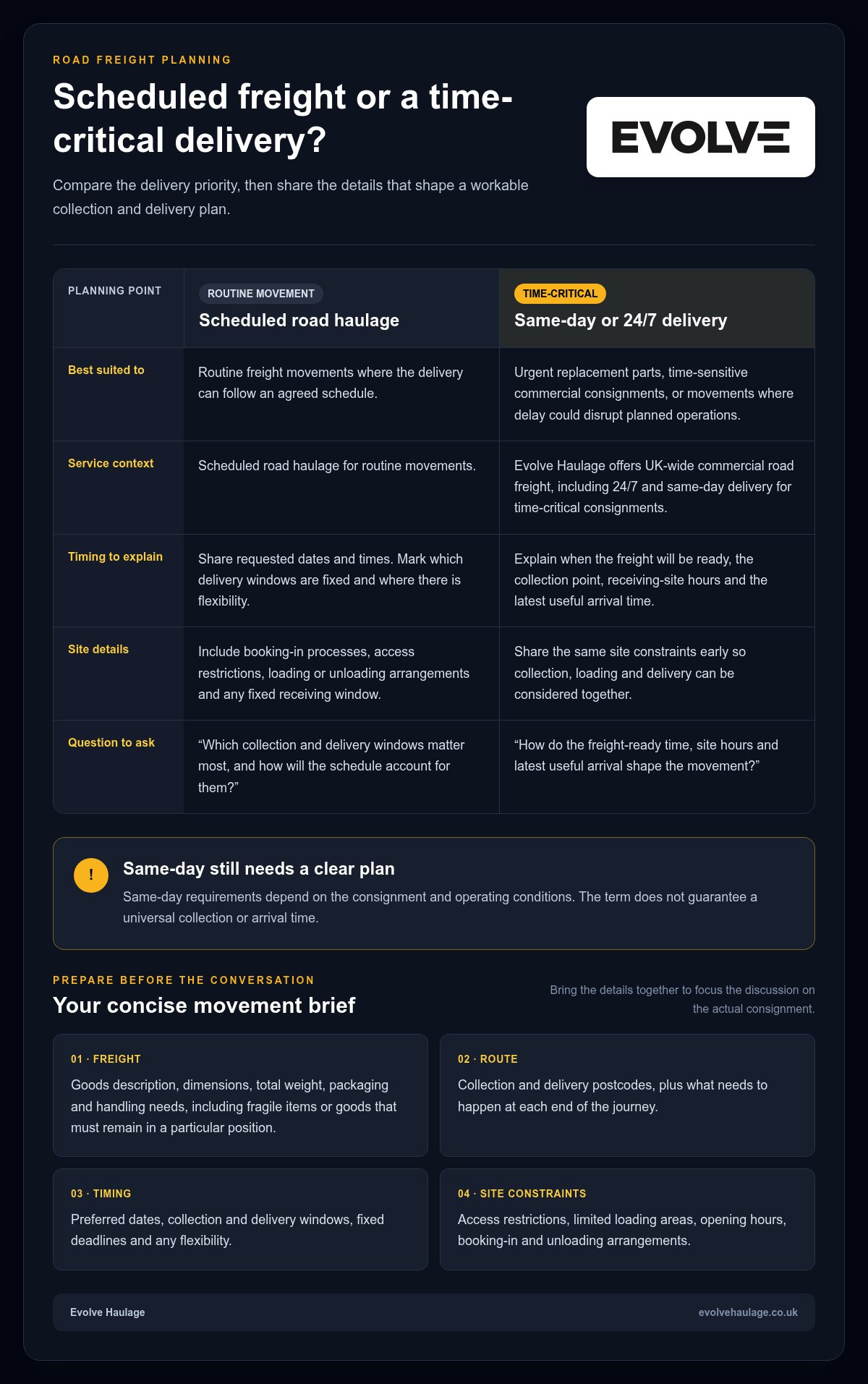
Coverage and timing need to work together. Ask: Which collection and delivery windows matter most to our operation, and how will the schedule account for them? Give the required delivery date, any fixed receiving window and the collection window. Freight needed before a production shift starts, for example, has a different priority from a consignment that can arrive at any point during the day.
Evolve Haulage provides UK-wide commercial road freight, including 24/7 and same-day delivery for time-critical consignments. Ask not only whether the route is covered, but how the movement can be planned around your deadlines and site arrangements.
How should you discuss collection and delivery deadlines?
Share the requested dates and times at both ends, along with any booking-in process, access restrictions and unloading arrangements. Explain which times are fixed and where there is flexibility. This distinguishes a firm receiving window from a preferred arrival time and helps establish a realistic schedule based on the journey and operating constraints.
Ask how collection, loading and delivery will be coordinated if timings change. Include the practical steps required at each site, rather than treating the journey as the only part of the schedule. Safe loading also matters to dispatch planning. The IRU’s international load securing guidelines provide background on securing freight during road transport.
When is a same-day haulage service relevant?
Same-day transport may suit an urgent replacement part needed to resume work, a time-sensitive commercial consignment or a movement where delay could disrupt planned operations. Evolve Haulage offers 24/7 and same-day delivery for time-critical freight, alongside scheduled road haulage for routine movements.
Urgent transport still needs a clear plan. Explain when the freight will be ready, where it needs to be collected, the receiving site’s hours and the latest useful arrival time. Discuss how these details shape the movement. Same-day requirements depend on the consignment and operating conditions, so do not assume the term means a universal collection or arrival time.
For a useful first discussion, separate regular scheduled freight from consignments that need a rapid response. Note the important delivery windows and site arrangements before discussing the route. To explore how your timing requirements fit a road freight plan, visit Evolve Haulage’s road haulage services.
Questions to ask about freight communication and delivery coordination
A well-managed consignment depends on clear communication as well as a suitable transport plan. Agree a simple sequence: share the requirement, confirm the plan, identify who coordinates it and review how delivery went. This gives everyone a shared understanding without assuming that a particular tracking platform or reporting system is needed.
Useful questions to ask a haulage company include: “Who coordinates the collection and delivery?”, “Who should we contact if the schedule changes?” and “What updates will help us manage the delivery at our end?” Agree which updates matter to your operation, such as confirmation of collection, notice of a schedule change or information for the receiving site.
Who coordinates the consignment from collection to delivery?
Clarify who is responsible for day-to-day transport coordination and schedule execution. Evolve Haulage’s transport management support includes driver coordination and schedule management, helping align operational activity with the agreed plan. Establish the communication route and decide who needs to share updates with the collection and delivery sites.
For UK freight movements, keep compliance discussions focused on the requirements relevant to the operating arrangement. Clarify how responsibilities are managed and what operational information your business needs to provide. This keeps the coordination discussion grounded in the movement and the applicable UK requirements.
What should happen if the delivery plan changes?
Collection times, site access and receiving arrangements can change after a movement has been planned. Ask how to raise a change, who needs to know and how it could affect the schedule. If a delivery entrance becomes unavailable or a receiving window shifts, share that information as early as possible so it can inform coordination.
Before dispatch, agree which updates your team needs and who will pass them to the receiving site. After delivery, review whether communication and coordination met the operational requirement, and note any adjustments that would help with future movements. This supports a collaborative working relationship without assuming every consignment needs the same type or level of update.
For a broader framework on assessing operational fit, read how to choose a road haulage company in the UK.
Questions to ask about haulage compliance and transport management
Discuss compliance alongside the practical work of moving freight. Ask how relevant transport requirements are managed within the proposed arrangement, who handles each operational task and how day-to-day activity is coordinated. Responsibilities depend on the business model, the vehicles and work involved, and the requirements that apply.
Keep your questions specific to the operation. Where relevant, clarify how operator-licensing requirements, drivers’ hours and applicable Driver and Vehicle Standards Agency (DVSA) expectations are taken into account. These topics depend on the transport arrangement, so treat the conversation as operational planning, not a substitute for current regulatory guidance or legal advice.
What compliance responsibilities should businesses discuss?
Ask how compliance responsibilities are identified and managed, what information your business needs to provide, and how relevant requirements are reflected in day-to-day operations. Clarify responsibilities for the work being discussed rather than assuming the same arrangements apply to every business. Evolve Haulage provides regulatory compliance guidance as part of its transport management support, helping businesses consider compliance alongside their operating needs.
Useful points to establish include:
- Which compliance considerations are relevant to the transport arrangement?
- How are responsibilities and operational tasks allocated?
- How will changes to the operation be reflected in transport planning?
Requirements can change, and their application depends on the circumstances. Use current official guidance for regulatory decisions, and seek qualified advice where your business needs an interpretation of its legal obligations.
Could transport management support solve a wider operational need?
A single consignment may need a defined collection and delivery plan. Recurring movements can require wider coordination, such as aligning drivers, schedules and daily transport activity across the operation. If your team repeatedly organises these moving parts, consider whether transport management support could help structure that work beyond an individual delivery.
Evolve Haulage’s transport management support covers day-to-day operations, driver coordination, schedule execution and regulatory compliance guidance. Its logistics consultancy can also help businesses assess wider operational requirements alongside road haulage. This allows you to consider both an immediate freight movement and the processes behind recurring transport needs.
Set out whether you need a one-off haulage movement, ongoing coordination or broader operational support. Discuss transport management support to explore how Evolve Haulage’s services can align with your requirements.
How to use your haulage checklist and agree a practical next step
A checklist is most useful when it becomes a concise brief, not simply a list of questions. Bring the key details together so the discussion can focus on the transport plan and how it fits your operation. The questions to ask a haulage company should clarify both the immediate movement and any wider support your business needs.
What information should you organise before discussing a haulage requirement?
Prepare a short summary covering the freight, collection and delivery sites, preferred dates and operational priorities. Include details that could affect the movement, such as site access or receiving arrangements. Note whether the consignment is time-critical, requires a full or partial load, or forms part of a regular schedule.
If your requirement extends beyond the movement itself, outline the operational issues too. You might need support coordinating drivers, managing schedules or understanding transport compliance responsibilities. Your brief could include:
- Collection and delivery postcodes, preferred dates and site constraints
- Freight type, dimensions, weight and any handling considerations
- Whether the need is urgent, recurring, full-load or partial-load transport
- Any driver coordination, compliance or schedule-management priorities
This summary gives the discussion a clear starting point. It also helps distinguish a one-off consignment from recurring haulage or a broader transport management requirement.
How can a haulage conversation lead to a better-fit solution?
Clear requirements make it easier to discuss service fit in practical terms. A single movement may call for road haulage planned around a specific consignment and delivery window. Recurring freight may prompt a wider conversation about coordinating day-to-day transport activity. Evolve Haulage’s road haulage, transport management and logistics consultancy services address these different needs.
Use the conversation to confirm priorities, responsibilities and next steps. If details are still developing, explain what is known and what may change. This keeps the discussion focused without assuming that every job follows the same process or needs the same arrangement.
When you’re ready, discuss your haulage requirements with Evolve Haulage and use your brief to start a practical conversation about the right support for your freight.
Turn your checklist into a clear transport plan
The most useful questions to ask a haulage company clarify more than a delivery date. They establish what the freight requires, how collection and delivery will be coordinated, and whether you need a one-off movement or support for wider transport operations. A concise brief covering the load, sites, schedule and priorities gives the first discussion a practical focus.
Keep delivery expectations grounded in the consignment and receiving arrangements. Then consider the level of support that fits. Evolve Haulage provides UK-wide commercial road haulage, including dedicated full and partial freight loads, as well as transport management and logistics consultancy. For time-critical deliveries, Evolve Haulage provides 24/7 and same-day options.
Ready to turn your freight details into a focused conversation? Discuss your haulage requirements with Evolve Haulage and take the next step towards a transport plan aligned with your operation.
Frequently Asked Questions
What should I ask a haulage company before booking?
Ask how the proposed service will meet your freight, schedule and operational requirements. Clarify the collection and delivery plan, who coordinates the movement, what updates your team will receive and how changes are handled. Share the load details and site constraints, then establish whether you need a one-off consignment or recurring support. These questions help you agree a practical plan before confirming arrangements.
How do I know whether a haulage company can handle my type of freight?
Describe the goods clearly, including their dimensions, weight, packaging and handling requirements, then discuss how these details shape the transport plan. Explain any loading or unloading constraints at each site. Evolve Haulage handles dedicated full and partial commercial freight loads across the UK. An accurate consignment description helps align the load requirements with the service and delivery arrangements.
Can a haulage company provide same-day delivery?
Yes. Same-day delivery can suit time-critical freight. Evolve Haulage provides 24/7 and same-day delivery for urgent consignments. The practical plan depends on the freight, when it is ready, the collection and delivery points, and site arrangements. Share the latest useful arrival time and relevant operating constraints so they can inform a focused discussion about the movement.
What information do I need to provide for a haulage quote?
Provide the collection and delivery postcodes, preferred dates, freight dimensions and weight, packaging details, and any handling or site-access requirements. State whether the load is full or partial, and flag urgent timing or receiving-window constraints. This information gives the haulage company a clearer view of the work involved and supports a tailored discussion of the transport requirement.
What is the difference between haulage and transport management?
Haulage is the physical movement of freight by road, while transport management covers the organisation of transport operations. Evolve Haulage provides commercial road haulage as well as transport management support for day-to-day operations, driver coordination, schedule execution and regulatory compliance guidance. A business arranging a single consignment may need haulage, while recurring movements or wider operational needs may also call for management support.
What compliance questions should I ask a haulage company in the UK?
Ask how relevant transport compliance responsibilities are identified, managed and reflected in the operating plan. Clarify what information your business needs to provide and how responsibilities are allocated. Requirements depend on the transport arrangement and circumstances, so do not treat general guidance as legal advice. Evolve Haulage provides regulatory compliance guidance through its transport management support, alongside day-to-day operational coordination.


