

What if improving transport performance doesn’t mean choosing between managing everything in-house and handing it all over? For businesses exploring transport management services UK, the practical question is often how to keep daily transport duties, compliance oversight and delivery coordination under control while maintaining focus on wider operational priorities. These demands can be difficult to balance when responsibilities and processes need consistent attention.
Effective transport management connects compliance processes, coordination and delivery execution. The right support can help organise day-to-day road transport activities, coordinate drivers and schedules, and identify opportunities to improve transport efficiency. It is also useful to distinguish an operational management service from transport software, which provides digital tools, and a freight marketplace, which connects businesses with transport capacity.
This guide explains what transport management services can cover, how they compare with an in-house operation, and when a blended approach may fit. You’ll also see how consultancy can help assess transport processes and how management support can work alongside haulage when your business needs both. The aim is to help you identify a practical balance of internal oversight and external support for your operation.
Key Takeaways
- See how transport management services UK can bring day-to-day oversight, compliance support, driver coordination and schedule execution together.
- Learn how operational management differs from software and freight marketplaces, so you can assess what kind of support your operation needs.
- Compare in-house management, outsourced support and consultancy across control, workload, continuity and coordination.
- Use a practical scoping process to map responsibilities, recurring issues, compliance processes and delivery requirements.
- Understand how transport oversight can connect with dedicated full or partial loads and time-critical delivery when your operation needs both.
Transport management services UK: what they cover and who they help
Transport management services coordinate the day-to-day work involved in moving goods by road. They align plans, people and delivery schedules with a business’s requirements. For organisations considering transport management services UK, it helps to distinguish an operational service from the tools and platforms used in transport.
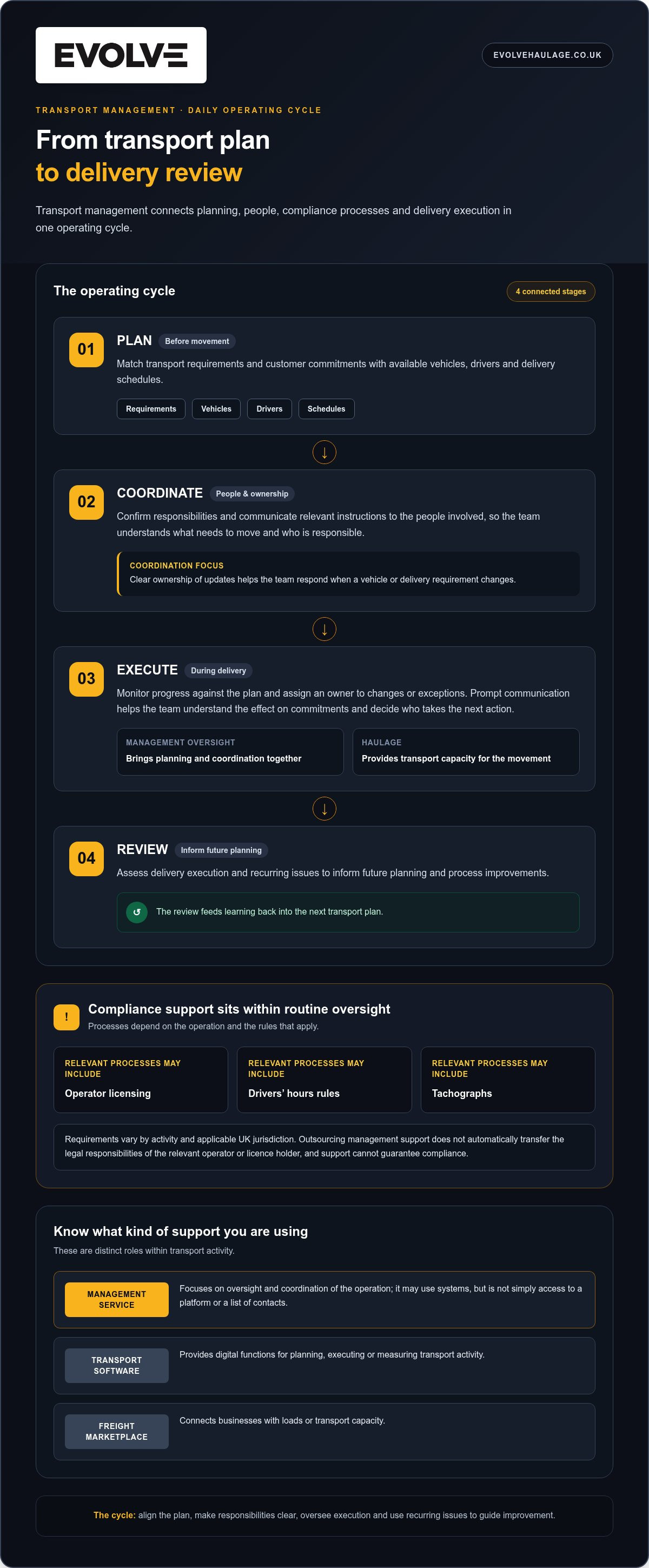
A freight marketplace helps businesses find loads or transport capacity, while a directory helps users locate companies or individuals. Transport software, including a transportation management system (TMS), provides digital functions for planning, executing or measuring transport activity. A management service focuses on oversight and coordination. It may use systems, but its purpose is to organise the operation and support delivery, not simply provide access to a platform or a list of contacts.
What does a transport management service include?
Transport oversight means coordinating activity against the business’s requirements, from planning work and allocating responsibilities to tracking schedules through to delivery. Depending on the agreed scope, this can include compliance support, driver coordination and day-to-day operational control.
These activities work together. Clear coordination helps the team understand what needs to move, who is responsible and how the schedule is progressing. Compliance support can bring relevant processes into the regular management routine, but no service should be treated as a guarantee of compliance or delivery outcomes. The responsibilities covered depend on the operation and the management arrangements agreed.
Which businesses may benefit from external transport support?
External support may suit businesses with limited internal capacity, growing transport activity or more moving parts to coordinate. It can also help firms that already have drivers and transport arrangements but want more consistent oversight of scheduling, compliance processes and daily execution.
The distinction is practical: sourcing a carrier for one delivery addresses a specific movement; transport management addresses how transport activity is organised and overseen over time. A business reviewing its arrangements may need help identifying where responsibilities or recurring issues sit. A growing operator may need additional management capacity as requirements expand.
For some operations, consultancy can help assess transport efficiency and strategy before or alongside changes to daily management. Evolve Haulage provides transport management and logistics consultancy, connecting operational oversight with practical assessment of how transport activity is organised.
How transport management services coordinate compliant daily operations
Transport management is the coordinated oversight of planning, people, compliance processes and delivery execution, not a single software tool. In practice, transport management services UK can connect decisions made before a load moves with the coordination needed to carry out the schedule and review how the operation is working.
A clear operating cycle helps teams maintain oversight:
- Plan: Match transport requirements and customer commitments with available vehicles, drivers and delivery schedules.
- Coordinate: Confirm responsibilities and communicate relevant instructions to the people involved.
- Execute: Monitor progress against the plan and assign an owner to changes or exceptions.
- Review: Assess delivery execution and recurring issues to inform future planning and process improvements.
This structure links management with freight delivery. A schedule is useful only when it reflects the job requirements and the capacity assigned to them. If a vehicle or delivery requirement changes, prompt communication helps the team understand the effect on commitments and decide who should take the next action. Management oversight brings these activities together, while haulage provides the transport capacity for the movement itself.
How compliance support fits into transport management
Where relevant to the operation, oversight may include processes connected with operator licensing, drivers’ hours rules and tachographs. Requirements vary according to the activity and applicable UK jurisdiction, so businesses need to understand which rules apply to their operation. Outsourcing management support does not automatically transfer the legal responsibilities of the relevant operator or licence holder.
Practical support can help organise responsibilities, records and recurring checks, making compliance processes part of routine oversight rather than a separate, occasional task. This supports management but cannot guarantee compliance. The Chartered Institute of Logistics and Transport (CILT) is a UK professional body for the sector and a resource for logistics and transport professionals.
How scheduling and driver coordination support delivery
Schedules need to align delivery requirements with vehicle and driver availability, while allowing the operation to respond when plans change. Clear ownership matters: the team should know who communicates an update, who reviews its effect on other work and who keeps relevant parties informed.
That does not require every operational detail to sit with one person. It does require agreed responsibilities and a consistent way to escalate exceptions, so customer commitments and delivery execution remain connected. Businesses looking to align oversight with road haulage can explore Evolve Haulage transport management.
In-house vs outsourced transport management: control, capacity and accountability
Choosing an operating model means balancing direct control against the time and capacity needed to manage transport consistently. In-house teams offer close visibility and internal knowledge. Outsourced management adds operational support, while consultancy focuses on assessing processes and identifying improvements. Transport management services UK can involve different balances of these approaches, depending on the operation’s complexity and priorities.
The comparison below highlights typical trade-offs. The precise division of responsibilities depends on the agreed scope.
| Consideration | In-house management | Outsourced operational management | Targeted consultancy |
|---|---|---|---|
| Control | Direct day-to-day oversight sits within the business. | Operational tasks are supported externally, with decision-making boundaries agreed. | Internal leaders retain control while using external advice to assess options. |
| Internal workload | Requires staff time for coordination, oversight and recurring processes. | Can provide additional capacity for agreed management responsibilities. | Concentrates external input on a defined review or improvement need. |
| Continuity | Knowledge remains close to the operation, but consistent coverage depends on internal capacity. | Can support continuity of agreed activities alongside the internal team. | Provides recommendations, while implementation remains an internal responsibility unless separately agreed. |
| Scope | Can reflect the business’s existing structure and priorities. | Can cover agreed day-to-day oversight, compliance support and coordination. | Can focus on compliance guidance, efficiency or transport strategy. |
| Coordination needs | Teams need clear ownership across transport duties and wider business functions. | Internal and external responsibilities need clear communication and handovers. | Findings need an internal owner to decide on and progress next steps. |
When does an in-house transport team make sense?
An internal team can make sense when direct visibility, close links with other departments and detailed knowledge of the operation are priorities. Staff can connect transport decisions with customer requirements and business processes as they change. That control still requires management time, clear responsibilities and enough capacity to sustain oversight. As workloads or coordination demands grow, reviewing the arrangement can show whether the existing team has the support it needs.
When can outsourced management or consultancy help?
Outsourced management can add operational oversight where internal capacity is stretched, without requiring the business to hand over every decision. Accountability should be explicit: agree which activities are supported externally, who makes decisions and how issues are escalated. Outsourcing supports the operation; it does not automatically remove the business’s responsibilities.
Consultancy serves a different purpose. It helps assess current arrangements and identify potential improvements, while ongoing transport management supports agreed operational activity. A business can use consultancy to inform change, retain internal decision-making and bring in external management support for specific responsibilities. The right mix depends on the complexity of the work and the capability available in-house.
How to scope transport management services for your operation
A useful scope starts with how transport currently works, where pressure is building and what the business needs to prioritise. This gives you a practical basis for deciding which responsibilities should stay in-house, where external support could help and how the working relationship should operate.
A clear service scope starts with documented operational needs. Use this process to record those needs before defining support:
- Map current activity. List regular movements, transport tasks, internal owners and how work is coordinated from planning through delivery.
- Record pressures and recurring issues. Note where delays, communication gaps, workload pressures or inconsistent oversight occur. Record what happens without assuming the cause.
- Separate immediate needs from longer-term goals. Identify requirements that affect current operations, then note wider aims such as improving efficiency or reviewing transport strategy.
- Map responsibilities and processes. Set out who coordinates drivers and schedules, oversees relevant compliance processes, communicates changes and makes operational decisions.
- Agree measures and working arrangements. Define useful reporting, communication routes, escalation points and how often the operation will be reviewed.
Map your current transport operation and priorities
Make the picture specific enough to guide decisions. For example, note the types of regular movements, who plans them, how delivery requirements are shared and where internal teams rely on external carriers. Include known service pressures and capacity constraints, but treat them as observations to investigate rather than proof of a particular problem.
Then distinguish urgent operational requirements from improvement objectives. A need to clarify who handles schedule changes is different from a longer-term aim to assess overall transport efficiency. Separating the two helps define whether you need ongoing management support, targeted consultancy or a combination.
Define responsibilities, measures and working arrangements
Write down the boundaries between internal and external roles. Specify who coordinates drivers, schedules and operational changes, who maintains oversight of relevant compliance processes, and who has authority to make or approve decisions. Set out how updates are shared and which issues need escalation, so responsibilities remain clear when plans change.
Choose reporting measures that reflect your priorities, such as schedule execution, recurring delivery issues or the status of agreed actions. Keep reporting useful and proportionate; the aim is to support decisions, not create administration without purpose. If carrier coordination forms part of the wider review, read this UK road haulage partner guide for related considerations.
For support assessing transport requirements or defining operational oversight, explore Evolve Haulage transport management.
Evolve Haulage transport management: connect oversight with delivery
Transport management is most useful when oversight reflects the freight operation it supports. Evolve Haulage provides day-to-day transport management across the UK, covering operational oversight, compliance support, driver coordination and schedule execution. For businesses seeking transport management services UK, this connects the planning and coordination of transport activity with the practical requirements of moving goods by road.
The scope can also include consultancy. This helps businesses assess existing transport arrangements, consider compliance guidance and identify opportunities to improve operational efficiency or transport strategy. It can inform changes before they are made or support decisions alongside ongoing management. The focus is on understanding the operation and its requirements, rather than promising a particular result.
A connected approach to transport management and haulage
Management and haulage address related but distinct needs. Transport management supports oversight and coordination; haulage provides capacity to move freight. Where a business needs both, connecting these capabilities can help align operational plans with the delivery requirement.
Evolve Haulage provides dedicated full and partial freight loads, alongside time-critical delivery options, including 24/7 and same-day delivery. These options can suit urgent movements, but not every load is time-critical. The appropriate transport arrangement depends on the freight requirement and how it fits into the wider operation.
This joined-up perspective can be useful when a business is reviewing both how transport is managed and how specific freight movements are delivered. For example, a company might need ongoing support coordinating road transport activity while also arranging dedicated capacity for particular loads. Keeping the management requirement distinct from the delivery requirement helps clarify what support is needed for each.
Plan the next step around your transport requirements
A productive discussion starts with a straightforward outline of your operation: the transport activity you manage, your priorities, how coordination currently works and where you are experiencing pressure. You can also note whether you are seeking ongoing operational oversight, help assessing efficiency, haulage capacity or a combination of these needs.
Evolve Haulage provides transport management and logistics consultancy across the UK, with road haulage that can complement management support where required. Share the context and priorities that matter to your business, and the conversation can focus on a practical scope for your operation.
Discuss your transport management requirements.
Build a transport operation that fits your business
The right transport approach depends on your operation’s complexity, internal capacity and priorities. Transport management services UK can provide day-to-day oversight, while a clear division of responsibilities helps retain appropriate internal control. Scoping your requirements first makes it easier to decide whether you need ongoing operational support, targeted consultancy or both.
Evolve Haulage provides UK-wide transport management and road haulage. Operational support covers compliance processes, driver coordination and schedule execution, helping connect oversight with delivery requirements. Logistics consultancy can help assess transport efficiency and strategy, so you can identify areas to review before or alongside operational changes.
If you are considering a different balance of internal and external support, start with your current arrangements, priorities and coordination challenges. Discuss your transport management requirements with Evolve Haulage and explore a practical approach for your operation.
Frequently Asked Questions
What are transport management services?
Transport management services provide oversight and coordination for commercial transport activity. They can cover tasks such as planning schedules, coordinating drivers and supporting the organisation of compliance processes. They differ from a freight marketplace, which connects users with loads or carriers, and from transport software, which provides digital tools but does not itself manage the operation. The precise scope depends on the business’s requirements and the responsibilities agreed.
What is included in transport management services?
Transport management services UK businesses use can include day-to-day operational oversight, driver coordination, schedule execution and support with organising relevant compliance processes. The scope should reflect the operation’s vehicles, delivery commitments, internal capacity and existing responsibilities, rather than assume every business needs the same arrangement. Some organisations also use consultancy to assess how their transport activity works and identify areas to review or improve.
Is outsourced transport management right for a small business?
It can be useful for a small business if transport duties take time away from core work or additional operational oversight is needed. Business size alone does not determine whether outsourcing is suitable. Consider how complex the transport activity is, what the team already manages internally and where support could address a practical need. Set out decision-making authority and responsibilities clearly so external support complements, rather than confuses, internal oversight.
What is the difference between an external transport manager and transport management services?
An external transport manager usually means an individual engaged for defined transport management responsibilities. Transport management services can describe broader operational oversight and coordination, potentially alongside consultancy or haulage. The terms can be used differently, so focus on what the arrangement covers: which tasks are managed, where accountability sits, how communication works and which decisions remain with the business. Clear boundaries make it easier to understand the support being provided.
Can transport management services help with compliance?
Yes. Transport management services can support the organisation and oversight of relevant compliance processes, including those relating to operator licensing, drivers’ hours or tachographs where applicable. This support does not automatically guarantee compliance or remove the legal responsibilities that apply to a business. Requirements depend on the operation and jurisdiction, so check specific legal obligations against current authoritative guidance and make sure responsibilities are clearly allocated.
How do I decide between in-house and outsourced transport management?
Compare the control you need with the internal time, knowledge and capacity available to manage transport consistently. An in-house team offers direct day-to-day visibility, while outsourced support can add operational capacity or external expertise. Consultancy may be appropriate for a defined assessment or improvement need. Before choosing an arrangement, document who handles each responsibility, how teams communicate, what gets reported and who makes operational decisions.
Can transport management and haulage be provided together?
Yes. Transport management covers oversight and coordination, while haulage moves freight, so a business may need either capability or both. Evolve Haulage provides transport management alongside dedicated full and partial loads, as well as 24/7 and same-day delivery options for time-critical requirements. Consultancy can also help assess transport efficiency and strategy. The appropriate combination depends on the business’s existing arrangements and delivery needs.
Discuss your transport management requirements with Evolve Haulage.


