

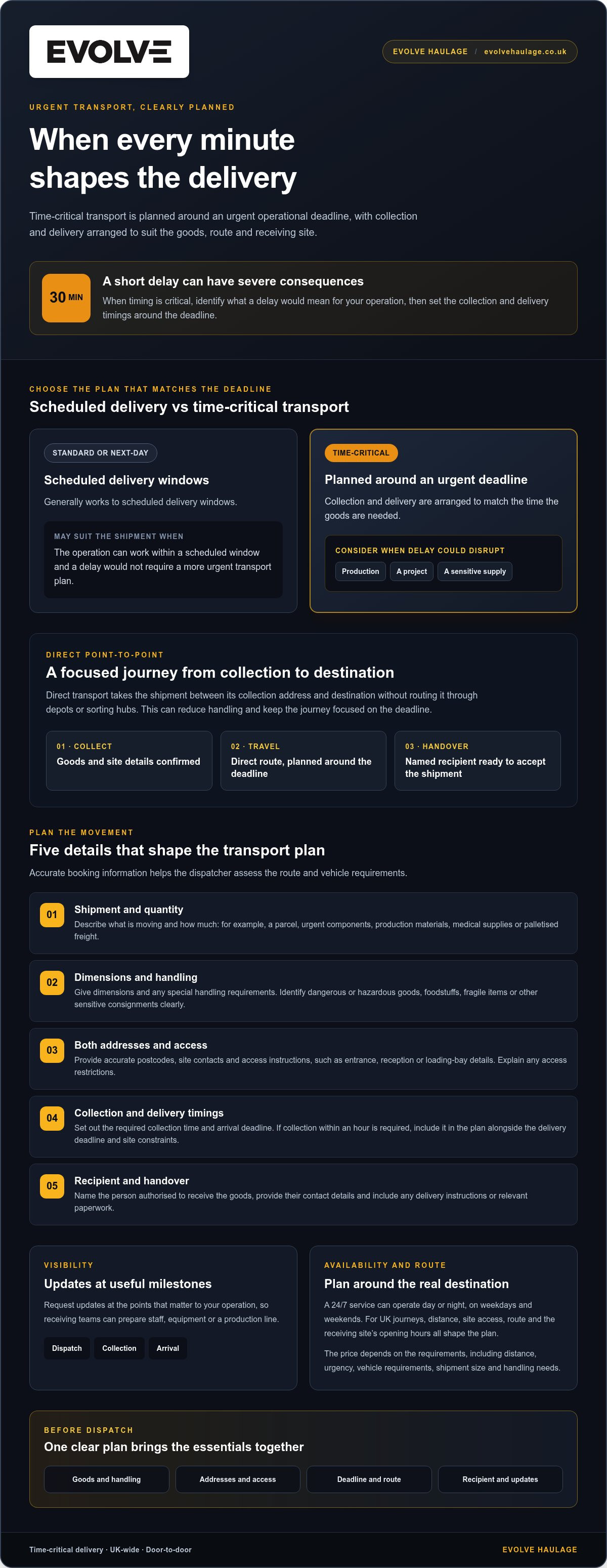
A 30-minute delay can have severe consequences when timing is critical. A time critical delivery service is designed to move urgent goods quickly and directly, helping businesses meet tight collection and delivery deadlines. It can be used for production-critical materials, urgent components, medical supplies and palletised freight.
When a shipment cannot wait for a standard delivery schedule, the right transport plan can help limit disruption, financial loss and reputational damage. This guide explains what time-critical delivery means, when it makes sense to use it and what to expect from a 24/7 UK-wide, door-to-door courier. You’ll also learn how direct delivery works and which practical details shape the service.
Key Takeaways
- Assess how a delay would affect your operation to decide whether a standard schedule is suitable or a time-sensitive transport plan is needed.
- Match the collection and delivery plan to the shipment, whether it is a parcel or palletised freight.
- Direct collection-to-delivery transport can avoid depot and sorting-hub stops when speed is essential.
- Set out the required collection and delivery times clearly so the transport plan reflects the urgency of the shipment.
- Consider how round-the-clock availability and the route affect urgent journeys across the United Kingdom with Evolve Haulage.
What is time-critical delivery and when do you need it?
A 30-minute delay can have severe consequences when timing is critical. A time-critical delivery service prioritises urgent collection and direct delivery against a defined operational deadline.
Parcel and pallet consignments
Time-critical transport can cover individual parcels, urgent components, production materials, medical supplies and palletised freight. The shipment’s dimensions, handling requirements and collection point all shape the vehicle and route plan. A small parcel of legal documents, for example, needs different loading arrangements from a pallet of production-critical parts.
Before booking, identify the shipment type and quantity, both addresses, and any special handling requirements. Give accurate access details for each site, such as the loading bay or reception point. Describe the goods clearly when arranging transport, particularly if they are dangerous or hazardous or are foodstuffs, as these can involve specific controls.
Guaranteed timings and delivery updates
Some time-critical services can offer guaranteed collection and delivery times. Agree the required time windows when booking, then provide site contacts and access instructions. A legal document, for example, may need a carefully planned journey to reach a court or regulatory body within an hour.
Request updates at the milestones that matter to your operation, such as dispatch, collection and arrival. These updates help receiving teams prepare staff, equipment or a production line. A named contact at each end also makes it easier to resolve access issues promptly.
Standard and next-day couriers generally work to scheduled delivery windows, while time-critical transport is planned around an urgent deadline. Choose a faster, more direct option when a delay could disrupt production, a project or a sensitive supply.
Insurance and liability cover depend on the policy terms, shipment type, declared value and applicable exclusions. Review the details when booking, especially for fragile, valuable or sensitive goods, so the cover aligns with the consignment.
To arrange a collection, give the courier a description of the goods, their dimensions, both addresses, access information and the delivery deadline. The dispatcher can then assess the route and vehicle requirements. If collection within an hour is required, include that in the plan alongside the delivery deadline and any site constraints.
A missed deadline can cause operational downtime, financial loss or reputational damage. For a time-sensitive shipment, first identify the consequence of delay, then set collection and delivery timings around when the goods are needed.
So, what makes a good time-critical courier?
A good courier matches the transport plan to the deadline, shipment and collection points. For UK journeys, planning must account for distance, site access and the receiving team’s schedule. Provide accurate postcodes and explain access restrictions before dispatch, so the dispatcher can organise the movement and respond if circumstances change.
Direct point-to-point transport takes a shipment from its collection address to its destination without routing it through depots or sorting hubs. This can reduce handling and keep the journey focused on the deadline. For example, urgent production parts travelling between UK sites can go directly to the receiving facility, where a named contact is ready to accept them.
Legal and financial documents need controlled handling and a clearly identified recipient. A time-critical courier can deliver legal documents to a court or regulatory body within an hour. When booking, specify the destination, the person authorised to receive the documents and any delivery instructions. For financial paperwork, identify the relevant department or recipient to make the handover clear.
For urgent transport across the UK, the collection time, route and receiving site’s opening hours all shape the plan. Include accurate postcodes, contact details, goods information and the required arrival time in the booking. For a business site, provide entrance or loading-bay details too. These practical details help plan the journey around the actual destination.
Transporting cremated remains requires care and respectful handling. Set out the collection and delivery arrangements, identify the receiving person, and provide relevant handling instructions or accompanying paperwork. Clear arrangements help ensure a controlled handover and appropriate handling throughout the journey, especially when family members or funeral professionals are coordinating the collection.
What affects the price of an urgent courier delivery? The price depends on the requirements and is provided after a quote request. Key factors include distance, urgency, vehicle requirements, shipment size and handling needs. A direct journey and a longer route may require different transport arrangements.
What items are restricted or unsuitable for time-critical courier services? Dangerous or hazardous goods and foodstuffs can involve specific controls; UK Government guidance highlights these considerations for express delivery operations. Describe the goods accurately during booking, including any sensitive handling requirements, so the transport plan accounts for them.
Before booking, bring together the shipment details, collection and delivery addresses, deadline, recipient and handling instructions. For an urgent UK movement, UK transport planning can help frame requirements around the route and consignment.
24/7 UK-wide availability
A 24/7 courier service can operate day or night, including weekdays and weekends. That availability matters when a consignment must move outside normal business hours. For example, a production site facing a parts shortage overnight may need urgent transport before its next shift begins. The collection time, destination and delivery deadline shape the plan.
UK-wide service means urgent journeys can be arranged between locations across the country. A route between distant business sites needs practical planning around distance, access and the receiving team’s schedule. Share full postcodes and site contacts when booking, so the plan reflects the actual collection and delivery points. Accurate details also help distinguish the correct premises when addresses or entrances are similar.
A service operating around the clock still depends on clear instructions. Before arranging a collection, prepare the consignment description, dimensions, handling requirements and delivery contact. A named contact at each address helps the driver find the right loading area or recipient, particularly when staffing is reduced outside daytime hours.
For a critical courier movement, agree the deadline and explain the operational reason behind it. A replacement component needed to restart a production line has a different priority from routine stock replenishment. Explain when the goods are needed and whether the receiver can accept delivery overnight or at weekends. This helps the logistics team plan a suitable collection and route.
Keep the booking, agreed timings and delivery instructions somewhere colleagues can access them. If your operation uses internal tracking, record the consignment reference and the people responsible for sending and receiving it. This creates a clear audit trail across shifts without relying on one person to be available throughout the journey.
An out-of-hours delivery needs a receiving plan as well as a vehicle plan. Confirm who can accept the goods, where the driver should report and how to access the site. A warehouse with a locked gate, for instance, may need an authorised night contact. Sharing these instructions before collection can prevent avoidable delays at the destination.
Use this sequence to prepare an urgent UK journey:
- Set the required collection and arrival times.
- Provide accurate addresses, postcodes and site access details.
- Name contacts for both collection and delivery.
- Describe the consignment and any sensitive handling needs.
- Keep the booking record and delivery information accessible to relevant teams.
A round-the-clock service is most useful when a shipment cannot wait until the next working day. Aligning the collection window, driver access and receiving arrangements makes the journey workable, whether it starts overnight, at the weekend or during normal business hours.
Dedicated door-to-door delivery
A dedicated journey carries one shipment per vehicle, directly from collection to delivery, without routing through depots or sorting hubs. This can suit critical transport when a production component, medical supply or sensitive consignment needs a focused journey. Agree the handover points with the sender and recipient before booking.
Door-to-door describes the collection and delivery arrangement, not simply the vehicle’s speed. The collection point might be a supplier’s loading bay, while the destination could be a hospital receiving area or business premises. Give the courier the correct entrance, site contact and access instructions. A precise address helps the driver reach the intended handover point.
A dedicated express courier service can help avoid an unwanted handling stage at an intermediate sorting hub. For example, a replacement machine part can travel directly from its supplier to the factory that needs it. The vehicle carries that shipment alone rather than sharing its route with another customer’s goods.
A dedicated vehicle is not necessary for every parcel. Compare the impact of delay with the benefit of a direct journey. Routine stock with a flexible arrival window may fit a standard delivery schedule, while a part needed to restart production may call for dedicated transport. The key question is whether the deadline justifies a journey arranged around that consignment alone.
Before booking, prepare the details that make a door-to-door plan workable:
- Give the full collection and delivery addresses, including site entrances.
- Describe the goods, their dimensions and any sensitive handling needs.
- Set out the required collection and delivery times.
- Name the people responsible for releasing and receiving the shipment.
- Share site access arrangements, such as reception or loading-bay instructions.
Medical supplies and production-critical components can have different handling and receiving requirements. State whether the goods need careful positioning, a named recipient or a particular handover process. This gives the transport team practical information for planning collection and delivery without relying on assumptions about the contents or destination.
A dedicated door-to-door movement also clarifies responsibility at each handover. The sender prepares the shipment, the driver collects it, and the named recipient accepts it at the destination. For a time-sensitive consignment, align these steps with site access and operating hours. This helps avoid a vehicle arriving when nobody can release or receive the goods.
Definition of time-critical delivery
Time-critical delivery is transport planned around a deadline where lateness could disrupt an operation. The defining feature is not simply speed, but the shipment’s importance at a particular time and place. A replacement component needed before a production line restarts is time-critical. Routine stock with a flexible arrival window usually is not.
A practical test is to identify what happens if the goods arrive late. If a missed handover could stop work, delay a project or affect a sensitive supply, the delivery may need priority planning. A delay of 30 minutes can have severe consequences in sectors where timing is critical. That makes the business impact, rather than the label “urgent”, central to the decision.
A time critical delivery service organises collection, route and arrival around the stated need. The dispatcher needs a description of the goods, collection and delivery addresses, access details and the required arrival time. This information helps determine whether same-day transport, a dedicated vehicle or another arrangement suits the consignment.
“Nationwide” describes the reach of a transport network, not a promise that every route takes the same time. A journey between nearby business sites differs from a cross-country movement. The route, collection readiness, site access and recipient’s operating hours all affect the plan. Give the courier accurate postcodes and explain when the goods must be available.
Direct transport is another useful part of the definition. Time-critical shipments can travel from collection to destination without being routed through depots or sorting hubs. This lets a critical courier service focus the journey on one delivery requirement rather than follow a standard network’s scheduled sequence of stops.
Time-critical does not mean every item needs an express vehicle. Weigh the consequence of delay against the urgency to decide whether a dedicated movement is proportionate. A production-critical part may justify direct transport, while replenishment for a well-stocked site may not. This helps businesses reserve urgent logistics for shipments that genuinely need it.
Use these questions to define the requirement before booking:
- What operational event depends on this shipment?
- By what time must the recipient have it?
- Can the collection site release it immediately?
- Who will receive it and manage the handover?
- Would a delay cause downtime, financial loss or reputational damage?
Clear answers turn “urgent” into a workable transport brief. For a deadline-led UK movement, arrange time-sensitive transport around the shipment, route and required arrival time.
Evolve Haulage: Haulage Service
Evolve Haulage provides haulage and time-critical same-day delivery for businesses moving urgent goods across the UK. Its 24/7 delivery solutions support shipments that need transport outside standard schedules, whilst transport management helps organise day-to-day logistics. Turn to Evolve Haulage when a deadline-sensitive consignment needs a clear transport plan, or when ongoing logistics operations need structured management. Consultancy is also available for businesses seeking support with transport planning. Share the shipment requirements, collection and delivery details, and the deadline to explain the task clearly. This gives the conversation a practical starting point, whether the need is a single urgent movement or broader transport support. To discuss your requirements, visit Evolve Haulage online.
Make your next delivery decision with confidence
The next step is to turn urgency into a clear operational brief. Decide what the shipment needs to achieve, who will receive it and how transport should fit into your wider logistics. This helps your team align its plans before the consignment moves, rather than treating urgent transport as a last-minute exception.
Evolve Haulage provides haulage, transport management and consultancy services. These help businesses arrange freight movements or organise their transport operations more effectively. Explain your main requirement, whether you need to move a specific load or improve how transport is managed.
A clear conversation can help establish a practical direction for your transport needs. If you’re considering a time critical delivery service for an upcoming shipment, contact Evolve Haulage about urgent delivery to discuss the next step. A well-defined brief gives your team a stronger starting point for planning with confidence.
Frequently Asked Questions
Do you provide proof of on-time delivery?
Proof of delivery records the handover; it does not, by itself, establish that the shipment arrived on time. For a commercial consignment, keep the delivery record with the order or job file and note who accepted the goods. Agree what evidence your process needs before dispatch, such as a signed receipt or an internal handover entry. This gives colleagues a practical reference when closing the shipment in their systems.
What is a time-critical delivery service?
A time-critical delivery service is transport arranged around a deadline that matters to a business operation. The deadline might relate to a planned installation, production schedule or document submission. What matters is the consequence of lateness, not simply describing the goods as urgent. Before booking, identify what depends on the shipment, when it is needed and who will receive it. These details define the transport requirement.
Which UK couriers offer same-day and urgent delivery?
Evolve Haulage offers same-day delivery and 24/7 transport for time-sensitive consignments across the UK. Its haulage service supports commercial freight, while transport management helps businesses organise day-to-day logistics. For example, a business with an urgent load can provide its shipment details and delivery deadline to outline the requirement. Compare the service needed with the freight, destination and operational priority when deciding how to arrange delivery.
How quickly can time-critical deliveries be collected and delivered?
Same-day collection and delivery are available for urgent shipments, with timing shaped by the route and collection readiness. The vehicle plan also depends on accurate addresses, site access and a recipient who can accept the goods. A consignment ready at a staffed loading point has different practical requirements from one still being prepared. Set the arrival deadline first, then provide the details needed to plan the journey.
How do I book a time-critical delivery in the UK?
To book a time critical delivery service, prepare both postcodes, a description of the goods, the required arrival time and site contact details. Include dimensions, loading arrangements and handling instructions, such as a restricted entrance or a receiving-area procedure. Explain why the deadline matters, so the urgency is clear. Keep the booking reference with the shipment paperwork and ensure collection and receiving contacts understand their responsibilities.
What vehicle and delivery options are available for urgent shipments?
The vehicle plan should match the freight’s size, quantity, loading needs and route. Evolve Haulage handles dedicated full and partial freight loads, with arrangements shaped around the consignment. A business shipping palletised components should provide load details and collection access; a smaller urgent shipment also needs an accurate description. Clear information helps establish a suitable haulage arrangement without assuming every load needs the same vehicle.
How can I track a time-critical delivery and get proof of delivery?
Tracking information and proof of delivery serve different purposes: one records shipment progress, while the other documents the handover. Keep the consignment reference available to colleagues handling the movement, and record the recipient and delivery outcome in your internal system. If a receiving department needs a particular record format, include that in the delivery instructions. This helps your team reconcile the goods with the original order.
What should I check when choosing a time-critical courier in the UK?
Match the transport arrangement to your freight, deadline and destination. Check that the collection and delivery points, shipment type and receiving arrangements suit the operational need. Evolve Haulage provides commercial haulage, transport management and consultancy. Consider whether you need support with a single urgent movement or with organising transport operations more broadly. Share a clear brief to identify the right fit.


