

A transport audit can uncover issues that routine operational reviews miss. Although a transport audit for businesses in the UK is not mandatory, it can help operators assess compliance, spot inefficiencies and identify potential savings. For manufacturers, retailers and logistics providers, reviewing transport operations can also support better planning and more consistent service.
An effective audit goes beyond paperwork: it connects compliance requirements with vehicles, drivers and everyday processes. This article explains what an audit can assess, the benefits it may offer and how findings can lead to practical recommendations. It also shows how to shape the review around your operation, rather than relying on a generic checklist.
Key Takeaways
- Understand which compliance, maintenance and operational records an audit can review, and how the sample can be tailored to fleet size.
- See how reviewing driver, vehicle and trailer records can reveal risks and opportunities to improve day-to-day transport management.
- Learn how findings can inform practical recommendations on processes, maintenance and efficiency.
- Explore how audit priorities can differ across manufacturing, retail and logistics operations, helping keep a review relevant to the business.
Legal compliance and operational efficiency
A transport audit reviews compliance alongside the processes that shape daily operations. It can flag gaps in records and inefficient practices before they disrupt service.
Transport Audit Requirements
UK businesses are not legally required to have transport audits. However, operators with an Operator Licence remain responsible for meeting its undertakings and maintaining compliant operations. An external assessment can compare management procedures with those undertakings and DVSA guidance, helping identify where controls need attention.
Vehicle records are a practical starting point: according to the Driver and Vehicle Standards Agency, UK transport operators should keep vehicle maintenance records covering the last 15 months. Financial statements can also support checks of financial standing: standard national or international licence holders need £8,000 for the first vehicle and £4,500 for each additional vehicle. Businesses may avoid audits because of staff time, implementation costs or concern about disruption, but a defined review can focus on priority risks.
Tachograph and Drivers’ Hours Checks
A professional assessment examines whether tachograph data is collected and analysed, not just stored. It can compare recorded activity with drivers’ hours requirements and flag missing records, patterns that need attention or inconsistent procedures.
Reviewers also consider how the business acts on findings. For example, recurring gaps in data analysis may indicate that responsibilities or reporting processes need clarifying. Addressing these issues can strengthen compliance oversight and help managers understand how driving schedules affect operational efficiency.
How a professional carries out a transport audit for your business
Start by agreeing the audit’s scope, objectives and required records. A professional can then review compliance documentation, vehicle maintenance files, tachograph information, invoices and shipping logs, selecting a sample suited to the operation.
The auditor then assesses procedures against relevant obligations and looks for evidence of gaps or inefficient processes. Findings are prioritised by risk and operational impact, then turned into practical recommendations, such as improving record controls or reviewing maintenance schedules.
The business receives a clear account of the findings and proposed actions. To limit disruption, the review considers staff time and implementation demands alongside compliance priorities, so actions can be planned and assigned effectively.
What are the benefits of having an Audit or Review?
UK transport operators must meet applicable vehicle, drivers’ hours and operator licensing requirements. An audit can assess how those duties are reflected in fleet records, driver management and everyday practice.
Vehicle, Trailer and Driver Records
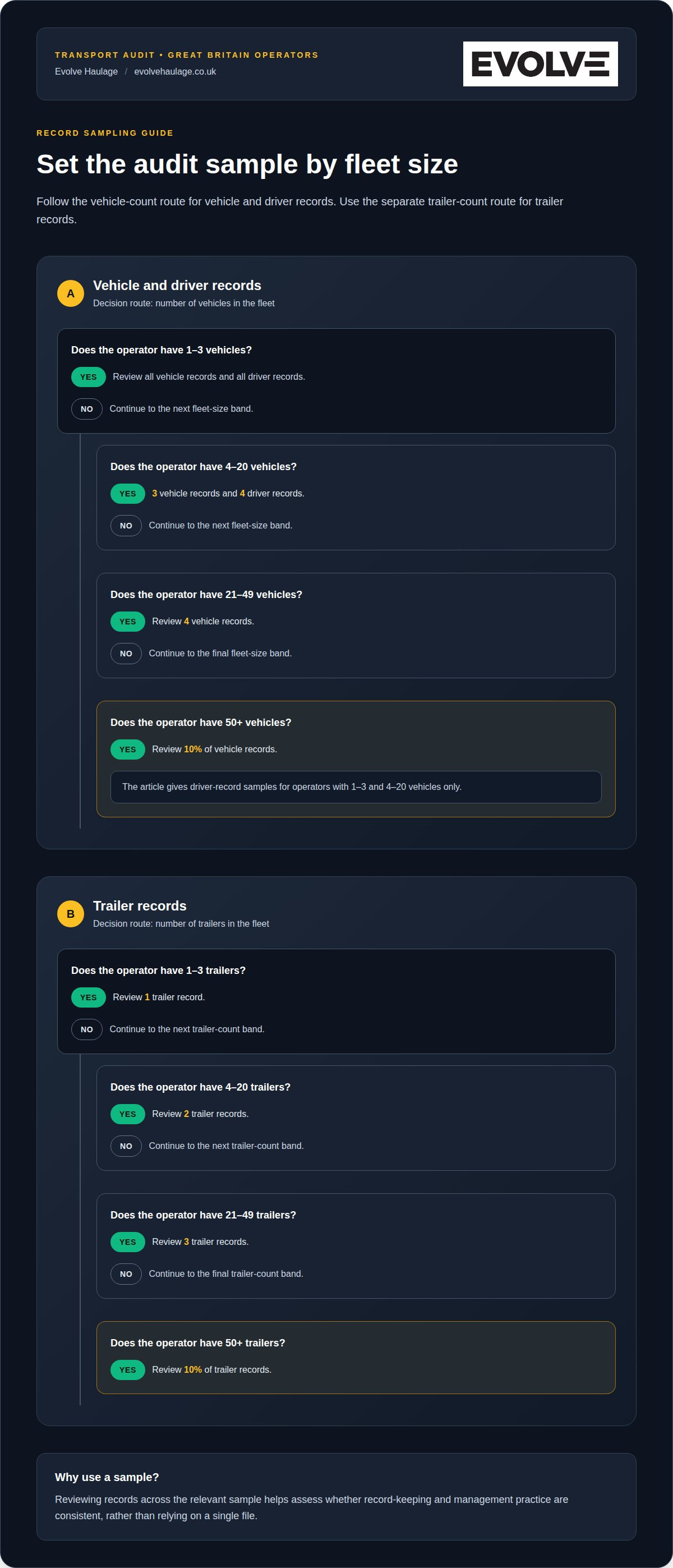
For Great Britain operators, the vehicle record sample varies by fleet size: check all records for 1-3 vehicles, 3 for 4-20 vehicles, 4 for 21-49 vehicles, and 10% for 50+ vehicles. Trailer samples are 1 for 1-3 trailers, 2 for 4-20 trailers, 3 for 21-49 trailers, and 10% for 50+ trailers.
Driver samples are all driver records for operators with 1-3 vehicles, and 4 driver records for those with 4-20 vehicles. Reviewing these samples helps assess whether record-keeping and management practice are consistent, rather than relying on a single file.
Drivers’ Hours, Working Time and Routing
An audit can review drivers’ hours records alongside tachograph data and the processes used to analyse it. This can reveal compliance gaps and whether schedules and routing support drivers’ hours limits.
Route planning and vehicle utilisation also affect operating efficiency. For example, comparing planned routes with operational records can highlight avoidable delays or underused vehicles. Managers can use these findings to refine schedules while keeping regulatory responsibilities in view.
Driver management is another important area. A review can consider recruitment processes, driver competence, risk management and driving-for-work responsibilities. Practical driving assessments may identify risks such as speeding, harsh braking or excessive idling, and provide feedback to improve driving standards.
If a review identifies a knowledge gap, refresher training can reinforce best practice and company procedures. Driver CPC training may also form part of corrective action after an audit. Linking training to observed behaviour helps managers focus development where it can support safe, compliant operations.
To connect audit findings with day-to-day processes, explore transport management support.
Audit findings and recommendations
A professional audit turns operational evidence into prioritised findings. It can show organisations which risks need action and where processes can work more efficiently.
Common Transport Audit Risks
Auditors assess whether the information collected is complete and useful. Missing invoices, shipping logs or maintenance records can obscure billing errors, inefficient practices and recurring costs. Incomplete data is a common weakness because it limits the reliability of conclusions.
Auditors can also examine accident reports, driver behaviour and vehicle maintenance schedules. For example, repeated harsh braking or unnecessary idling may point to driving practices worth reviewing. A useful assessment connects these observations to fleet efficiency and the needs of the operation.
Compliance Failures to Check
Compliance checks can identify gaps in operator licensing, tachograph analysis, drivers’ hours records and vehicle maintenance documentation. Hired vehicles still require appropriate maintenance, so an audit should assess how responsibilities are managed and documented.
Non-compliance can lead to penalties, licence restrictions or revocation. Three unsatisfactory OCRS scores can put a UK transport business at risk. Enforcement officers can access compliance ratings based on past roadside checks, so consistent record management matters between inspections.
Each recommendation should link a finding to a clear corrective action. If invoices reveal billing errors, the auditor can identify which processes need review. If maintenance schedules appear inefficient, the review can assess whether planned work aligns with fleet requirements. This helps organisations direct resources to specific issues rather than making broad changes.
Data analysis can also inform operational improvements. An auditor can use collected records to identify opportunities in route planning or vehicle utilisation, then set out practical changes for managers to consider. Eco-driving training may help reduce fuel use and unnecessary vehicle wear. Recommendations should explain the supporting evidence, priority and how progress can be monitored.
Audit services across transport and logistics industries
Manufacturers, retailers and logistics providers use transport differently, so audit scope should reflect the operation. The right review connects compliance evidence with the practical demands of moving goods.
Comparing Transport Audit Providers
When choosing an audit provider, consider their understanding of operator licence obligations, vehicle maintenance, tachograph processes and your operational context. A useful assessment defines its scope, explains how evidence will be reviewed and presents findings as practical actions, not just observations.
ISO 9001:2015 certification can indicate an audit provider’s qualifications, but it isn’t mandatory. Also consider whether the proposed review addresses your business model: a manufacturer’s delivery fleet may need different attention from a logistics provider managing varied transport tasks.
Transport Audit Costs
There isn’t one fixed cost for a UK transport audit. The price depends on the case and is given after a quote request; key factors include organisational size, operational complexity and the review’s scope.
Costs may also involve specialist auditors, software and internal staff resources. A focused review of tachograph processes differs from a broader assessment covering vehicle records, driver procedures and site operations. Defining the required coverage helps clarify the resources involved.
Business Transport Audit Coverage
A business transport audit can examine Operator Licence commitments, maintenance systems, driver records, tachograph data and route planning. It may also review accident reports, vehicle utilisation and how transport procedures support deliveries.
Industry context shapes the focus. A manufacturer may assess how transport supports outbound deliveries; a retailer may review vehicle use across distribution activity. A logistics provider may need a wider view of record-keeping, driver processes and operational controls.
Across these sectors, a valuable audit shows how evidence connects to everyday practice. The auditor can map findings to specific responsibilities and recommend workable improvements for the organisation. This makes the outcome useful to both managers overseeing compliance and teams running transport operations.
For support aligning transport processes with operational needs, discuss transport management.
Evolve Haulage: Transport Management
Evolve Haulage provides transport management for businesses looking to strengthen day-to-day logistics after reviewing audit findings. Its consultancy service can help organisations consider how recommendations fit their transport processes and operational priorities.
This support is relevant when findings highlight areas for improvement in transport management or when logistics responsibilities need a more structured approach. Evolve Haulage’s haulage services can also support the movement of goods as part of your transport operations.
Contact Evolve Haulage to discuss how transport management or consultancy could support your business.
Turn audit insight into your next operational step
A review is most useful when its recommendations become part of everyday decision-making. Treat the findings as a starting point: assign responsibility, set priorities and revisit actions as your transport operation changes. This helps keep compliance and efficiency aligned with how your business runs.
A transport audit for businesses can also clarify what support is needed to put improvements into practice. Evolve Haulage offers transport management, consultancy and haulage services to support businesses’ operational requirements.
If you’re ready to discuss your transport requirements and the practical next step, contact Evolve Haulage about an audit. A focused conversation can help you move from findings towards a considered plan for your business.
Frequently Asked Questions
What is a transport audit for a business in the UK?
A transport audit is a structured review of how a business manages transport compliance, records and operations. It can assess whether documented procedures match everyday practice, such as how managers handle a vehicle defect or review a delivery schedule. The useful outcome is a clear view of risks and processes to improve, not a pass-or-fail label.
What documents and data are needed for a fleet transport audit?
Useful evidence includes vehicle maintenance files, inspection records, driver documentation, tachograph data, invoices, shipping logs and accident reports. The records required depend on the audit’s scope. For example, a review focused on delivery efficiency may need route and vehicle-use information, while a compliance assessment will examine records relevant to operator responsibilities. Organised, dated records help an auditor trace how procedures work in practice.
How can a transport audit reduce fleet costs, emissions and road risk?
An audit can identify billing errors, inefficient practices, unnecessary idling and vehicle wear, giving managers evidence for targeted changes. Reviewing route planning and vehicle use may reveal opportunities to organise journeys more effectively. Assessing accident reports and driver behaviour can also highlight road-risk concerns. These findings can support lower fuel use and reduced wear, though emissions outcomes depend on which changes are implemented.
Are there UK-specific transport audit grants, standards or local requirements?
Transport audits are not mandatory in the UK, but operators must manage their relevant compliance obligations. Reviews can consider Operator Licence undertakings, DVSA guidance, Department for Transport guidelines and relevant industry standards. Grant support is separate from audit requirements; eligibility depends on the particular funding scheme and its criteria. Requirements may also vary with the activity and location, so assess the rules that apply to each operation.


