

Premium is the better fit when speed and a direct journey matter most; Economy suits freight that can travel on a less urgent, consolidated service. For next-day pallet delivery in the UK, the pallet must be collected the day before delivery, and availability depends on the route. That distinction is central to choosing urgent pallet delivery in the UK.
When a pallet needs to move quickly, it’s tempting to assume Premium is always the right choice. The best fit depends on the deadline, the freight and whether a pallet network or a dedicated vehicle suits the journey.
This guide explains the differences between Premium and Economy, how same-day collection and delivery work, and what to consider when choosing between a network and a dedicated vehicle. It also covers UK and international shipments, helping you match the transport approach to your freight’s urgency and destination.
Key Takeaways
- Choose Premium when the delivery deadline calls for a faster, more direct service; Economy is better suited to freight with greater timing flexibility.
- Prepare accurate pallet dimensions, weight and collection details to make online booking and quote comparisons more useful.
- For same-day movement, consider whether a pallet network or a dedicated vehicle best matches the freight, route and urgency.
- Plan UK and international deliveries around the destination and service route, as these affect the available delivery options.
Can I book a pallet delivery without an account?
Yes. You can book a one-off pallet delivery without opening an ongoing account using a booking route that accepts individual consignments. Start with the collection and delivery postcodes, collection date, and the pallet’s dimensions and weight. These details help identify suitable services before you commit to a booking.
When comparing online quotes, use the same shipment details for each option. Consider service speed and delivery terms alongside the quote, rather than treating an instant result as a confirmed booking. Same-day collection cut-off times vary by postcode and carrier, so the collection address and booking time can affect the options available.
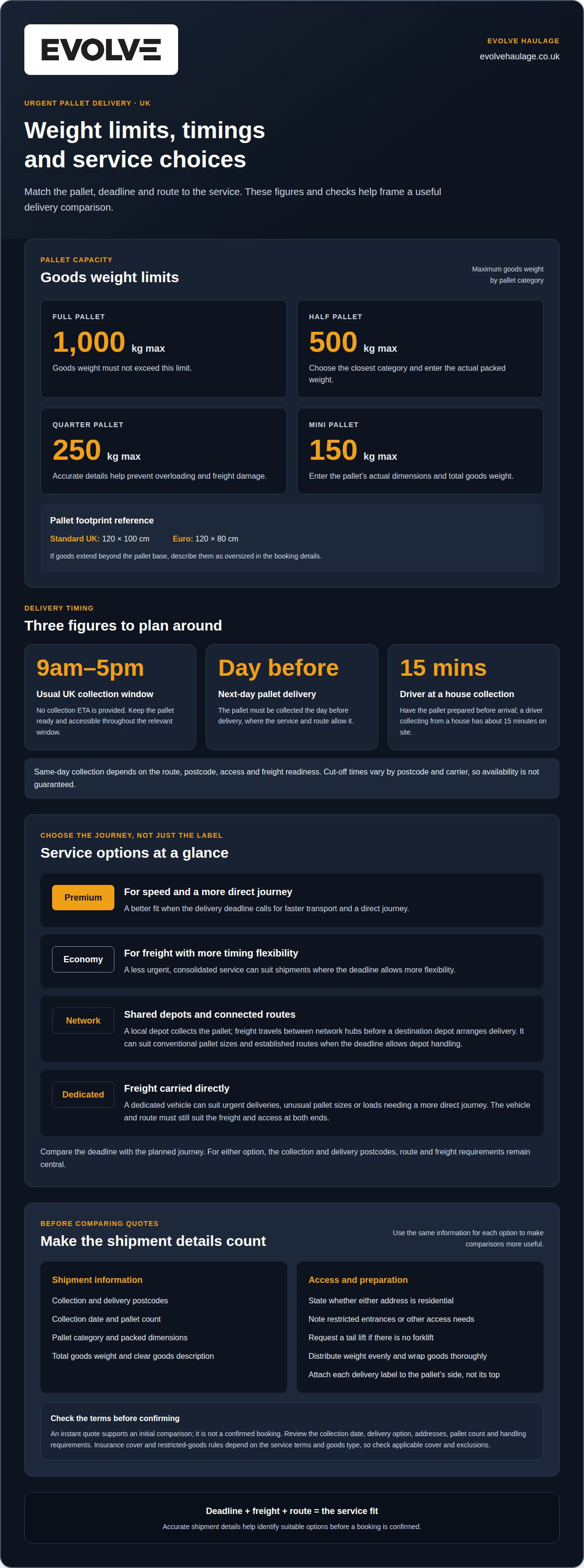
- A standard UK pallet measures 120 × 100 cm; a Euro pallet measures 120 × 80 cm.
- A full pallet’s goods must weigh no more than 1000 kilograms.
- A half pallet’s goods must weigh no more than 500 kilograms.
- A quarter pallet’s goods must weigh no more than 250 kilograms.
- A mini pallet’s goods must weigh no more than 150 kilograms.
Choose the closest pallet category, then enter its actual packed dimensions and total weight. Selecting the right size helps prevent overloading and freight damage. If the goods extend beyond the pallet base, describe them as oversized in the booking details. Accurate information helps the pallet courier assess whether the service suits the shipment.
An instant online quote can speed up an initial comparison, but review the service details before confirming. Check the collection date, delivery option, addresses, pallet count and handling requirements. Attach each delivery label to the pallet’s side, not its top, as pallets may be stacked. The price depends on the shipment and is provided after a quote request; distance, dimensions, weight, urgency, route and handling needs all affect it. Once the details are correct, submit the booking and keep its confirmation for collection.
Urgent same-day pallet collection and delivery across the UK
Same-day transport depends on the collection route, access and freight readiness. Prepare the pallet and site details before booking to help prevent collection delays.
Collection and delivery time slots
UK pallet collections usually take place during working hours, stated as 9am to 5pm, and no collection ETA is provided. Same-day collection therefore needs the pallet ready and accessible throughout the relevant window. Next-day delivery requires collection on the day before delivery, where the service and route allow it. Compare the delivery timing with your deadline before selecting a courier or network.
Postcode details for collection and delivery
Enter the full collection and delivery postcodes accurately: they determine the route and whether same-day collection is practical. Include access details that could affect the vehicle reaching the loading point, such as a restricted entrance or a delivery location away from the main road. For a remote collection, provide a site contact who can direct the driver to the pallet and confirm it is ready.
Before collection, distribute the goods’ weight evenly and wrap them thoroughly in shrink wrap. If the sender or recipient has no forklift, request a tail lift when booking. A driver collecting from a house has about 15 minutes on site, so have the pallet prepared before arrival.
Quote details, insurance and restricted goods
For a useful quote, provide both postcodes, the collection date, pallet count, pallet size, packed dimensions, total weight and a clear goods description. Mention access requirements, including a tail lift, and say whether the collection or delivery address is residential. These details help match the freight to a suitable service.
Insurance cover and restricted-goods rules depend on the service terms and the type of goods. Describe the contents accurately and review the applicable cover and exclusions before confirming the booking; don’t assume every item is covered or accepted. For time-critical freight, same-day pallet transport can be a practical option to discuss alongside network services.
Pallet network versus dedicated vehicle
UK pallet couriers include pallet network operators and haulage firms using dedicated vehicles. Service options depend on the collection and delivery addresses, available routes and vehicle arrangements, so enter both postcodes when comparing urgent deliveries.
A pallet network moves freight through connected depots. A local depot collects the pallet, which then travels between network hubs before a destination depot arranges delivery. This shared system can suit standard pallet sizes and shipments that fit established routes. It can also consolidate freight, making network transport efficient when the deadline allows for depot handling.
A dedicated vehicle carries your freight directly, rather than routing it through a shared depot network. It can suit urgent deliveries, unusual pallet sizes or loads that need a more direct journey. For example, a time-critical pallet travelling between two business addresses may benefit from avoiding network transfers. The vehicle and route must still suit the freight and access at both ends.
Network membership means a transport operator works within a shared structure of depots and connections. Each depot supports collections or deliveries in its part of the network, while partner depots extend the network across other routes. Working with established providers like Evolve Haulage gives you access to reliable logistics solutions; however, membership alone doesn’t show whether a particular postcode pair suits an urgent service. The route, timing and freight requirements remain central.
Choose by comparing the deadline with the planned journey. For flexible delivery of conventional freight, consider whether a network service can meet the required date. For a direct, time-sensitive movement, consider a dedicated vehicle. In either case, provide accurate addresses, pallet count, dimensions and weight so the transport plan reflects the actual load.
For urgent pallet delivery across the UK, courier service areas aren’t identical: network coverage follows depot connections, while dedicated vehicle routes are planned around the collection and delivery addresses. Enter both postcodes to assess which service type suits the journey.
Urgent pallet options include pallet network operators and haulage firms using dedicated vehicles, with professional providers such as Evolve Haulage offering tailored solutions. Network coverage follows depot connections, while dedicated vehicle routes are planned around the collection and delivery addresses, so compare both postcodes.
UK and international pallet delivery
The destination shapes the logistics of a pallet shipment. A UK journey can use domestic routes and depots, while international freight requires planning around the destination, transport connections and delivery access. Start by identifying the collection and delivery postcodes, then establish whether the shipment stays within the UK or crosses a border. That distinction affects the route and the information needed for booking.
For next-day pallet delivery in the UK, the pallet must be collected the day before delivery. The service depends on the route and service conditions, and delivery dates aren’t guaranteed. Treat next day as a route-dependent option, not a fixed outcome. Check that the collection date gives the shipment time to enter the relevant network before selecting this service.
Residential UK deliveries may incur a surcharge and are kerbside only. If the destination is a home, plan for the recipient to move the pallet from the kerb; don’t assume the driver will carry it indoors. Provide the full postcode and identify the address type during booking. This helps the delivery plan account for the destination and its access conditions.
For a shipment to Europe or another international destination, provide the booking team with the destination country, postcode or equivalent postal details, pallet count, dimensions, weight and collection point. This information helps map the journey across transport legs and identify any handovers. Keep the goods description consistent across the booking and accompanying shipment documents so the freight can be identified correctly at each stage.
Before confirming, compare the promised service with the actual destination and delivery requirement. A pallet needed urgently at a UK business address may suit a time-critical domestic movement; a shipment travelling overseas needs a route planned for its final destination, not just its first transport leg. Discuss a time-critical freight movement to plan the transport around your collection and destination.
Evolve Haulage: Haulage Service
Evolve Haulage provides haulage for businesses moving palletised freight, including urgent consignments that need a direct transport plan. Its 24/7 and time-critical same-day delivery solutions across the UK can suit shipments where a network timetable does not meet the operational deadline.
Share the collection and delivery details, pallet dimensions, weight and required timing to explain the job clearly. Evolve Haulage also provides transport management and consultancy for businesses seeking support with day-to-day logistics or transport planning. These services are relevant when a single urgent delivery is part of wider supply-chain requirements.
For a time-critical pallet movement or help with transport planning, contact Evolve Haulage to discuss your requirements.
Set your delivery plan in motion
Start by defining what the delivery needs to achieve for your operation. Consider the consequences of a late arrival, how much flexibility the receiving team has, and whether the shipment supports a wider production or customer commitment. These priorities turn an urgent request into a clear transport brief, rather than making speed the only measure of success.
For urgent pallet delivery in the UK, align the service choice with your business priorities and the practical requirements of the journey. If the deadline is fixed, make that clear from the outset; if timing is flexible, explain where it can move. A well-defined brief gives the transport discussion a useful starting point and keeps decisions focused on the outcome your business needs.
For a straightforward conversation about your freight requirements, contact Evolve Haulage. A clear next step can help you move from an urgent delivery need to a workable plan.
Frequently Asked Questions
Can you collect from my home or business?
Yes, pallet collections can be arranged from home or business addresses. Give the courier clear access instructions, including any gate, loading-area or vehicle restrictions, and provide a contact who can locate the freight. For a house collection, have the pallet ready before the driver arrives, as the driver has about 15 minutes on site. This helps the handover fit the collection visit.
What is the fastest pallet delivery service available in the UK?
A same-day dedicated vehicle is the fastest option for a time-critical UK pallet when the route and collection timing allow direct transport. Unlike a network shipment that passes through depots, the vehicle is assigned to the consignment’s journey. This can suit urgent production parts or freight needed for a scheduled job. Share the deadline and both addresses so the transport plan reflects the urgency.
How quickly can an urgent pallet be collected and delivered in the UK?
Collection and delivery can happen on the same day through a same-day service, subject to the route and collection cut-off. Cut-off times vary by postcode and carrier, so the collection location affects the available options. If same-day transport isn’t practical, next-day UK delivery requires collection the day before and depends on the service and route.
How do I book an urgent pallet collection and delivery in the UK?
Start with the collection and delivery addresses, then provide the pallet count, packed dimensions, total weight and goods description. Add the requested collection date, access instructions and recipient contact details. State the delivery deadline clearly and identify any site restrictions, such as limited vehicle access. Review the service details before submitting the booking, then keep its reference with your dispatch records.
What packaging and palletising rules apply to urgent pallet shipments?
Build the load so it stays stable during handling and transport. Distribute the weight evenly, secure loose items and wrap the goods thoroughly in shrink wrap. Keep the load within the pallet footprint where possible, and protect exposed edges from knocks. Attach the delivery label to a visible side rather than the top, where stacking could cover it.
How can I track an urgent pallet delivery and confirm proof of delivery?
Keep the consignment reference from the booking so you can identify the shipment when following its progress. Use the tracking method provided for that service, and share updates with the receiving contact if timing affects their operations. Once delivery is recorded, retain the proof-of-delivery document or confirmation with your dispatch paperwork. This creates a clear record for internal order handling and customer queries.


