

A delivery operation can become more complex than an in-house team can manage efficiently. Understanding what a logistics partner means for your business starts with its core role: coordinating the movement of goods, transport planning and related logistics support. The right arrangement can help you meet shipping requirements without managing every transport task yourself.
A logistics partner can do more than move goods from A to B. Services vary, so focus on which parts of your operation need support, from regular transport to time-critical deliveries or day-to-day transport management.
This article explains what logistics partners do, which businesses use them and how to match a provider to your shipping and delivery needs. It also looks at the practical signs that outside support could suit your operation, helping you understand the options before deciding what role a partner should play.
Key Takeaways
- Compare a potential partner’s communication, relevant experience and ability to adapt, not just the quoted price.
- Map your goods, shipping frequency and delivery priorities to identify the transport support your operation needs.
- Consider external logistics support when coordination becomes complex or takes focus away from your core business.
- Understand the difference between providers focused on logistics services and those coordinating a wider supply chain before choosing a fit.
How do I choose the best logistics service provider?
Choose a provider whose expertise, coordination and service scope fit your supply chain over time. Compare the operational value, not simply the lowest offer.
Choosing for expertise and long-term value
Relevant experience means understanding your transport demands, handling requirements and delivery patterns. A provider familiar with similar operations may identify practical solutions beyond a low initial price. Compare its proposed services with your actual needs, and use references to understand how it has handled comparable challenges. Consider whether it can adapt as your requirements change.
In the UK, costs depend on factors such as shipment frequency, goods, transport requirements and service scope. Request a quote, then compare what each proposal includes as well as the price.
Types of logistics partner
A third-party logistics provider, or 3PL, performs logistics activities such as transportation, warehousing or fulfilment. A fourth-party logistics provider, or 4PL, takes a broader coordinating role across logistics operations and providers. The distinction matters: a business seeking transport support may need a different arrangement from one needing supply-chain coordination. Assess the activities you want to outsource and how much oversight your team intends to retain.
External support and single-provider benefits
External logistics partners may provide transport, storage, inventory management, order fulfilment and coordination. Using one provider for several relevant services can reduce the hand-offs your team manages. Outsourcing shifts selected operational tasks to a partner, while your team oversees the relationship and performance. Risks include communication gaps and delivery disruption. Define responsibilities, escalation routes and reporting to reduce them. Before operations begin, document current processes, agree the service scope, share requirements and establish reporting.
Coordinating providers and systems
When several providers or systems handle a shipment, your business must coordinate information and responsibilities between them. Delayed updates or mismatched records can complicate delivery decisions, so define who owns each hand-off and how teams share shipment information. A UK logistics agreement should set out the service scope, responsibilities, reporting, communication and issue escalation. Include the pricing basis and review process so both parties understand how performance and changing requirements will be managed.
Identifying shipping and delivery requirements
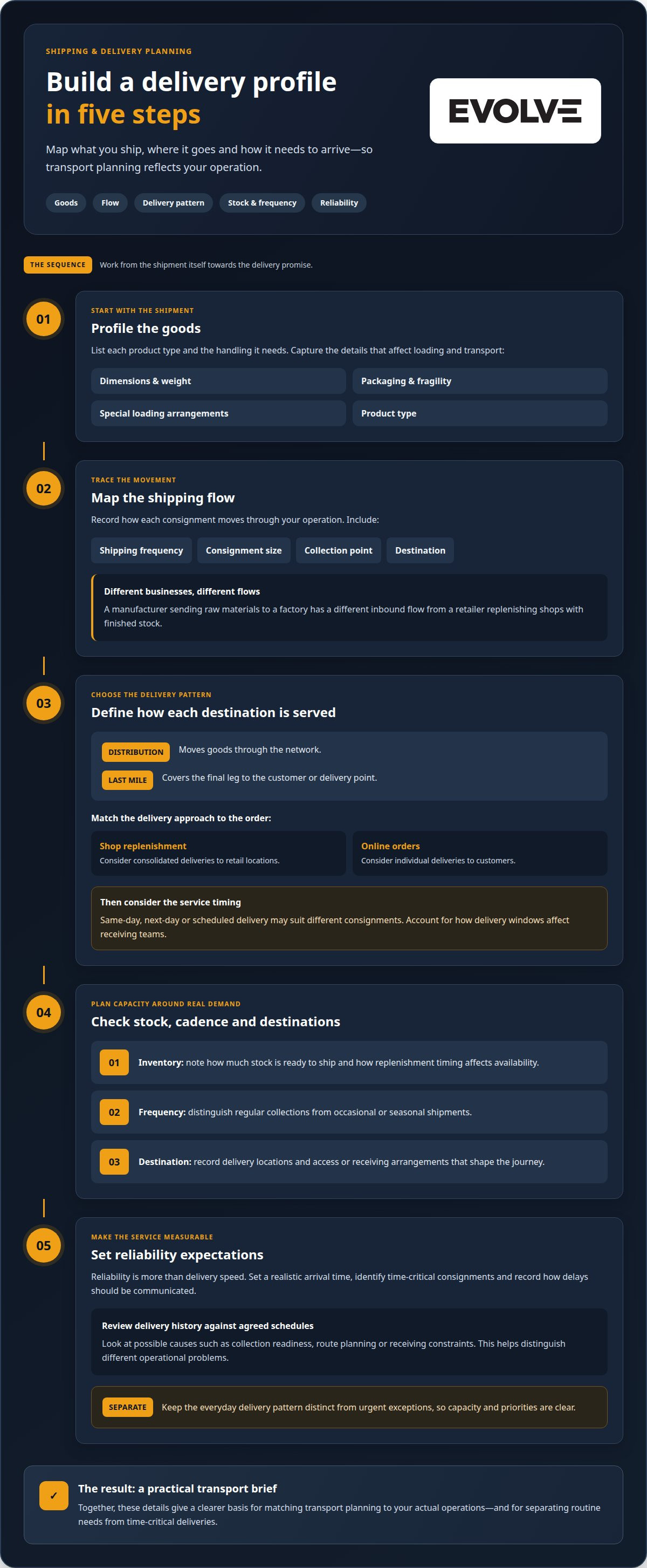
Start by listing each product type and its handling needs. Record dimensions, weight, packaging, fragility and any special loading arrangements. Then map shipping frequency, consignment size, collection point and destination. For example, a manufacturer sending raw materials to a factory has different inbound flows from a retailer replenishing shops with finished stock. This profile helps match transport planning to your actual operations.
Next, identify the delivery pattern each destination requires. Distribution moves goods through the network, while last-mile delivery covers the final leg to the customer or delivery point. A business supplying shops might plan consolidated deliveries to retail locations; an online seller may need individual orders delivered to customers. Consider whether same-day, next-day or scheduled delivery suits each consignment, and how delivery windows affect receiving teams.
- Inventory: note how much stock is ready to ship and how replenishment timing affects availability.
- Frequency: distinguish regular collections from occasional or seasonal shipments.
- Destination: record delivery locations and any access or receiving arrangements that shape the journey.
Reliability means more than choosing a delivery speed. Set a realistic arrival time, identify time-critical consignments and record how delays should be communicated. Review delivery history against agreed schedules, then consider causes such as collection readiness, route planning or receiving constraints. This gives you a clearer basis for assessing performance without treating every late arrival as the same operational problem.
Requirements can change as a business expands, adds destinations or experiences seasonal demand. Separate the everyday delivery pattern from urgent exceptions, so capacity and priorities are clear. For a time-critical consignment, same-day delivery may be relevant; for planned replenishment, a scheduled service may fit better. Businesses assessing urgent UK deliveries can explore delivery support for time-critical shipments as part of their options.
Businesses that use logistics partners
Logistics partners can suit businesses whose goods movement requires time, specialist coordination or capacity that would otherwise take staff away from core work. High shipping volume is not the only trigger. A growing business may need support when suppliers, destinations or delivery schedules become harder to coordinate. For example, a new retail channel can add store replenishment to direct customer orders, creating distinct transport demands.
Manufacturers need logistics support for both sides of production. Materials must reach factories, then finished goods must move to customers or retail sites. Delayed incoming materials can disrupt production, while a delivery bottleneck can hold finished stock. A logistics company can coordinate transport for these flows, and shipment tracking helps teams see where consignments are and plan around delays.
Retailers use logistics partners to move goods from manufacturers to shops. E-commerce businesses may need a different mix, including individual customer deliveries and capacity that can respond to changing demand. Growing fast-moving consumer goods brands can combine internal logistics teams with external partners. This allows an in-house team to retain operational oversight while using outside capacity for specific routes, shipment peaks or transport tasks.
Smaller businesses may consider outsourcing when building an internal function would add more complexity than it removes. An internal team can involve planning, warehouse operations, transport coordination, systems and data management. An external partner can take on selected activities, leaving staff more time for sales, production or customer service. The principle applies beyond freight; for example, routine business communications such as statements and customer notices can be automated through Postal Methods rather than handled manually. The choice depends on which tasks create the greatest bottleneck, not simply the number of parcels shipped.
Use complexity as a practical test. List the hand-offs between suppliers, sites and customers, then identify where delays or staff time accumulate. A manufacturer with irregular inbound materials may need different support from a retailer managing store deliveries. If the main issue is a specialist internal process, outsourcing may not solve it. The best fit addresses the actual pressure point and works alongside the responsibilities your team retains.
What types of logistics partners are available, such as 3PL and 4PL providers?
Logistics partners differ by the activities they perform and the level of coordination they take on. A carrier focuses on moving goods, while a specialist provider may support a particular transport requirement. A third-party logistics provider, or 3PL, can handle services such as transport, warehousing or order fulfilment. The right model depends on which operational responsibilities your business wants external support to manage.
A 3PL usually delivers specific logistics activities on your behalf. For example, a retailer might outsource store deliveries whilst keeping stock planning and supplier relationships in-house. A fourth-party logistics provider, or 4PL, generally takes a broader coordinating role across providers and supply-chain stages. This may suit a business that needs oversight across several transport or logistics suppliers, rather than one activity alone. For operations managing international movement and trade compliance, specialist partners like Global4PL can coordinate cross-border logistics and import requirements.
These labels describe different operating models, not a guarantee that every provider delivers the same scope. One 3PL may focus on road transport; another may combine transport with storage and fulfilment. A 4PL may coordinate multiple partners, information flows and performance reporting. Define the outcomes you need, such as moving finished goods to retailers or aligning several providers, then match the model to that work.
Some businesses use one provider for a defined service; others combine a carrier, specialist and broader coordinator. The trade-off is focused expertise versus the effort needed to manage hand-offs. A manufacturer with straightforward UK deliveries may need transport execution, while a business with complex supplier and customer flows may value wider coordination. Keep responsibility clear at each stage, especially when a provider hands goods or information to another.
Map the tasks and hand-offs you want covered before deciding which arrangement fits. For practical support aligning transport needs with a suitable service, discuss your logistics requirements.
Evolve Haulage: Haulage Service
Evolve Haulage supports businesses that need goods moved or transport operations managed. Its haulage service can suit regular freight movements, while transport management helps organise day-to-day logistics. If your operation needs to refine its approach, the consultancy service can help address transport challenges. For urgent shipments, Evolve Haulage provides 24/7 and time-critical same-day delivery solutions across the UK.
This support is most relevant when transport demand, delivery timing or logistics coordination is putting pressure on your team. Match the service to the task: haulage to move freight, transport management to coordinate operations, or consultancy to plan improvements. Share your delivery requirements and the challenge you need to solve to start a practical conversation with Evolve Haulage.
Contact Evolve Haulage to discuss your transport requirements.
Make your next logistics decision count
As your operation changes, review whether your transport arrangements still support its priorities. A new customer, delivery pattern or pressure on internal resources can change what you need from a logistics partner. Understanding what a logistics partner means for your business is an ongoing decision shaped by the work you need handled and the responsibilities you want to retain.
Evolve Haulage can support your operation with haulage, transport management and consultancy. Identify which part of your logistics operation needs attention, then start a focused conversation about your requirements. Clear priorities make it easier to discuss an approach that fits your business without adding services that do not address the challenge.
Contact Evolve Haulage about your logistics needs and take a considered next step towards transport support that fits your operation.
Frequently Asked Questions
What does a logistics partner do?
A logistics partner helps organise the movement of goods and related transport activities. This could mean planning collections from suppliers, arranging freight to a distribution point and coordinating delivery information with your team. The arrangement can cover selected tasks or broader operational support. Your business retains the responsibilities agreed between both parties, so clear ownership matters whenever a shipment changes hands.
What are logistics services and how can they benefit your business?
Logistics services help move goods through a business’s supply chain, from collection and transport to delivery coordination. They can give staff more time for production, sales or customer service. For example, a business facing a sudden increase in orders could use external transport capacity rather than divert its team from fulfilment planning.
What’s a logistics company?
A logistics company carries out transport or other logistics activities for organisations. Its role can range from moving a consignment between two locations to supporting several connected operational tasks. A company becomes a partner through an ongoing working relationship, where both sides agree on responsibilities, communication and service expectations rather than treating each shipment as an isolated transaction.
What is a logistics partner and what services do they provide?
A logistics partner is an external provider that supports a business’s goods movement and related operations. Depending on the agreement, services can include road freight, transport planning, order fulfilment or supply-chain coordination. For instance, a business might outsource deliveries but keep stock decisions in-house. The key is the agreed scope: which tasks the provider performs and which remain with your team.
How can a logistics partner benefit a UK business?
Understanding what a logistics partner means for your business starts with identifying the pressure it should relieve. A UK wholesaler expanding its customer base, for example, may need to coordinate more delivery destinations without adding every transport task to existing roles. External support can provide operational capacity and let teams focus on core work, provided responsibilities and communication are clearly aligned.
How do you choose the right logistics partner for your business?
Choose a logistics partner by matching its scope to the operational problem you need to solve. Before deciding, write down the goods involved, the hand-offs causing difficulty and the outcomes your team needs. Then compare how each proposed arrangement handles exceptions, delivery changes and routine updates. A suitable partner makes responsibilities clear and works alongside the processes your business intends to retain.


