

A 24/7 haulage service provides UK collection and delivery around the clock, with time-critical same-day options for urgent consignments. It helps businesses move goods when standard daytime schedules don’t fit, whether a delivery is planned or needs a faster response.
When an important load is delayed, the knock-on effects can reach customers, production schedules and day-to-day operations. Around-the-clock transport gives businesses another way to keep goods moving beyond conventional working hours, while the right service depends on the load, collection point, destination and delivery deadline.
This guide explains how UK haulage and courier services work, what information to prepare when booking, and which factors affect the cost. It also covers practical uses across industries and how to decide between a one-off urgent delivery and an ongoing transport arrangement.
Key Takeaways
- Prepare clear collection and delivery details, plus the load’s size and handling needs, to make a booking more straightforward.
- Round-the-clock transport can help businesses respond to urgent consignments and delivery schedules outside standard working hours.
- Assess how timely transport could support your operation, from keeping production moving to meeting customer delivery requirements.
- Understand which job details shape an out-of-hours quote, including the route, timing and nature of the load.
- Compare one-off delivery needs with ongoing transport management to identify the approach that best fits your logistics.
Haulage booking and delivery process
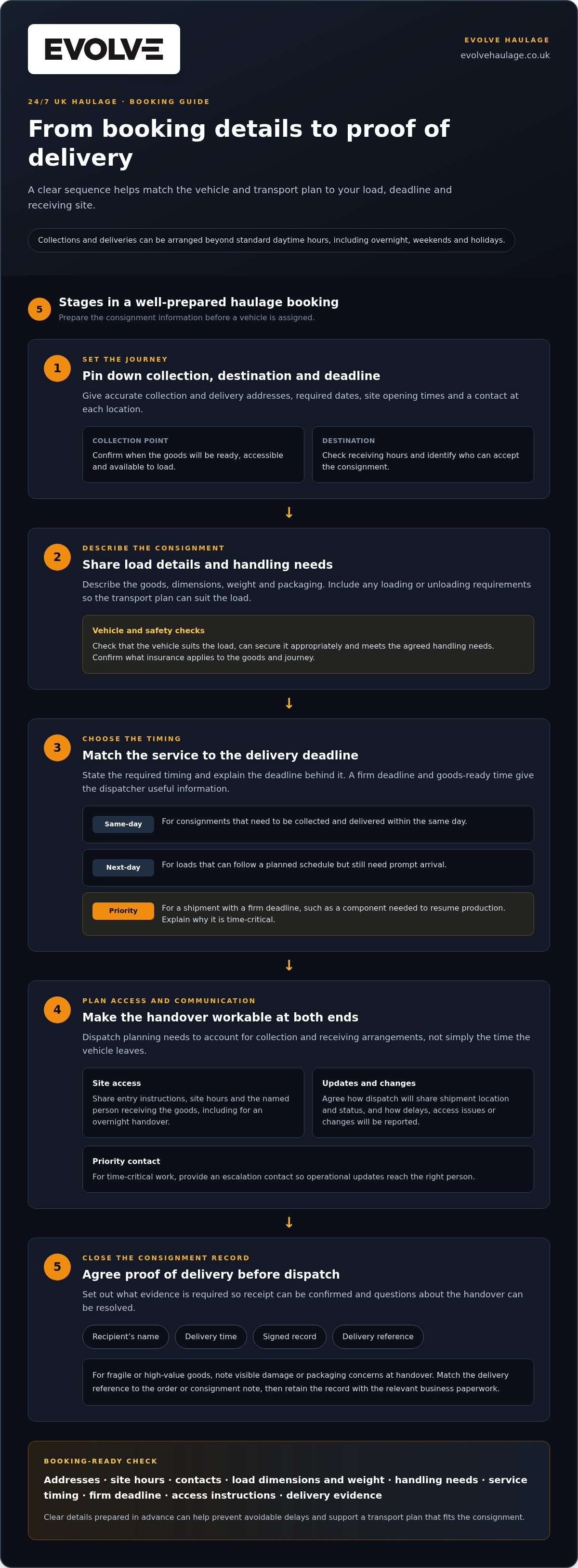
Start with four essentials: collection point, destination, load details and delivery deadline. Before booking, consider whether the vehicle suits the load, how it will be secured, what insurance applies, and how you will receive updates if plans change.
Same-day and next-day delivery
Same-day delivery is for consignments that need to be collected and delivered within the same day. Next-day transport suits loads that can follow a planned schedule but still need prompt arrival. The route, collection readiness and delivery window shape the plan. When booking, provide accurate addresses, site opening times and load dimensions.
Priority and time-critical deliveries
Priority transport centres on a shipment with a firm deadline, such as a component needed to resume production. Explain why the delivery is time-critical, when the goods will be ready and who can receive them. This helps the dispatcher assess the route, collection sequence and delivery constraints. Include site access instructions and an escalation contact so operational updates reach the right person.
Proof of delivery
Proof of delivery helps close the consignment record and resolve questions about receipt. Agree what evidence is required, such as the recipient’s name, delivery time and a signed record. For a fragile or high-value load, note visible damage or packaging concerns at handover. Match the delivery reference to the order or consignment note, then retain the record with the relevant business paperwork.
A clear booking sequence helps prevent avoidable delays. Prepare the consignment details before arranging collection, rather than filling in gaps after a vehicle has been assigned.
- Set out the collection and delivery addresses, required dates, site hours and a contact at each location.
- Describe the goods, dimensions, weight, packaging and any loading or unloading requirements.
- State whether the request is same-day, next-day or priority, and explain the deadline behind it.
- Agree the delivery evidence and the process for reporting delays, access issues or changes.
These details help match the vehicle and transport plan to the consignment. A small packaged item, for example, may need different handling from palletised engineering equipment. Avoid describing a load only as “urgent”. A firm deadline and ready time give the dispatcher information they can act on.
Safety checks should focus on whether the vehicle suits the load, whether it can be secured appropriately, and whether insurance covers the goods and journey. Also establish how incidents, damage or missed access will be recorded and escalated. Companies House classifies 24/7 HAULAGE SERVICES LTD under SIC code 53202, Unlicensed carrier.
Confirm that the vehicle can secure the consignment and meet the agreed handling needs before dispatch. 24/7 transport services states that it has a 2 hour response time, which can help set expectations when requesting a booking.
For administrative planning, 24/7 HAULAGE SERVICES LTD's next confirmation statement date is 29 October 2026, and it is due by 12 November 2026. Its next accounts are made up to 31 October 2026 and are due by 31 July 2027.
Around-the-clock UK haulage and courier services
Round-the-clock transport means collections and deliveries can be arranged beyond standard daytime hours. In the UK, this can include overnight movements, weekends and holidays, supporting operations that cannot pause until the next working day.
What UK licences, insurance and operator requirements apply? Requirements depend on the vehicle and the type of transport operation, so assess the operator’s applicable licensing and insurance for the specific work and goods. Companies House classifies 24/7 HAULAGE SERVICES LTD under SIC code 53202, Unlicensed carrier; that business classification is not proof of an operator licence or insurance cover.
The practical value of a 24/7 arrangement lies in coordinating each stage outside normal business hours. A warehouse may release a load late in the evening, while a receiving site accepts deliveries before its daytime team arrives. Dispatch planning must account for both ends of the journey, not simply the time a vehicle leaves.
Before choosing a service, match the consignment to four operational details:
- Collection readiness: confirm when goods are packed, accessible and available to load.
- Vehicle fit: match the vehicle to load dimensions, weight and loading access. Market services include vehicles with a capacity of 3.5 ton and articulated lorries with a capacity of 44 ton.
- Site access: provide entry instructions and identify the person receiving the goods, including for an overnight handover.
- Communication: establish how dispatch will share shipment location and status updates during the journey.
These checks matter because a vehicle arriving outside a site’s receiving window can cause avoidable delays. For example, a delivery planned for an early production shift needs a suitable unloading arrangement and a named contact on site. Agreeing these details connects transport timing to the recipient’s schedule.
Round-the-clock transport can support both regular movements and one-off consignments. A business with repeated night deliveries can include them in its transport plan, while an urgent replacement part may need a separate, direct movement. The right arrangement depends on the load, route, collection readiness and receiving site’s hours.
For businesses reviewing how their transport operation should run across shifts, haulage planning support can help structure the logistics around operational needs.
Some providers state availability commitments directly. 24/7 transport services states that its staff are available 24/7 365days, while 24/7 Haulage Services Ltd offers UK-wide delivery services 365 days a year. These statements can help businesses compare coverage when planning movements across weekends and holidays, but the specific collection time and destination handover still need to be agreed for each consignment. Clear booking details help connect the stated availability to the timing and access needs of the actual movement.
Vehicle scale may also shape the choice. 24/7 Haulage Services Ltd offers vehicle capacity for up to 3 pallets and loads weighing up to 1 tonne, which may suit smaller consignments where the load and access arrangements fit. 24/7 transport services describes its collection and delivery service as fully insured; businesses can confirm that the cover is appropriate for their goods and planned movement. The service offers both regular deliveries and one-off transport, with solutions tailored to business needs. A transport plan can therefore reflect recurring schedules or an individual requirement, while keeping collection readiness, vehicle fit and receiving arrangements clear.
Benefits of 24/7 haulage
Round-the-clock haulage gives businesses more flexibility to match transport with operating hours. A factory receiving a replacement component overnight, for example, can prepare for its next production shift without relying on a daytime delivery window. The benefit is not simply a later collection: it is planning freight around when the goods are needed.
Flexible timing can also reduce disruption at busy sites. A retailer might schedule stock deliveries before opening, keeping customer areas clearer during trading hours. A construction project can plan material deliveries around site working hours, with access and unloading arranged in advance. In both cases, agreed receiving arrangements make the delivery timing useful to the operation.
Urgent transport can support business continuity when an unexpected issue disrupts normal plans. If a production line needs a part, a time-critical movement may bring it to site sooner than waiting for the next routine shipment. Its usefulness depends on the part being ready, the destination being able to receive it and the deadline being clear.
Businesses can use around-the-clock transport for both one-off consignments and regular movements. A recurring overnight route can be built around repeat collection and delivery requirements. A single priority delivery can address an unplanned need. This distinction helps teams decide whether to organise a regular schedule or arrange transport for a specific operational event.
To make these benefits practical, align the delivery plan with the reason for moving the goods:
- Protect production: identify which component or material is needed before a shift begins.
- Reduce site disruption: plan delivery around customer activity, site access or unloading arrangements.
- Respond to changes: explain the deadline and operational impact of a delayed consignment.
- Support repeat movements: document regular collection points and receiving requirements.
Vehicle choice is another part of an effective plan. Market services include trucks with a capacity of 3.5 ton and articulated lorries with a capacity of 44 ton. Matching load dimensions and weight to the vehicle helps avoid selecting transport that does not suit the consignment.
For businesses, the main advantage is scheduling flexibility that can support customers, staff and operating sites. An out-of-hours delivery is useful when it meets a defined need, such as replenishing stock before opening or supplying equipment for a planned shift. Clear priorities turn availability into a workable logistics plan.
Industries using 24/7 haulage
Manufacturers, construction firms, retailers and suppliers may need goods moved outside standard working hours. Loads can include palletised stock, production components, building materials or equipment. A 24/7 haulage service is most useful when delivery timing supports a specific operational need, such as replenishing a production line before its next shift.
In manufacturing, a delayed component can affect a scheduled production run. A time-sensitive movement can bring replacement parts or materials to a factory outside its usual receiving hours. The booking should specify the load, access arrangements and team responsible for accepting it. This aligns delivery with production planning rather than treating transport as a separate task.
Retail and wholesale businesses may use overnight transport to move packaged stock between suppliers, distribution points and shops. A store replenishment load, for example, could arrive before opening to reduce disruption during customer hours. Consider the number of delivery locations, unloading requirements and each site’s receiving schedule.
Construction projects can require materials or equipment at a site when work is due to begin. A delivery of timber, fixtures or tools may need coordination with site access and the team handling unloading. For larger loads, vehicle capacity matters: market services include trucks with a capacity of 3.5 ton and articulated lorries with a capacity of 44 ton. The load’s dimensions and weight help determine a suitable vehicle.
Other commercial operations may need urgent deliveries of replacement equipment, packaged goods or event materials. Suitable loads depend on the vehicle and handling requirements. Describe the goods accurately, including packaging, size, weight and any special loading needs, so the transport plan fits the consignment.
Before arranging a movement, match the load to its business purpose:
- Production: identify components needed to keep a manufacturing process supplied.
- Retail: group packaged stock by destination and receiving window.
- Construction: match materials or equipment to site access and unloading arrangements.
- Business continuity: explain how replacement parts or equipment support the operation.
These examples show why industry alone does not determine the transport plan. A manufacturer’s small component and a construction site’s bulky materials have different handling and vehicle needs. Clear load details, delivery timing and destination requirements help shape an appropriate plan for each movement.
What factors affect the price of out-of-hours haulage?
Out-of-hours haulage costs depend on the work involved, not simply the time on the booking. A night collection with straightforward loading differs from an urgent movement to a distant destination with restricted access or specialist handling. Clear job details help establish the resources and schedule required.
Route and timing both shape the transport plan. A local collection and delivery differs from a longer UK journey, particularly when the collection window is narrow. Overnight, weekend or holiday movements may need different scheduling from a planned daytime delivery. Provide preferred collection and arrival windows so the requirements can be assessed together.
The load determines vehicle suitability and handling needs. Share its dimensions, weight, packaging and any loading or unloading requirements. Bulky goods may need a different vehicle from compact palletised freight. Include any site equipment or access restrictions that affect loading. Missing details can make it harder to plan the right vehicle and journey.
Urgency can also affect the work involved. A priority request may need a dedicated movement to meet a fixed deadline, while a flexible delivery allows more scope for scheduling. Explain why the timing matters, such as a component needed before a production shift. A specific deadline gives the transport planner a clearer basis for arranging the journey.
Collection and delivery conditions matter. Limited site access, a required handover contact or a narrow receiving window may need extra coordination. Waiting can affect the schedule if goods are not ready or the recipient cannot accept the load. Confirm the ready time, entry instructions and unloading arrangements at both ends.
For a clearer assessment, prepare these details before requesting a quote:
- Route: collection and delivery locations, plus any planned stops.
- Load: dimensions, weight, packaging and handling requirements.
- Timing: collection readiness, delivery deadline and acceptable time windows.
- Access: site restrictions, loading arrangements and recipient availability.
- Frequency: whether the movement is a one-off job or part of a recurring schedule.
The price depends on the individual job and is provided after a quote request. Route, timing, load, access and handling requirements all shape the assessment. Accurate information helps ensure the proposed transport plan reflects the actual consignment and delivery site, rather than assumptions.
For an out-of-hours movement, discuss your haulage requirements with Evolve Haulage and provide the route, load details and delivery window.
Evolve Haulage: Haulage Service
Evolve Haulage supports UK businesses with haulage for planned movements and time-critical deliveries. Its 24/7 and same-day delivery solutions suit urgent consignments or schedules that fall outside standard working hours.
For a one-off load, share the collection and delivery details, load requirements and deadline. For ongoing logistics needs, Evolve Haulage’s Transport Management service supports day-to-day operations, while its Consultancy Service helps businesses review their transport requirements. The best starting point depends on whether you need a specific delivery or broader operational support.
To discuss your haulage requirements, contact Evolve Haulage or visit evolvehaulage.co.uk.
Build transport resilience into your next plan
Rather than treating urgent transport as an isolated response, consider how delivery planning fits your wider operating model. Identify the movements where timing has the greatest effect on customers, production or site activity, then decide what information your team should have ready when circumstances change. A 24/7 haulage service can form part of that planning for consignments that cannot wait for standard schedules.
Evolve Haulage provides haulage, Transport Management and Consultancy Service for different operational needs. Whether you need a particular delivery or want to review how transport is managed day to day, a clear picture of your requirements is a useful starting point.
Outline your collection and delivery needs, load details and preferred timing, then contact Evolve Haulage to discuss the next step. A considered transport plan can help your business approach changing delivery demands with greater clarity.
Frequently Asked Questions
What does a 24/7 haulage service include in the UK?
A 24/7 haulage service can include commercial road freight collections and deliveries outside standard working hours, with same-day options for urgent consignments. Evolve Haulage handles full and partial freight loads. For example, a business can arrange transport for a complete shipment or a smaller consignment requiring a dedicated movement. Share handling instructions, packaging details and recipient requirements so the transport plan reflects the goods and their intended use.
Which UK haulage companies offer 24-hour, seven-day transport?
Evolve Haulage offers UK-wide haulage and 24/7 or same-day delivery solutions for time-sensitive commercial consignments. Its 24/7 haulage service is designed for businesses moving freight, rather than passenger or household removal transport. To assess whether it suits your operation, consider the kind of load, collection and delivery points, and whether you need one movement or ongoing support. Evolve Haulage also provides Transport Management and Consultancy Service for broader logistics requirements.
How quickly can a UK haulage company arrange an urgent collection or delivery?
Urgent arrangements depend on when the goods are ready, the route, vehicle suitability and the receiving site’s access. A same-day request needs a clear collection point, destination and deadline, plus accurate load details. For example, when moving a replacement machine part, explain when it will be ready and who can accept it. This helps the transport team plan the collection and journey around the requirement.
How can I book an urgent 24-hour haulage service?
To book a 24/7 haulage service, provide the collection and delivery addresses, the goods’ dimensions and weight, the ready time, and the delivery deadline. Add loading instructions, site access details and a contact for each handover. Explain why the consignment is urgent, such as a component needed for a scheduled repair. Evolve Haulage provides around-the-clock and same-day delivery solutions for UK businesses, and these details help define the transport requirement.


