

An optimised logistics network needs facilities in the right locations, with capacity and layouts suited to the goods moving through them. A logistics consultancy in the UK can assess how distribution sites, transport connections and operational requirements work together, helping businesses make network decisions that support reliable goods flows rather than simply adding space.
When costs, delays or capacity pressures arise, it’s easy to focus on individual warehouses or delivery routes. But a change in one part of the network can affect the rest, so facilities, transport and demand need to be considered as connected decisions.
This guide explains how to assess facilities, their locations, capacity and roles, alongside transport optimisation and network planning. It also outlines what to expect from consultancy sessions and how to identify practical improvements. A structured review can clarify priorities and turn them into workable next steps.
Key Takeaways
- Assess facilities by their location, capacity and role in the wider network, then align routeing and scheduling with the goods moving through them.
- Review transport plans for practical opportunities to improve how loads, routes and delivery requirements fit together.
- Plan network changes across the whole operation, considering how decisions about one facility or route affect other parts of the supply chain.
- Consultancy can help identify operational priorities, assess warehouse automation opportunities and turn findings into practical next steps.
- Consultancy fees depend on the scope and complexity of the work; Evolve Haulage’s consultancy, transport management and haulage services can support businesses addressing these needs.
What facilities are required to optimise the logistics network?
An optimised logistics network depends on facilities that match the goods, customer locations and transport flows. A warehouse is only one part of the supply chain: its location, handling capacity and road connections all affect how efficiently orders move. Start by mapping suppliers, stock points, delivery destinations and transfer locations. This shows where facilities support the chain and where handovers create avoidable travel or waiting.
UK logistics operations must account for applicable transport, workplace safety and goods-handling requirements. The relevant rules depend on the vehicles and cargo involved. Operators must maintain vehicles to an appropriate standard, either in-house or through a contracted third party. Maintenance capability is therefore part of network planning, since vehicle availability affects routes and schedules.
Facility size should follow the work it needs to perform, rather than a broad assumption about storage demand. A UK consumer goods business in a warehouse outsourcing case study operated a 140,000-square-foot warehouse and despatched 1.8 million items annually. The example illustrates why planners should assess throughput, stock profile, order preparation and dispatch together. A site with enough floor space may still constrain operations if its layout slows picking or loading.
Supply chain optimisation connects facility decisions with routing and scheduling. Map recurring collection and delivery points, identify time windows, then group compatible movements into practical routes. For example, a distribution centre serving nearby customer areas may benefit from planned delivery sequences that reduce backtracking. Schedules must also allow for loading time, vehicle capacity and the handover process at each stop.
Supply chain strategy sets operating priorities; operational improvement turns them into changes teams can use. Choose measures tied to the strategy, such as order despatch accuracy, vehicle utilisation or the time between arrival and loading. Compare the same measures across facilities and sectors, then investigate differences. A recurring dispatch delay at one warehouse may point to a process issue, an unsuitable layout or a mismatch between inbound arrivals and available labour.
To find supply chain inefficiencies and delays, trace an order from inbound receipt to final delivery. Record where goods wait, information is re-entered or teams repeat checks. For instance, compare planned arrival times with when loading bays are actually ready. This helps distinguish a routing problem from a warehouse bottleneck, so the remedy addresses the cause rather than shifting the delay elsewhere in the chain.
Plan people and facilities together. Recruitment for supply chain and logistics roles should reflect the skills each site requires, such as scheduling, stock control or transport coordination. If a new distribution point adds a handover stage, identify who owns booking, loading and dispatch information. An independent review can uncover unclear responsibilities between teams and help define workable processes.
For a logistics consultancy in the UK, a practical starting point is a network map supported by operational evidence. Compare facility locations, capacity, route plans and performance measures, then prioritise changes that address a specific constraint. The right facilities support the required flow of goods and information, with routes, schedules and people aligned to their role.
Transport optimisation
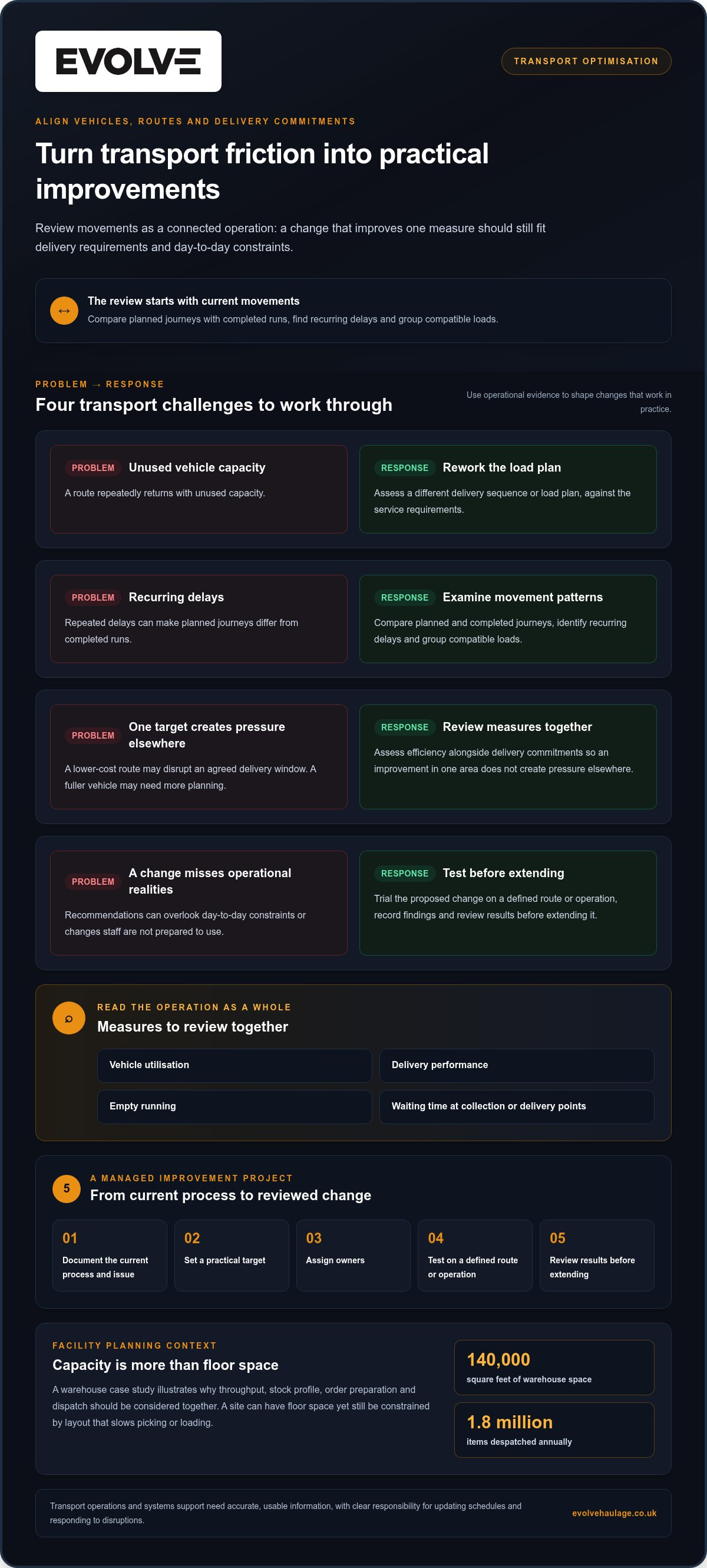
Transport optimisation aligns vehicle capacity, delivery commitments, routes and operating processes. Start by reviewing current movements: compare planned journeys with completed runs, identify recurring delays and group compatible loads. For example, a route that repeatedly returns with unused capacity may need a different delivery sequence or load plan. Assess changes against service requirements as well as operating efficiency, so improving one area doesn’t create pressure elsewhere.
Useful measures include vehicle utilisation, delivery performance, empty running and time spent waiting at collection or delivery points. Review them together rather than treating each as a separate target. A lower-cost route may be unsuitable if it disrupts an agreed delivery window, while a fuller vehicle may require more planning. Transport operations and systems support should give planners accurate, usable information, with clear responsibility for updating schedules and responding to disruptions.
Transport network and logistics improvement work best as a managed project. First, document the current process and the issue to be solved. Then set a practical target, assign owners, test the proposed change on a defined route or operation, and review the results before extending it. For instance, trial a revised collection sequence against existing schedules. Record the changes and findings so implementation decisions are based on operational evidence.
Consultants can support transformation project management by coordinating analysis, operational teams and implementation tasks. Their work may include assessing current systems, mapping handovers, documenting process changes and helping teams adopt revised procedures. Keep decision-making with accountable operational leads. A defined scope, named project owner and agreed review points help manage risks, such as recommendations that overlook day-to-day constraints or changes staff are not prepared to use.
No single qualification or accreditation suits every logistics assignment. Assess relevant transport experience, analytical capability and evidence of delivering comparable projects. Check that any claimed accreditation applies to the proposed work. For example, a fleet-planning review requires different expertise from a systems implementation project. Ask how the consultant will work with operational teams and turn findings into practical improvements.
UK transport and logistics consulting firm rankings can offer market context, but shouldn’t replace a project-specific assessment. More than 500 consulting firms were assessed for the UK Transport & Logistics ranking, with 40 qualifying as top players. The ranking includes seven Diamond-level firms, 10 Platinum-level firms, 12 Gold-level firms and four Bronze-level firms. Use these figures as one reference point, then assess experience, scope and working approach against your operation’s needs.
Risks of hiring a logistics consultant include recommendations that don’t fit operations, unclear project ownership and disruption during implementation. Manage them by agreeing the scope, assigning an internal lead, involving the people who run transport and reviewing changes through a controlled trial.
Where internal teams need help aligning transport processes with operational priorities, consultancy and transport management can provide structured support. Consider transport management support when the work involves day-to-day coordination as well as planned improvements.
Logistics network optimisation
Network optimisation brings suppliers, operating sites, transport links and customer demand together in one workable design. Trace a product’s path from origin to delivery, noting each transfer, decision point and delay. For example, a UK distributor serving customers across several regions can compare its current flow with a model using different dispatch points. The aim is to optimise the whole network, not improve one link while creating extra handling elsewhere.
Build the analysis around demand patterns and service requirements. Separate stable, recurring orders from seasonal or time-critical movements, then map where each needs to enter and leave the network. An organisation serving both retail outlets and direct customers may need distinct flows, even when goods come from the same supplier. This helps planners identify which operations can share resources and which need separate processes to protect delivery commitments.
Use operational evidence to compare network options. Assemble order histories, delivery locations, shipment profiles, transit times and handling requirements, then test how each proposed design changes the flow. For example, compare direct delivery with a transfer through a regional distribution point. Consider the extra handling alongside transport distance, site workload and delivery timing. A model is useful only if its assumptions reflect the organisation’s actual operating constraints.
Network changes also depend on clear roles between organisations. Define which partner owns each handover, how dispatch information is shared and who resolves exceptions. If a supplier changes a collection time, for instance, the receiving operation needs a process to update its plan before onward deliveries are affected. Documenting responsibilities reduces confusion and gives teams a consistent basis for managing supply chain changes.
European movements can add connections to the network, including cross-border suppliers, customers and transfer points. Map these flows separately from domestic movements to see where the networks interact. For example, a UK business receiving goods through a European entry point can trace the journey from arrival through domestic distribution. This helps identify where timing assumptions, handovers or information gaps could disrupt the downstream plan.
Choose performance measures that reflect the network’s purpose. A business prioritising dependable delivery may monitor on-time completion and the causes of missed commitments; one focused on stock flow may examine replenishment patterns and inventory movement. Review measures at each handover, not only at final delivery. This reveals whether a delay starts with supplier readiness, transfer coordination or the receiving operation, helping target improvement work at its source.
Move from analysis to controlled change. Record the current process, agree the intended outcome, assign an owner and test the redesigned flow before applying it more widely. For example, trial a revised supplier-to-customer pathway with one product group, then compare operational evidence with the original process. Include frontline teams and relevant partners in the review, since their experience can reveal practical issues a network model misses.
Reputation depends on consistent performance across the complete journey, not just one efficient movement. Organisations can protect customer confidence by aligning network design with service promises and communicating changes clearly. Logistics consultancy UK support can help map dependencies and assess alternatives. When evaluating logistics consultancy UK options, look for a plan that explains each proposed change, assigns responsibility and shows how its operational effect will be assessed.
What services do logistics consultancies in the UK offer?
Logistics consultancy can range from a focused operational review to a wider transformation programme. The scope depends on the issue: a business facing repeated delivery delays needs different support from one redesigning its supply chain. Start by defining the problem, affected teams and desired operational outcome. For example, a review might examine dispatch handovers rather than every process across the organisation.
Network and transport reviews examine how goods move between suppliers, operating sites and customers. A consultant can map current flows, identify avoidable transfers and compare alternatives. For instance, a business moving products through several depots could assess whether a different sequence reduces handling. The analysis should consider service commitments, capacity and day-to-day constraints, not just distance. It may result in a recommended network design, with assumptions and implementation priorities.
Warehouse and automation assessments focus on how work moves through a site. They can examine receiving, storage, picking, packing and despatch, then identify tasks where automation may merit evaluation. For example, assess whether repetitive order-picking activity suits automated handling. The assessment considers potential operational benefits alongside process changes, space requirements and implementation demands. This helps decision-makers understand where automation could fit, rather than treating technology as a solution in itself.
Operational improvement projects can review processes, responsibilities and performance information. A consultant might trace an order from booking to delivery, documenting where information is entered, which team owns each handover and where queues form. Recommendations could include revised work instructions, clearer ownership or better use of existing systems. To make changes practical, implementation planning should assign an internal owner, identify affected teams and set review points to track progress.
Some assignments also cover systems and data. A review can assess whether planning tools support the decisions staff need to make, such as allocating loads or updating delivery schedules. For example, teams can compare the information used by transport planners with customer-service records. This can reveal gaps or duplicate steps. Recommendations may address process design, system configuration or staff guidance, depending on the cause.
Consultancy sessions provide a structured way to investigate a defined operational question. A session might bring transport, warehouse and customer-service staff together to map a late-delivery process and agree on its causes. To keep the work focused, prepare examples, existing procedures and relevant performance records. The consultant can document findings, discuss options with the team and turn agreed actions into a practical improvement plan.
Before work begins, agree the scope, deliverables, access to operational information and decision-makers. For example, a fleet review should state whether it covers vehicle allocation, scheduling or both. Clear boundaries help prevent a focused assignment from expanding without agreement. They also give the organisation a way to assess whether the final recommendations answer the original business question and are workable for its teams.
How much do UK logistics consultants charge?
There is no standard fee for logistics consultancy; the price depends on the work involved. A focused review of delivery scheduling differs from a network redesign covering several sites. Scope, data access, operational complexity and implementation support all influence the fee, which is provided after a quote request. Defining the assignment clearly helps ensure the proposed work addresses the business need.
Start by describing the problem and the decision you need to make. If dispatch delays recur, for example, explain which operations are affected and what information is available. A consultant can then shape the work around the issue, rather than treating every process as part of the same assignment. A defined scope also clarifies which tasks fall outside the agreed work.
The fee structure can reflect how the assignment is delivered. A project may have a defined scope and set of outputs, while ongoing support may involve work over an agreed period. The key is to understand what each arrangement includes. Ask for activities, deliverables, assumptions and responsibilities to be set out clearly, so you can compare like with like.
Complexity affects the analysis and coordination required. A single-site process review may involve different work from a study spanning multiple facilities, transport flows and teams. Costs can also reflect the quality and accessibility of operational data, the number of processes under review and whether recommendations include implementation support. Mapping one order pathway, for example, is narrower than evaluating several product flows.
Prepare useful information before requesting a proposal. Relevant material may include operating procedures, delivery schedules, order patterns, site processes and examples of delays. Identify the teams that need to contribute and the decisions the work should inform. This helps define the effort required and makes the proposed scope more relevant. Avoid seeking broad recommendations if your immediate need is a specific operational decision.
Review proposals against practical criteria, not just the headline fee. Check whether the scope explains the approach, expected outputs, access needed from your team and how changes will be managed. For instance, a route-analysis proposal should clarify whether it includes reviewing current schedules and presenting options. Confirm how additional work is handled so changes to the scope don’t cause confusion during delivery.
To manage the budget, separate analysis from implementation and prioritise decisions with the greatest operational impact. A business might begin with a defined review of a recurring delivery issue, then decide whether further support is appropriate. This staged approach links expenditure to clear outputs and lets decision-makers assess recommendations before committing to wider work.
For consultancy support shaped around your transport or logistics requirements, request a consultancy discussion. A clear outline of the issue, affected operations and desired decision provides a practical starting point for defining the work.
Evolve Haulage: Haulage Service
Evolve Haulage supports businesses with haulage, transport management and consultancy when freight movements need practical coordination. Its haulage service can help businesses move goods, whilst transport management supports smooth day-to-day logistics operations. For urgent requirements, Evolve Haulage provides 24/7 and time-critical same-day delivery solutions across the UK.
Turn to Evolve Haulage’s consultancy service when you need support reviewing transport operations or identifying practical improvements. If your immediate requirement is moving freight, haulage may be the relevant next step; if your challenge is ongoing coordination, transport management can address it. The right starting point depends on the operational task you need to resolve.
To discuss your transport or haulage requirements, contact Evolve Haulage.
Turn your next operational priority into action
Choose one decision that could improve how goods move through your operation, then assign a clear owner and practical next step. You might examine a recurring transport constraint, refine day-to-day coordination or set priorities for a wider network review. A focused starting point helps turn logistics consultancy in the UK into operational action, rather than leaving recommendations on paper.
Evolve Haulage offers haulage, transport management and consultancy services. These support businesses that need to move freight, coordinate transport operations or review logistics requirements. Start with the issue you need to address and the outcome your operation needs.
Contact Evolve Haulage to discuss your logistics and explore a practical next step for your business.
Frequently Asked Questions
Which are the leading logistics consultancy firms in the UK?
No single firm is best suited to every logistics assignment; the right choice depends on your operation and project. A fleet review, for example, needs transport expertise, while a warehouse process assessment requires relevant site knowledge. Compare firms by the work they undertake, the clarity of their proposed scope and how they support implementation. Ask for examples relevant to your sector and the specific operational challenge you need to address.
How do I choose a logistics consultancy in the UK?
Choose a logistics consultancy in the UK by matching its experience and approach to the decision you need to make. Set out the issue, affected teams and intended outcome before discussing the scope. Then assess the proposed method, deliverables, access required from your staff and how recommendations will be put into practice. For example, a transport-planning project should explain how existing schedules and operational constraints will inform its recommendations.
How can a logistics consultant reduce transport and warehousing costs?
A consultant can identify avoidable activity by examining how goods move, wait and are handled. For transport, review load planning, delivery sequences and unnecessary empty journeys. For warehousing, trace a representative order through receiving, picking and dispatch to find repeated handling or avoidable waiting. Prioritise changes that address the underlying cause, then monitor relevant operational measures. These steps can reveal efficiency opportunities, but don’t guarantee a particular cost reduction.
How can I find a logistics consultant near me in the UK?
Match the consultant’s coverage and working approach to the locations and teams involved in your project. A nearby adviser may suit work requiring regular site visits, while a national operation may need support across several locations. Evolve Haulage serves customers across the UK and offers consultancy to improve transport efficiency. Share your operational challenge and the areas affected to start a focused discussion about your requirements.


