

What if a missed renewal or incomplete record points to a wider gap in your operating routine? Common haulage compliance mistakes often happen when checks, documents and follow-ups are split between different people. That makes it harder to see what is due, who owns it and whether it has been completed.
Busy operators face a practical challenge: vehicles still need to move, while responsibilities for driver records, vehicle checks and licence requirements must remain clear. A task can be familiar to the whole team and still be missed if no one owns it from start to finish.
This checklist helps you spot recurring gaps, assign ownership and create repeatable checks with evidence of completion. It covers routines worth reviewing, explains when to consult current official guidance and flags where requirements may differ between Great Britain and Northern Ireland. The aim is to make compliance part of day-to-day transport management, rather than a scramble when a renewal, inspection or operational issue exposes a gap.
Key Takeaways
- Identify common haulage compliance mistakes by checking whether each requirement has a clear owner, evidence and follow-up.
- Review operator-licence records and deadlines so important information is easy to retrieve and actions are not overlooked.
- Compare driver, tachograph and vehicle-check procedures with evidence that checks and follow-up are happening.
- Use a repeatable checklist to record responsibility, evidence location, review dates and escalation routes.
- Schedule reviews as part of transport operations, and consider where additional management or compliance guidance could help.
Common haulage compliance mistakes start when routine responsibilities are unclear
Compliance can slip even in a capable haulage team. A vehicle is ready, a driver is waiting and the person who usually handles a record is away. If the next step depends on memory or an informal handover, a routine check or follow-up can fall between shifts.
Many common haulage compliance mistakes come down to a gap between four things: a requirement, the person responsible, evidence that it was completed and any follow-up needed. A procedure may exist, but without a named owner and a reliable record, it can be difficult to tell whether it was followed or what happened when someone found an issue.
The requirements that apply depend on how your operation works. Consider the activities you undertake, how each vehicle is used, the goods carried and the jurisdictions in which you operate. Requirements can differ between Great Britain and Northern Ireland, and international work may bring additional considerations; for instance, operators coordinating commercial drivers under US regulations can reference certified exam providers like miamicdldotphysicals.com for FMCSA medical requirements. Use this checklist to organise a review, not as a substitute for current official guidance or advice on a specific situation.
Why a one-off compliance check can miss recurring gaps
An audit shows what was in place on the day it took place. Ongoing monitoring helps reveal what changes afterwards: a record needing attention, a responsibility moving to another colleague or an action that remains open. Without regular follow-up, a clean audit can create false reassurance.
Make ownership explicit. For each recurring task, record who completes it, who covers during an absence, where the evidence is kept and how unresolved issues are escalated. A check that happened but was not recorded can be difficult to demonstrate later. A dated record, together with notes of any action taken, gives managers a clearer view of completed checks and outstanding work.
Which haulage compliance duties apply to your operation?
Map your operation before reviewing individual requirements. List the vehicles you use, the work they perform, the goods carried and the places they travel. This helps you identify which rules and records need closer attention instead of relying on a generic checklist that may not fit your activities.
If you hold an operator licence, include its undertakings in the review. Make sure the people responsible understand what those commitments mean for their work and how the business monitors them. Identify the evidence that shows each relevant process is being followed, and note where you need to check guidance for your operation’s jurisdiction.
For a broader overview of operator responsibilities, the practical UK haulage compliance guide can help frame your review. Trade bodies can provide industry context too. The Road Haulage Association (RHA) is one reference point, but use current official sources to verify requirements. Record any uncertainty, assign someone to resolve it and set a review date so it does not remain an open question.
Mistakes in operator-licence oversight, recordkeeping and deadline management
An operator licence is not a task to complete once and then file away. Its undertakings and related responsibilities need ongoing attention as operations, vehicles and business arrangements change. If nobody owns the review, a change may not prompt the right update or follow-up. These are common haulage compliance mistakes because responsibility is often assumed to belong to someone else.
Records can create a similar blind spot. A business may hold relevant documents but still struggle to retrieve the current version, see what action is outstanding or show how a discrepancy was addressed. Treat the licence, supporting records and review process as connected parts of operational oversight.
Leaving licence changes, renewals or undertakings without an owner
Assign a named person to monitor applicable licence responsibilities, and identify a colleague to cover absences. Use a controlled calendar for relevant review dates, with reminders and an escalation route for overdue actions. Do not assume every date or change requirement is the same across operations. Confirm what applies to your licence and jurisdiction using current official guidance.
For operators in Great Britain, the Traffic Commissioners are a relevant source of operator-licensing information. Northern Ireland has a separate regulatory context, so check the applicable authority and guidance rather than applying Great Britain information automatically. Keep a record of the source and date of your review, particularly when a decision depends on how your operation is structured.
Keeping records without a reliable retrieval and review process
Having a document is not the same as knowing it is complete, current and accessible to the people who need it. For example, a vehicle record may be saved, but a later amendment could be stored elsewhere without a clear link to the earlier version. During a review, it may then be difficult to establish which information is current and whether follow-up was completed.
Set a consistent approach to naming and organising records. Apply sensible access permissions, make version changes identifiable and show authorised staff where records are kept. Avoid relying on one person’s inbox or a folder structure only its creator understands. Retention requirements can vary by record type, so check current rules before setting deletion dates.
A simple controlled register can bring the moving parts together. For each licence obligation, record:
- Owner: the person accountable, plus cover arrangements.
- Review date: when the next check is due, based on applicable requirements.
- Evidence location: where the current record and relevant history are stored.
- Escalation step: who must be told if information is missing, a deadline is at risk or a change needs action.
Use the same discipline to compare vehicle, business and insurance details across the records your operation relies on. If information differs, log the discrepancy, assign someone to resolve it and confirm the corrected record is available in the right place. Evolve Haulage’s transport management supports day-to-day operational oversight, helping businesses coordinate records and compliance processes as part of their wider operations. Find out more about Evolve Haulage’s transport management.
Driver, tachograph and vehicle-check oversights that disrupt daily compliance
A written procedure is only the starting point. It needs to be followed in practice, and the business needs a clear record of what happened when a check identified a concern. If a driver reports a defect but nobody records the decision or confirms the next step, the process has a gap even if the form was completed.
These common haulage compliance mistakes often surface during handovers between drivers, transport staff and maintenance teams. Build a traceable process that connects the check, any exception, the person assessing it and the action taken. The detail required depends on the vehicle, work and applicable rules, so avoid applying one blanket process to every operation.
Treating tachograph and drivers’ hours records as a filing task
Where tachograph and drivers’ hours requirements apply, assign responsibility for required downloads, reviews and follow-up. Filing data without checking it can allow missing or inconsistent records to build up unnoticed. Set a recurring review routine, record who completed it and note how exceptions were investigated or resolved.
Scope matters. From 1 July 2026, goods vehicles over 2.5 tonnes used for international hire or reward transport are required to have a Smart Tachograph Version 2 fitted. This change brings many lighter vehicles into the scope of EU drivers’ hours and tachograph rules when they operate internationally. Do not assume the same rules apply to every vehicle or journey. Check current DVSA guidance for the vehicle, driver, work and relevant jurisdiction.
Recording vehicle checks without closing out defects
A completed inspection record shows that a check was documented. On its own, it does not show what happened after a defect was reported. A reliable process follows each issue through assessment and a recorded decision, whether that means repair or an authorised decision about returning the vehicle to service. Make sure the defect status is clear at shift change.
Use a defect log that connects each report with its outcome. For example, record the vehicle, date, reported issue, person assessing it, action taken and closure status. If further work is required, make the outstanding action visible to the responsible person so it cannot be mistaken for a resolved item. Set inspection routines to suit applicable requirements and operational risk, rather than relying on an unverified universal interval or technical threshold.
Match checks to the work being undertaken. If the operation carries dangerous goods, identify the applicable requirements, including ADR where relevant, and ensure checks and records reflect them. Dangerous-goods procedures do not replace routine vehicle and driver controls, and they do not apply to every load.
During a review, sample records from different vehicles and drivers. Follow each one from the initial check through to the documented decision, and note missing evidence or unresolved actions for follow-up. This practical test helps establish whether the process works in day-to-day operations, not just on paper.
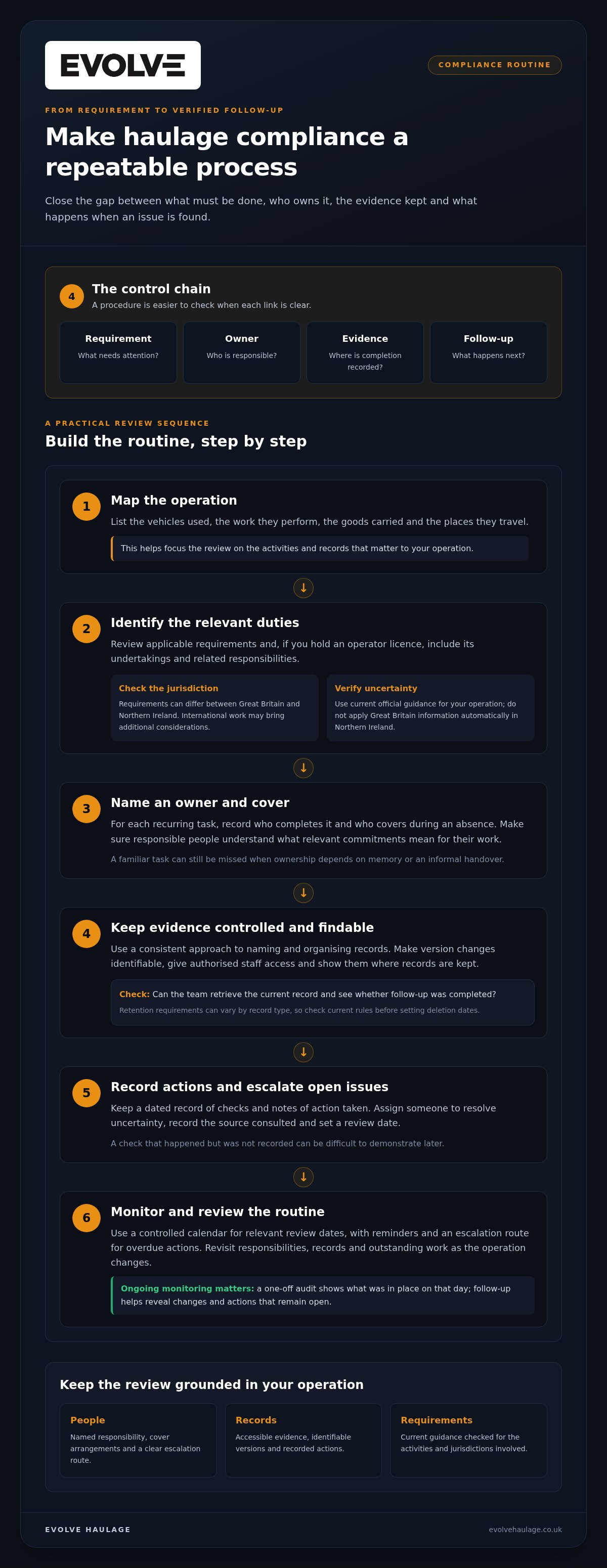
A practical haulage compliance checklist for finding gaps before they grow
A useful compliance review tests whether responsibilities and controls work in practice, not just whether policies exist. Follow the steps below in order, adapting the scope to your vehicles, activities, goods and operating jurisdictions. Use current official guidance to confirm which requirements apply.
Run a focused review of responsibilities and evidence
Set aside time to trace selected obligations from requirement to evidence and follow-up. Start with operator-licence undertakings, driver processes and vehicle records, then include controls for specific goods where relevant. Sample records from different dates or vehicles to see whether routines are consistent. If evidence is missing, unclear or out of date, record what you found without assuming why the gap occurred.
- Map the obligations. List the relevant licence undertakings, driver and vehicle processes, and any goods-specific controls. Note the source used to establish each requirement and whether the jurisdiction or type of operation affects its application.
- Assign an owner. Name the person responsible for each recurring task and identify who provides cover. Make accountability clear across teams so a task is not left unclaimed during an absence or handover.
- Locate and inspect evidence. Record where the current record is held, then check a sample for completeness, currency and accessibility. Compare what the process says should happen with what the evidence shows happened.
- Log each gap and its priority. Describe the missing or unclear evidence, the requirement it relates to and its potential operational significance. Prioritise according to applicable requirements and possible impact, not simply because an item is easier to resolve.
- Schedule and escalate follow-up. Give each action an owner, proportionate deadline, completion evidence and escalation route. Set a review date, then keep the item open until the outcome has been checked and recorded.
Turn findings into assigned, trackable actions
A concise review log can provide a working audit trail without duplicating every underlying record. Include the obligation or process, finding, owner, evidence location, review date, action status and escalation route. If an issue could have serious operational consequences, use your organisation’s escalation process promptly and seek appropriate guidance rather than waiting for the next routine review.
Close actions with evidence, not just a verbal update. For example, if a record needs correcting, note where the revised version is stored and who checked that it addresses the finding. If a gap remains unresolved, carry it forward visibly with a new review date and the reason it is still open. This makes recurring weaknesses easier to identify and helps managers distinguish a completed action from one that has merely been discussed.
For broader context on how operational oversight can support consistent reviews, see this UK transport management guide. Evolve Haulage provides transport management support for day-to-day operational oversight. Explore Evolve Haulage’s transport management support.
Make haulage compliance an ongoing management routine, not a last-minute exercise
A checklist is most useful when it becomes part of how the operation is managed. Scheduled reviews help teams identify overdue actions, changing responsibilities and repeated gaps before they become urgent. They also give managers a clearer view of whether controls are working, rather than relying on a last-minute search for paperwork.
Build a review cycle around operational risk, changes in the business and the requirements that apply. A change to vehicles, work patterns, goods or operating jurisdictions may mean existing checks need to be revisited. Keep the process proportionate, and use current official guidance to confirm rules that affect your operation.
Build a repeatable review cycle that fits the operation
Set review points for recurring responsibilities and make the schedule visible to the people involved. Include relevant managers and staff so that a handover, absence or change of duties does not leave a task without an owner. At each review, check open actions, confirm that evidence is accessible and identify what needs escalation. Record decisions and any changes to responsibilities.
Look for patterns as well as individual omissions. If similar records are repeatedly incomplete, consider whether the process is unclear, difficult to follow or missing a practical handover. The aim is to improve the control, not simply assign blame. This approach addresses common haulage compliance mistakes at their source and makes improvements more likely to last.
When transport management or consultancy can help
Additional structure can help when responsibilities are spread across teams, operational changes make existing routines harder to maintain, or managers lack a clear view of outstanding actions. Evolve Haulage’s transport management supports day-to-day operational oversight. Its consultancy provides compliance guidance and assessments of how current processes work, helping businesses identify practical priorities and manage responsibilities more clearly.
This support can bring driver-related processes, vehicle records and follow-up routines into a more coordinated management picture. It does not replace the operator’s responsibility to understand applicable requirements or review current official guidance. It can, however, help make oversight more consistent and clarify where action is needed.
For wider context on the operational systems that underpin transport activity, the UK transport management guide explores how management routines support day-to-day operations.
To discuss how structured oversight could fit your operation, talk to Evolve Haulage about transport management and compliance support.
Make your next compliance review a practical starting point
Use your next review to turn compliance from an administrative concern into a management habit. Choose one area where responsibilities or follow-up are least clear, then agree how the team will keep oversight visible as the operation changes. A focused first step can help prevent common haulage compliance mistakes from becoming routine.
Where internal capacity or operational complexity makes consistent oversight difficult, structured support can help. Evolve Haulage’s transport management includes day-to-day operational oversight, while its consultancy covers compliance guidance and operational assessments. Together, these services can help you examine how current routines work and identify practical priorities for improvement.
Start a conversation with Evolve Haulage about your operation’s needs. Discuss transport management and compliance support and take a practical first step towards more consistent oversight.
Frequently Asked Questions
What are the most common haulage compliance mistakes?
Common haulage compliance mistakes include missed licence-related actions, incomplete records, overlooked driver or vehicle issues and failing to follow up on reported problems. For example, a defect may be logged but its status not checked before the vehicle is next allocated. Reviewing a sample of real dispatches and their supporting records can show whether written processes match what happens during normal operations.
Can haulage compliance mistakes affect an operator licence?
Yes, serious or repeated failures can bring an operator’s compliance and fitness to hold a licence into question. The significance depends on the circumstances, applicable requirements and how the operator responds. If an issue may affect licence undertakings, do not treat it as an internal paperwork matter alone. Check current guidance from the relevant licensing authority and keep a clear record of corrective steps and decisions.
Who is responsible for haulage compliance in a transport business?
Responsibility depends on the business structure and licence arrangements, but it should not be left as an informal assumption. The operator or licence holder retains important responsibilities, while a designated transport manager may have professional duties within their role. For example, a driver can report a concern, but management needs a defined process for deciding what happens next. Make responsibilities clear in role descriptions and working procedures.
Do all commercial vehicles need a tachograph?
No. Tachograph requirements depend on factors such as vehicle type, weight, use and journey, so “commercial vehicle” alone does not determine whether one is needed. From 1 July 2026, goods vehicles over 2.5 tonnes used for international hire or reward transport require a Smart Tachograph Version 2 under the applicable rules. Check current DVSA guidance for the specific vehicle and operation before deciding what applies.
How long should haulage compliance records be kept?
There is no single retention period that safely covers every haulage record. Requirements can differ by record type and the rules applying to the operation. Identify each record category, then check its current official retention requirements before setting a disposal date. A retention schedule should also explain who can authorise disposal and how records needed for an open investigation, claim or review are protected from routine deletion.
What should a haulage compliance audit check?
A useful audit should test more than whether documents exist. It can compare a sample of actual journeys with relevant driver, vehicle and operational records, then check whether discrepancies were investigated and resolved. Include records from different points in the review period and ask a staff member to retrieve selected evidence. This tests whether information is reliable and accessible when the business needs to demonstrate its processes.
Are haulage compliance requirements the same across the whole UK?
No. Some transport rules apply across the UK, but licensing and other requirements can differ between Great Britain and Northern Ireland, and particular activities may have their own rules. A business operating across jurisdictions should identify where each vehicle and service operates, then verify the relevant requirements with current official guidance for that jurisdiction. Avoid relying on an old checklist if the operation or applicable rules have changed.


