

What if the main cause of transport inefficiency isn’t where you expect? A transport efficiency assessment looks beyond visible delays to examine the measures behind them, including on-time delivery, cost per mile, fuel use and vehicle utilisation. For UK businesses, the aim is to understand what’s working, where performance is being lost and which changes are worth prioritising.
It’s not always easy to know which figures matter, compare assessment approaches or turn a report into practical action. Reviewing transport operations shouldn’t mean losing sight of the day’s deliveries, either. A structured assessment can be planned around operational needs, helping you build a clear picture while keeping essential activity in view.
This guide explains what an assessment examines, how to compare approaches and how to use findings to set evidence-based priorities. It also covers how consultancy can evaluate an existing logistics setup and inform a more effective transport strategy, with transport management providing day-to-day operational oversight where needed.
Key Takeaways
- A transport efficiency assessment should uncover the causes behind performance gaps, not just present isolated figures.
- Compare measures such as fuel use, vehicle utilisation, empty running and delivery performance to identify where to investigate.
- Choose an assessment approach that fits your operation, available data and level of complexity.
- Use a proportionate process to turn findings into practical priorities while keeping essential transport activity in view.
- Evolve Haulage’s consultancy supports internal logistics assessments, compliance guidance and transport strategy.
What does a transport efficiency assessment examine?
A transport efficiency assessment is a structured review of transport activity, resource use and operational performance. It looks at how vehicles, journeys, schedules and people work together to meet a business’s transport requirements. The purpose is to identify what is driving performance, where resources may not be aligned with demand and which issues deserve attention first. A collection of figures alone won’t explain why a vehicle is underused or a delivery is delayed.
A transport efficiency assessment examines how a business uses its transport resources and identifies practical priorities for improving performance. This business-focused view differs from academic or policy-level evaluation. For wider context on the factors involved in transport energy use, see Energy efficiency in transport.
Which parts of a road transport operation can be assessed?
The scope can include vehicle use, journey planning, delivery schedules and the coordination of people and resources. These areas are connected. A missed delivery slot, for example, might appear to be a scheduling issue, but the underlying cause could be an unsuitable route plan, vehicle availability or how work is allocated across the fleet. Treating the symptom alone may leave the actual constraint unresolved.
The review should reflect the business’s operation and objectives. A company focused on scheduled deliveries may need to examine how journeys and delivery windows align. Another may want to understand whether available vehicles are being used effectively across its workload. The right questions depend on the transport activity under review, so define the scope before interpreting findings.
How does an efficiency assessment differ from a compliance check?
An efficiency assessment examines how well transport resources support operational requirements. It may consider how work is planned, whether vehicle capacity is used effectively and where processes create avoidable delays or effort. Its focus is operational performance: understanding causes and deciding what could be improved.
A compliance review has a different purpose. It considers whether relevant processes and records align with applicable requirements. Compliance guidance can be included where it is relevant to the review, but it should not be treated as interchangeable with efficiency analysis. A process weakness can affect both: unclear responsibilities, for instance, may make routine work harder to coordinate and consistent record-keeping more difficult. The UK haulage compliance guide provides further context on compliance as a distinct operational concern.
Keep the distinction clear when setting objectives. If the priority is to understand why resources aren’t supporting the workload effectively, focus the assessment on operational causes. If the concern is a process or record-keeping gap, frame that as a compliance question. Separating the two helps businesses interpret findings accurately and direct follow-up work to the right area.
Which measures help reveal transport efficiency?
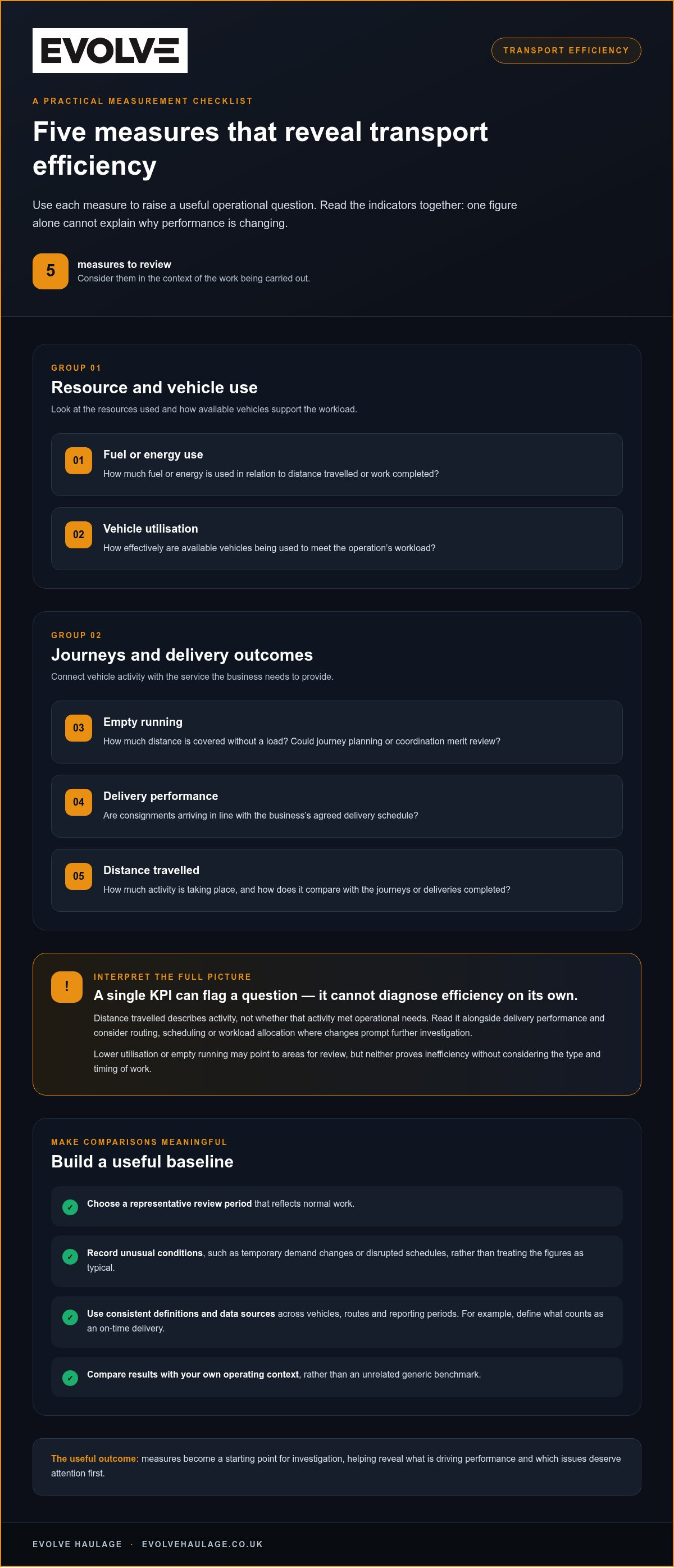
Useful measures connect transport activity to the result it supports. A transport efficiency assessment might compare fuel or energy use, vehicle utilisation, empty running and delivery performance, but no figure explains the whole operation by itself. A single KPI can flag a question, but it cannot diagnose transport efficiency without context from other measures and the work being carried out.
Pair each indicator with a clear operational question. This helps teams move from recording numbers to investigating what they mean. The North American Council for Freight Efficiency (NACFE) also focuses on freight efficiency through research and analysis of technologies and practices.
| Measure | Question it helps answer |
|---|---|
| Fuel or energy use | How much fuel or energy is used in relation to distance travelled or work completed? |
| Vehicle utilisation | How effectively are available vehicles being used to meet the operation’s workload? |
| Empty running | How much distance is covered without a load, and are there opportunities to review journey planning or coordination? |
| Delivery performance | Are consignments arriving in line with the business’s agreed delivery schedule? |
| Distance travelled | How much activity is taking place, and how does it compare with the journeys or deliveries completed? |
How should businesses interpret fleet and journey measures?
Distance travelled is an activity measure: it describes what vehicles have done, not whether that activity met operational needs effectively. Delivery performance is an outcome measure, showing whether journeys supported the required service. Read them together. A change in distance alongside a change in delivery performance, for example, may prompt a closer look at routing, scheduling or workload allocation. Lower utilisation or empty running can also point to areas for review, but neither proves inefficiency without considering the type and timing of work. Compare results with your own operating context rather than an unrelated generic benchmark.
How can businesses build a useful baseline?
Choose a representative review period that reflects normal work. Unusual conditions, such as a temporary change in demand or disrupted schedules, can skew comparisons, so record relevant context rather than treating the figures as typical. Use the same definitions and data sources across vehicles, routes and reporting periods. For instance, define what counts as an on-time delivery and apply that definition consistently. If records are incomplete or inconsistent, flag the limitation. A data gap is a reason to qualify a finding, not proof of poor performance. A dependable baseline makes later comparisons more meaningful.
Once measures are defined, use them to frame focused operational questions and decide where further analysis is useful. Explore Evolve Haulage’s transport consultancy for support evaluating and improving internal logistics.
How can you compare transport efficiency assessment approaches?
The right approach depends on the question, the information available and how closely different parts of the operation interact. A focused diagnostic review can investigate a specific concern, such as recurring delays on a type of journey. A broader operational assessment may be more suitable when causes could span planning, vehicle use, delivery schedules and team responsibilities. The review doesn’t need to become an elaborate exercise: the aim is to produce useful evidence and priorities that support decisions.
Compare approaches against your operation’s needs rather than assuming one format fits every business:
- Scope: Is the review addressing one defined issue or examining connected operational processes?
- Objectivity: Can the people conducting it test established assumptions and consider alternative explanations?
- Operational knowledge: Do they understand the day-to-day work well enough to interpret records in context?
- Implementation support: Can findings be translated into practical next steps, with responsibilities and follow-up considered?
A review can stay tightly focused or widen as evidence points to other contributing factors. Prioritised recommendations are more useful than extensive analysis that leaves decision-makers unsure what to do next.
When might an internal assessment be suitable?
An internal review may work well when the question is narrow, such as understanding why a particular process takes longer than planned, and relevant records are readily accessible. Staff who know the operation can explain how work is organised and identify details that figures alone may not show.
There are limits. Teams may bring existing assumptions to the review, or lack the time and analytical capacity to examine complex causes. Keep conclusions transparent by recording the scope, evidence considered and criteria used to reach decisions. This makes it easier to distinguish a supported finding from an interpretation that needs further investigation.
When can external transport consultancy add value?
An independent perspective can be useful when a problem crosses teams or processes, or when familiar ways of working make it difficult to see how causes connect. Evolve Haulage’s consultancy helps businesses evaluate and improve internal logistics, including through operational efficiency assessments and transport strategy. The review can be shaped around the business’s question and the complexity of its transport setup.
Consider how findings will be put into practice, too. An assessment identifies priorities, while ongoing operational oversight can help manage activity day to day. The UK transport management guide explores how transport management supports that continuing operational role. Aligning the assessment with the decision to be made helps keep recommendations actionable and proportionate.
How to carry out a transport efficiency assessment in practical stages
A practical review should answer a defined business question and fit around essential transport activity. Keep the work proportionate to the operation: focus on relevant records and processes, involve the people who understand them, and separate what the evidence shows from what you decide to change.
Define the question, examine relevant evidence, trace the causes, prioritise action and agree how progress will be reviewed. This sequence gives a transport efficiency assessment a clear path from initial concern to operational follow-up.
Set the assessment scope and gather relevant evidence
Start by agreeing the question the review needs to answer, such as whether journey planning supports delivery requirements. Set boundaries around the activities, teams or vehicles included so the review stays focused. Gather relevant transport, vehicle, journey and delivery records already available to the business. Schedule discussions or checks to avoid interrupting essential work.
- Define the scope. Record the operational question, what is included and what falls outside the review. Be clear about the decisions the findings need to inform.
- Collect and organise evidence. Bring together records that relate directly to the question. Use consistent definitions and reporting periods where possible, so information can be compared meaningfully.
- Note context and limitations. Document assumptions, gaps in records and unusual operating conditions. These details help distinguish a reliable pattern from a result affected by incomplete or atypical information.
- Interpret before recommending. Look for relationships between findings and investigate plausible causes. For example, consider a delivery delay alongside relevant journey and scheduling information rather than treating it as a standalone fault.
- Agree priorities and follow-up. Group findings by underlying cause, then rank potential actions by relevance, feasibility, dependencies and expected operational impact. Select consistent measures and agree a review point to assess whether changes are helping.
Turn findings into prioritised operational actions
A list of disconnected symptoms can lead to scattered responses. Group related findings instead. If several issues point to a coordination problem, for instance, address the shared process rather than treating each instance as unrelated. This keeps proposed actions tied to evidence and makes it easier to explain why one change takes priority over another.
Not every possible action will be equally practical. Consider whether a change depends on another process, whether the people responsible can implement it alongside daily work, and what operational effect it is intended to support. Record the reasoning, owner and measure for each agreed action. At the review point, compare like with like and note any changes in operating conditions that could affect interpretation. If results are mixed, use them to refine the next step rather than assuming the intervention succeeded or failed.
Evolve Haulage’s consultancy supports businesses evaluating and improving internal logistics, helping connect assessment findings with operational priorities. Explore transport efficiency consultancy to consider how this support could fit your review.
How Evolve Haulage can support transport efficiency improvements
An assessment is most useful when it connects operational evidence with decisions a business can act on. Evolve Haulage’s consultancy helps businesses evaluate and improve internal logistics through operational efficiency assessments, compliance guidance and transport strategy. The review focuses on relevant questions and gives businesses a clearer basis for considering how their logistics setup supports day-to-day requirements.
The focus is on understanding existing arrangements and identifying areas for consideration, rather than assuming a standard solution will suit every operation. The scope reflects the logistics setup, current priorities and information available. Findings can inform transport strategy, while compliance guidance stays focused on matters relevant to the review.
What businesses can bring to an initial discussion
A useful starting point is a concise picture of what the transport operation needs to achieve and where pressures arise. Outline your objectives, the questions you want the assessment to answer and relevant records already available. It also helps to flag known gaps or inconsistencies in the information, so these are taken into account rather than mistaken for evidence of poor performance.
You don’t need to have every answer before discussing the scope. A clear account of the logistics setup, the work involved and the decisions the business is considering can help shape a review that is proportionate to its needs.
What happens after assessment findings are reviewed?
Findings can be used to agree practical priorities and responsibilities. Not every recommendation needs to be introduced at once; sequence actions according to their relevance, feasibility and connection to other operational changes. The business can then review consistent operational measures after changes are made, helping it understand whether they support the intended objectives and whether further adjustment is appropriate.
For businesses that need ongoing day-to-day operational oversight, assessment and transport management can complement one another. Consultancy supports evaluation and transport strategy, while Evolve Haulage’s transport management provides operational oversight. Evolve Haulage’s road haulage and transport management services can support businesses as they consider improvement priorities and the operational arrangements needed to put them into practice. The right level of support depends on the business’s requirements.
Bring your transport objectives and questions into the conversation, and explore how consultancy can support your logistics review. Discuss your transport efficiency requirements with Evolve Haulage.
Make your next transport decision with confidence
Improvement doesn’t need to begin with a large-scale change. Choose one operational question that matters to your business, then use the answer to guide a measured next step. A transport efficiency assessment can become a useful point of reference for future decisions, helping you connect logistics priorities with the way your operation develops.
Evolve Haulage’s consultancy helps businesses evaluate and improve internal logistics, while its UK-wide road haulage and transport management services provide operational support alongside that strategic perspective. Start with a conversation about the pressures your operation faces and the direction you want to take. You don’t need to have every detail resolved before you begin.
Explore your transport improvement options with Evolve Haulage and take a considered step towards an operation that better supports your business.
Frequently Asked Questions
How often should a business carry out a transport efficiency assessment?
There’s no universal timetable; review transport performance when there’s a clear business reason to do so. A change in delivery requirements, fleet arrangements or operating processes may justify a fresh look, as can recurring issues that aren’t explained by routine monitoring. Businesses can also align reviews with their own planning cycle. Revisit the assessment when assumptions have changed, rather than repeating it on a fixed schedule without a decision to inform.
Can a small business benefit from a transport efficiency assessment?
Yes. A smaller operation can benefit from examining a specific pressure, even if it has only a few vehicles or manages records in spreadsheets. For example, a business might investigate whether frequent schedule changes are affecting vehicle allocation. The review can be scaled to the question and information available; it doesn’t need complex systems to be useful. A focused scope helps keep the work manageable and relevant.
What information should a business prepare for an assessment?
Start with a short outline of the transport service the business needs to deliver and the issue it wants to understand. Useful existing information may include planned and completed journeys, vehicle allocation, delivery records, mileage or fuel data, and notes about delays or changes. A record of why a scheduled journey changed, for example, can help explain a difference between plan and outcome. Share data limitations too, so conclusions reflect what the records can support.
Does a transport efficiency assessment include compliance?
It can include compliance guidance where that falls within the review’s scope, but operational efficiency and compliance are distinct questions. An assessment focused on resource use or scheduling doesn’t automatically amount to a full compliance review. If the business has a particular compliance concern, make it an explicit part of the discussion and define what needs examining. This keeps the purpose clear and helps distinguish operational findings from compliance-related ones.
Will an assessment require transport operations to stop?
Not necessarily. A review can be planned around the information and conversations needed, with evidence gathered in stages to limit interference with essential work. Staff discussions or record reviews, for example, may be arranged around operational demands rather than during a busy dispatch period. The practical approach depends on the review’s scope and the business’s working arrangements. Agreeing access and timing in advance helps the assessment fit alongside day-to-day activity.
How can a business tell whether an assessment has been useful?
It should help decision-makers explain what needs attention and why, then connect agreed actions to responsibilities and measures they can review. If a change is intended to reduce repeat schedule amendments, for instance, track those amendments consistently before and after it is introduced. Useful findings also make limitations clear, so the business knows where evidence is strong and where further observation may be needed before making another decision.


