

What if reliable deliveries depend less on a perfect plan and more on a consistent way to manage changes? In day to day transport management, priorities and schedules can shift quickly, leaving planners, drivers and customers working with different information. A small exception can affect service if nobody spots it early.
Effective daily control needs more than a schedule. It calls for a repeatable routine that keeps delivery activity visible, supports clear communication and gives the team a practical way to respond when plans change.
This guide explains what day-to-day transport management involves, from reviewing the day’s workload to dispatch, live monitoring and end-of-day follow-up. You’ll learn how to set priorities, keep updates aligned between the office and drivers, handle disruptions and record exceptions so they can inform future planning. The aim is a steadier operating rhythm, with clearer oversight and fewer issues left to surface at the last minute.
Key Takeaways
- Build a repeatable daily control cycle to coordinate people, vehicles, schedules and operational information.
- Use a pre-dispatch sequence to prioritise work and align vehicle suitability and driver information with the plan.
- Keep planned, active and completed movements visible, with clear updates when delivery activity changes.
- Record exceptions and follow-up actions at close of day so patterns can inform tomorrow’s planning.
- Recognise when internal routines need strengthening or structured day to day transport management support.
What day-to-day transport management controls, and why a routine matters
Day-to-day transport management coordinates the people, vehicles, schedules and information needed to plan, dispatch and monitor transport work. It gives the operation a clear way to set priorities, share updates and respond when activity changes. A consistent routine helps teams spot gaps early and maintain oversight when the day doesn’t run to plan.
The focus is operational control: what needs to move, who is responsible, which vehicles are assigned and how progress is communicated. Broader transport strategy considers longer-term questions, such as how to improve efficiency or shape the operation. The two are connected, but a daily routine turns plans into coordinated activity. A Transportation Management System (TMS) can support planning, execution and monitoring. Whatever tools you use, clear responsibilities and useful updates remain essential.
Which activities belong in a daily transport routine?
A practical routine links each stage of the working day, rather than treating planning, dispatch and delivery updates as separate tasks. The process will vary with the workload and the operation’s structure, but responsibilities should be clear from the outset. For example, a planner sets priorities and shares the schedule, drivers provide progress updates, and customer-facing colleagues pass on relevant delivery information.
- Plan: Review the work and identify priorities or information gaps.
- Coordinate dispatch: Confirm assignments and communicate the current plan.
- Monitor deliveries: Track progress and flag changes that need attention.
- Update the team: Share relevant information with drivers, customers and management.
Together, these activities create a shared operating picture. When someone changes a delivery priority or reports a delay, the update needs to reach everyone whose work is affected. A defined handover helps prevent conflicting instructions and makes clear who owns the next action.
What does a well-managed day help prevent?
Clear priorities and complete information reduce avoidable confusion. If a driver is working from an outdated schedule, or a planner doesn’t know a delivery is delayed, the team may miss the chance to adjust other work. A routine gives people regular opportunities to check what has changed and where an update or decision is needed.
Early visibility also supports a measured response. If a delivery is running behind, the team can assess the impact, communicate relevant changes and consider the next step before the delay affects more of the schedule. A routine won’t remove disruption, but it can stop uncertainty from compounding it. In day to day transport management, consistency means maintaining control and learning from events, not expecting every movement to run without a hitch.
How to prepare the transport operation before dispatch
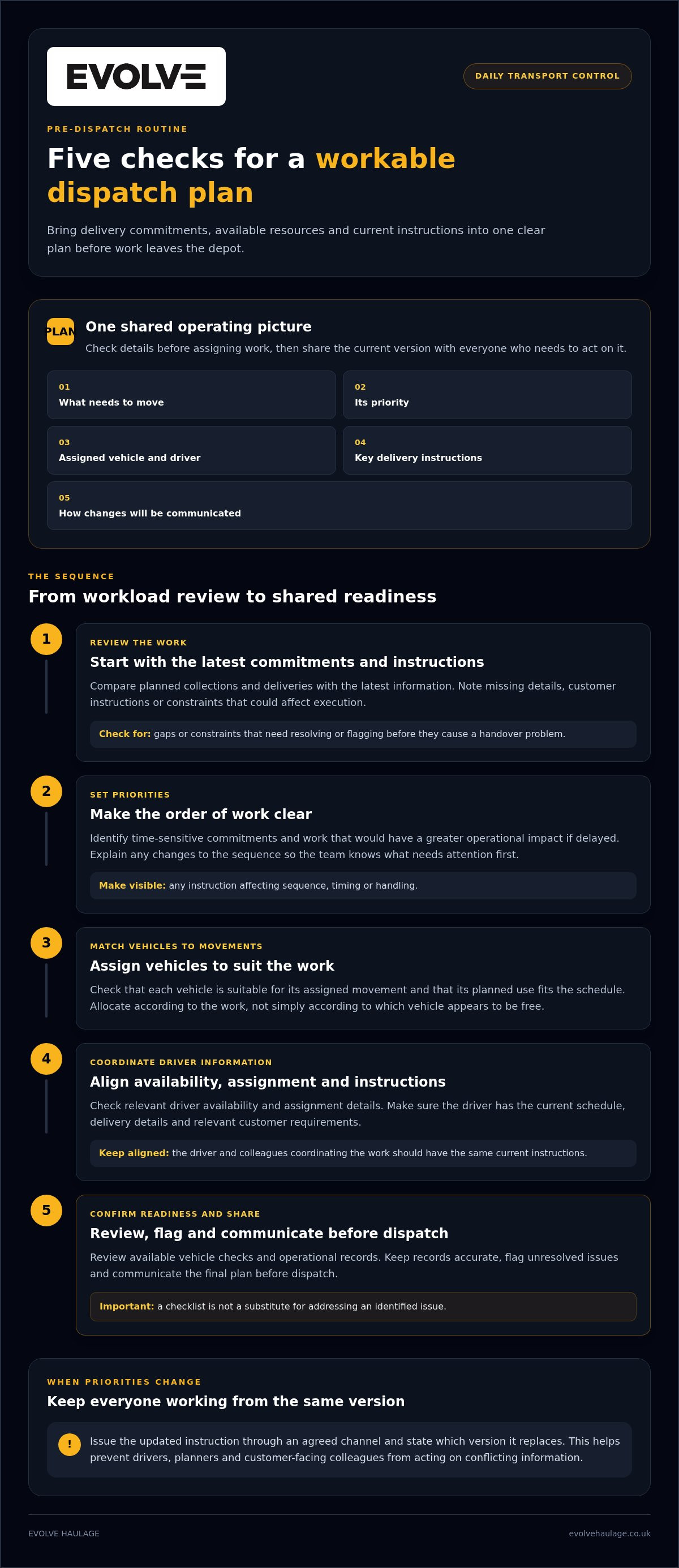
A useful pre-dispatch plan brings delivery commitments, available resources and current instructions into one workable picture. In day to day transport management, check the details before assigning work, then share a clear version of the plan with everyone who needs to act on it. If information is incomplete or priorities change, resolve the gap or flag it before it causes a handover problem.
A dispatch plan should show what needs to move, its priority, the assigned vehicle and driver, key delivery instructions, and how changes will be communicated.
Review the work and set priorities
Start with planned collections and deliveries, including commitments, customer instructions and known constraints. Identify work that is time-sensitive or would have a greater operational impact if delayed, then make those priorities clear to the people planning and carrying out the movements. Avoid relying on informal assumptions. Any instruction that affects sequence, timing or handling should be visible in the shared plan.
If priorities change, issue an updated instruction through an agreed channel and state which version it replaces. This helps prevent a driver, planner or customer-facing colleague from acting on conflicting information.
- Review the work. Compare planned collections and deliveries with the latest instructions, noting missing details or constraints that could affect execution.
- Set priorities. Identify time-sensitive commitments and explain any changes to the order of work, so the team knows what needs attention first.
- Match vehicles to movements. Check that each assigned vehicle is suitable for the work and that its planned use fits the schedule.
- Coordinate driver information. Check relevant availability and assignment details, then make sure the driver has the current schedule and instructions.
- Confirm readiness and share the plan. Review available vehicle checks and operational records, flag unresolved issues and communicate the final plan before dispatch.
Confirm readiness and communicate the plan
Allocate vehicles according to the work, not simply according to which one appears to be free. Check that each assignment suits the movement and review the information available about the vehicle and driver before confirming dispatch. Follow established vehicle-check processes and keep operational records accurate. A checklist is not a substitute for addressing an identified issue.
Give the driver and colleagues coordinating the work the same current instructions. Include delivery details, relevant customer requirements, the planned sequence and how to report changes. Broader context on UK transport management can help show how daily preparation fits within the wider operation.
For operations that need structured help with coordination and schedule execution, Evolve Haulage’s transport management support provides additional operational oversight alongside useful internal visibility.
How to coordinate dispatch and monitor transport activity
Once vehicles are moving, the priority is to maintain a dependable view of what is planned, active and complete. Day to day transport management works best when everyone involved can see the latest status and understand who owns the next action. You can use a shared log, dispatch board or suitable digital tools. The important thing is to keep updates consistent and easy to find.
Timely, accurate updates help the team understand progress, identify service risks and act on current information.
Keep dispatch information visible and current
For each movement, record enough detail to make its status useful: what is being collected or delivered, its progress, any issue and the next action. Agree who records updates, where they are shared and how changes are flagged. This reduces duplicated messages and the risk of someone working from an outdated version of events.
Route-planning software and fleet telematics can improve visibility, but they aren’t prerequisites. A straightforward shared record can also work, provided it is kept current and accessible to the people coordinating the work. Keep status updates focused: they should say what has changed and what needs to happen next.
Respond to delays and changing priorities
When a delay or vehicle issue arises, follow a calm sequence: establish the facts, assess the effect on service, agree a practical response, then update everyone affected. This prevents assumptions from spreading while the team decides what can still be achieved.
- Establish what’s known. Confirm which movement is affected, the current position and the nature of the issue.
- Assess the impact. Identify whether a collection, delivery or connected movement may be affected, and how urgent the response is.
- Agree the next action. Consider the available options, such as adjusting the sequence or reallocating work where practical.
- Communicate the change. Share the agreed update with the driver, planner and relevant customer-facing colleagues, then keep the status current.
For example, a delayed collection may affect a later delivery if both movements depend on the same vehicle. A vehicle issue may mean reviewing the assignment and revising the schedule. In each case, prioritise exceptions according to service impact, urgency and the options available, rather than treating every change as equally critical.
If a time-sensitive movement needs a different response, urgent freight arrangements may form part of the wider operational plan. Evolve Haulage provides commercial road haulage and time-critical delivery services across the UK, alongside transport management to support operational oversight and schedule execution. This structured support can help coordinate activity while your team retains visibility of the work. Explore transport management support as part of a considered approach to dispatch.
How to close the day, record exceptions and improve tomorrow’s plan
A useful close-out does more than confirm which deliveries are complete. Reconcile the day’s activity, capture unresolved issues and give the next planning cycle reliable information to work from. This connects disruption handling with practical learning, helping prevent the same avoidable problem from passing unnoticed into tomorrow’s plan.
Capture outcomes and hand over open issues
Review the movement record against the work planned. Mark completed activity, note anything outstanding and record the next action, its owner and relevant context. Proof of delivery can substantiate a completed movement and support clear operational records. If an item remains open, make the handover specific enough for another team member to pick it up without reconstructing the day from scattered messages.
- Reconcile progress. Compare planned movements with completed, delayed, cancelled or outstanding work.
- Record exceptions. Capture what happened, when it became known and which movements or commitments were affected.
- Assign follow-up. Name the person responsible for each open action and record the next step.
- Review the day. Note recurring issues or planning assumptions that may need attention before the next dispatch cycle.
Useful daily service indicators might include completed movements, late deliveries, unresolved exceptions or missing updates. Choose measures that reflect the operation’s priorities and can be recorded consistently. These indicators support routine oversight, but they do not replace formal compliance auditing or detailed legal advice. Keep the daily review proportionate and focus on what helps the team maintain service and coordinate its next actions.
Turn recurring exceptions into improvements
One exception may be unusual, but a repeated pattern deserves closer attention. Review records periodically for recurring delays, communication gaps or assumptions that regularly prove inaccurate. For example, if a type of movement repeatedly needs schedule changes, examine the planning information behind it rather than simply noting each delay. Choose a practical adjustment, assign an owner and review whether it improves the process.
Keep the learning loop simple: identify the pattern, agree an action, then check whether the issue becomes less frequent or easier to manage. If external freight support could help address a capacity or delivery requirement, consider the factors outlined in this UK road haulage company guide. In day to day transport management, accurate records help ground those decisions, while periodic reviews distinguish a one-off disruption from a process that needs refinement.
If your operation would benefit from structured coordination, driver coordination and schedule execution, explore Evolve Haulage’s transport management support as part of your operational improvement plan.
When day-to-day transport management needs additional operational support
A well-designed routine helps teams stay coordinated, but it can also reveal when the operation relies on too much informal effort. Repeated missed handovers, limited visibility of active work or unresolved exceptions may indicate that responsibilities or capacity need reviewing. These signs don’t automatically mean the process is failing. They are prompts to find what is creating pressure and whether a practical change could improve control.
Recognise when the current routine is under pressure
A temporary increase in workload may call for short-term adjustments, while recurring issues can point to a persistent process or capacity challenge. Look for patterns: are updates regularly arriving too late, are the same tasks competing for one person’s attention, or do open actions carry over without a clear owner? The right response depends on the workload, existing responsibilities and where coordination is becoming difficult.
Before changing the routine, distinguish a busy period from a pattern that continues during normal operations. Note when handovers are missed, which information is hard to access and what follow-up is delayed. This gives managers a clearer basis for deciding whether to refine internal processes, reassign responsibilities or bring in additional operational support.
Choose a practical next step for the operation
Start by documenting how work currently moves through the operation: who plans and coordinates it, how drivers receive updates, where progress is recorded and how exceptions are handed over. Include the friction points, not only the intended process. A concise, accurate picture helps the team decide whether a clearer routine is enough or additional support would better fit operational needs.
Strengthening internal routines may suit an operation with the capacity to clarify responsibilities and maintain consistent updates. External transport management support can provide structured day-to-day operational control, driver coordination and schedule execution while preserving useful internal visibility. The aim is to support the operation’s work, not create a separate process that leaves your team unsure what is happening.
Where the challenge extends beyond daily coordination, consultancy can assess transport efficiency and help shape operational arrangements. A review might consider how planning, communication and follow-up connect, then identify areas for improvement that fit the operation. This helps ensure changes address the underlying issue rather than simply adding another check or handover.
Evolve Haulage provides transport management to support day-to-day operational oversight, compliance, driver coordination and schedule execution. If you’re considering additional support, bring a clear picture of your current workflow and the recurring challenges you want to address. Discuss transport management support with Evolve Haulage to explore a practical next step for your operation.
Make your next transport improvement practical
The next step doesn’t need to be a complete redesign. Choose one recurring source of friction, clarify who owns it and test a practical change in your day to day transport management routine. This gives your team a focused way to build on what already works while improving how the operation handles pressure.
If you’d benefit from an external perspective, Evolve Haulage can support operational control, driver coordination and schedule execution. Its transport consultancy can also assess efficiency and help shape suitable operational arrangements. The aim is to give your team structured support that complements, rather than replaces, useful internal visibility.
Share the operational challenge you’re looking to address and take the next step towards a more manageable routine. Discuss day-to-day transport management with Evolve Haulage.
With a clear improvement to focus on, you can keep developing a transport operation that is organised, responsive and ready to learn from each working day.
Frequently Asked Questions
Is day-to-day transport management only necessary for businesses with their own fleet?
No. Businesses that arrange deliveries using hired vehicles or external haulage can still benefit from coordinating bookings, priorities and updates. For example, a business using different carriers can keep a central record of collection times, delivery progress and customer changes. This helps staff understand the status of each movement, even when they don’t operate the vehicles themselves. The routine should reflect the business’s role in arranging and overseeing transport.
Can transport management software handle daily transport decisions automatically?
Software can organise information and support tasks such as planning, tracking and sharing updates, but it shouldn’t replace operational judgement. A system may flag a conflict, for example, while a planner assesses the effect on a customer commitment and decides what to change. Agree who reviews alerts, corrects inaccurate information and approves changes, so automated prompts support decisions rather than generating instructions without oversight.
How often should a business review transport performance?
Review day-to-day service information as part of the normal operational close-out, then examine recurring patterns at intervals that suit the volume and nature of the work. A business with frequent movements may find regular reviews useful, while a smaller operation may have enough information to assess trends less often. Focus on measures that support decisions, such as missed collections or repeat causes of schedule changes, and adjust the review frequency if it isn’t producing useful actions.
What information should a delivery status update include?
A useful update identifies the movement, its current stage, when the information was recorded and whether anything needs attention. If a delay is reported, distinguish confirmed details from estimates and note who is following up. For example, “collection delayed, revised arrival time not yet confirmed, planner to update customer” is more actionable than “running late”. This format makes the status clear to colleagues who weren’t part of the original conversation.
Is transport management the same as logistics management?
No. Transport management focuses on organising the movement of goods, including vehicle assignments, delivery schedules and transport progress. Logistics management is broader and may include how transport connects with other activities, such as coordinating stock flows and fulfilment. The terms can overlap in practice, particularly in smaller businesses where one person handles several responsibilities. Defining tasks and decision owners internally helps avoid gaps, whatever job titles the team uses.
What should a transport team do when a delivery plan changes during the day?
Confirm the change and its source before altering the working plan. Then assess which deliveries, collections or colleagues may be affected, agree the revised instruction and make sure the previous version is clearly superseded. For instance, if a customer changes a delivery window, check whether that affects the driver’s other planned work before promising a new arrangement. Record who approved the change, so later questions can be resolved without relying on memory.
How can a small business make its daily transport routine manageable?
Keep the process proportionate: use one shared place to track movements, nominate someone to maintain it and agree a simple way to flag changes. A short daily check can focus on exceptions rather than reviewing every detail from scratch. If one person covers several roles, use clear handover notes to make responsibilities visible when they’re unavailable. Start with the information that supports immediate decisions, then add detail only where it solves a real coordination problem.


