

Outsourcing logistics doesn’t have to mean handing over control. The term 3PL's is used inconsistently, covering everything from freight transport to order fulfilment, so it can be difficult to tell what support a provider actually offers. A third-party logistics arrangement isn’t one fixed bundle: its scope depends on the activities a business chooses to outsource.
If you’re weighing up external support, start by identifying what you need help with and how you’ll keep track of the work. This guide explains what third-party logistics providers do, how a 3PL differs from related providers and operating models, and where transport fits. It also compares when haulage, transport management or logistics consultancy may suit different operational needs.
For example, a haulage partner can manage the movement of full or partial freight loads within a wider logistics operation, while transport management and consultancy address planning and operational oversight. Distinguishing these roles helps you set clear responsibilities and choose support that fits your requirements while retaining visibility of deliveries.
Key Takeaways
- A 3PL arrangement can cover selected logistics tasks rather than one standard package of services.
- Compare transport, fulfilment, storage and coordination to identify which activities could be outsourced.
- Understand how 3PL's differ from 4PLs, haulage providers and in-house logistics teams.
- Assess the task, demand pattern, control needs and priorities to identify the right type of support.
- See how full or partial freight loads, transport management and consultancy can fit into a wider logistics strategy.
What are 3PLs? A clear definition of third-party logistics
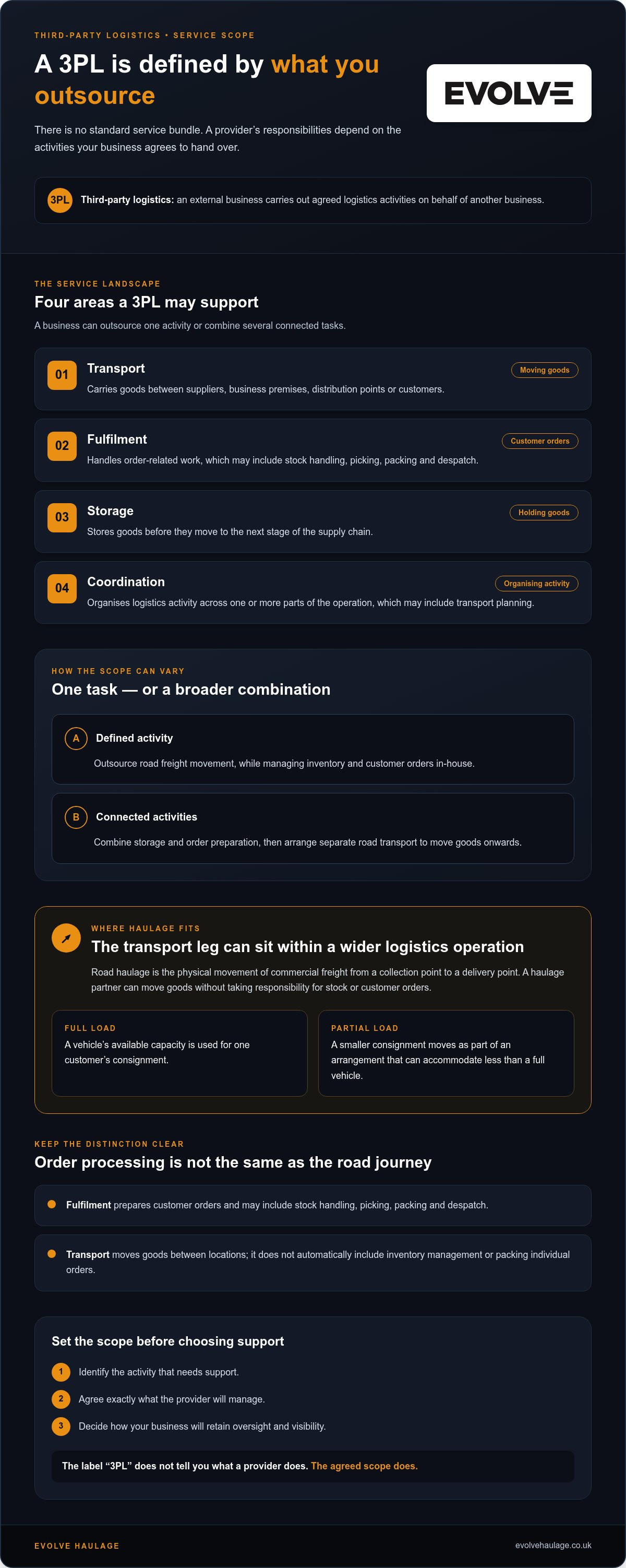
A third-party logistics provider (3PL) is an external business that carries out agreed logistics activities on behalf of another business. These activities may include moving freight, managing fulfilment or coordinating parts of a supply chain. The term describes an outsourced working relationship, not a standard package that every provider delivers in the same way. The arrangement might focus on one operational need or cover several connected tasks.
The distinction matters because “3PL” is used across different parts of logistics. A provider focused on e-commerce orders may offer fulfilment services, while a freight partner may concentrate on moving goods. Both can be described as 3PLs, but their responsibilities differ. The Third-party logistics (3PL) overview also describes the range of activities associated with the term.
What does the term third-party logistics include?
A 3PL's scope depends on what a business needs and what the parties agree the provider will manage. Common activities include:
- Transport: moving goods between suppliers, business sites or customers.
- Fulfilment: handling processes such as preparing and despatching customer orders.
- Warehousing: storing goods as part of a wider logistics arrangement.
- Coordination: organising or managing logistics activities, which may include transport planning.
A business that outsources road freight movement but manages its own orders has delegated a specific logistics activity. Another might combine storage, order preparation and delivery under a broader arrangement. The label alone doesn’t tell you what a provider does. The agreed scope does.
Outsourcing a defined part of logistics is different from booking a single delivery. A one-off booking is for a particular transport task. A 3PL arrangement gives an external provider responsibility for an agreed part of the logistics operation, whether that means a defined movement or an ongoing function. The key distinction is the scope of responsibility, not simply whether a delivery takes place.
Why do businesses use a 3PL?
A business may use an external logistics partner to get support with operational tasks without managing every activity itself. For instance, it might need help moving freight but retain responsibility for customer orders and stock decisions. Another business might need a wider combination of services because its logistics requirements are more complex.
Needs can change as products, order patterns or delivery priorities shift. An outsourced arrangement can focus on the activities that need support, while the business retains oversight of its operation. Outsourcing isn’t automatically the right choice: the value depends on whether the provider’s responsibilities fit the task and the level of control the business wants to maintain. Defining the scope first makes it easier to assess that fit.
What services can a 3PL provide, from fulfilment to road haulage?
A 3PL may handle one defined task, such as moving commercial freight, or coordinate several connected parts of a business’s logistics. The service mix depends on the operation and the responsibilities agreed between the parties. ASCM’s overview of 3PL logistics services also describes the breadth of activities associated with third-party logistics.
Common activities can be grouped into four broad areas:
- Transport: carrying goods between suppliers, business premises, distribution points or customers.
- Fulfilment: handling customer orders, which may involve stock handling, picking, packing and despatch.
- Storage: holding goods before they move to the next stage of the supply chain.
- Coordination: organising logistics activities, such as transport movements, across one or more parts of the operation.
A business might outsource transport alone while keeping inventory and order processing in-house. Another may combine storage and fulfilment, then arrange separate road transport to move goods onwards. A 3PL's services can therefore range from one operational activity to a broader combination of complementary tasks.
Where does road haulage fit within third-party logistics?
Road haulage is the physical movement of commercial freight from a collection point to a delivery point. A full load uses a vehicle’s available capacity for one customer’s consignment. A partial load is a smaller consignment moved as part of a transport arrangement that can accommodate less than a full vehicle. The practical distinction is how much freight needs to move, not whether the business outsources other logistics tasks.
Dedicated transport can fit into a wider operation without taking responsibility for stock or customer orders. For example, a business may manage its own inventory and order preparation, then use a haulage partner to move full or partial loads between its premises and customers. Evolve Haulage provides UK commercial road freight, including dedicated full and partial loads, as a transport partner within broader logistics arrangements.
How do fulfilment and transport services differ?
Fulfilment centres on processing customer orders and related stock or despatch steps. Transport centres on moving goods between locations. A fulfilment operation may prepare an order for delivery, but that doesn’t include the road journey itself. Similarly, a carrier moving freight isn’t necessarily managing inventory or packing individual customer orders.
These functions can be coordinated together or divided between partners, depending on how a business organises its supply chain. Separating them helps clarify responsibilities: who prepares the goods, who arranges the movement, and who oversees each stage. For businesses focused on freight movement or transport planning, Evolve Haulage’s commercial road haulage and transport management can form part of that wider structure.
How 3PLs differ from 4PLs, haulage and in-house logistics
These terms describe different ways of organising logistics, although their boundaries aren’t always fixed. A 3PL delivers selected outsourced logistics activities, with responsibilities set by the agreement. A 4PL is commonly described as taking a broader coordinating role across logistics functions and providers. A haulage partner focuses on freight transport, while an in-house operation is managed directly by the business.
The comparison below shows typical differences, not a ranking. Responsibilities can overlap, so the scope agreed between the business and its partner matters more than the label alone.
| Model | Typical role and scope | Operational control |
|---|---|---|
| 3PL | Delivers selected outsourced activities, such as transport or fulfilment; scope can combine services. | Provider manages agreed tasks; the business retains oversight of the wider operation. |
| 4PL | Often coordinates broader logistics activity, potentially across several providers and functions. | May take a wider coordination role; the extent depends on the arrangement. |
| Haulage partner | Moves commercial freight between collection and delivery points. | Manages the agreed transport movement, not necessarily other logistics tasks. |
| In-house logistics | The business organises logistics using its own people and resources, which may include its own fleet. | Direct operational control stays within the business. |
3PL versus 4PL: delivery of services or broader coordination?
A useful distinction is that a 3PL commonly performs specific logistics activities, while a 4PL is often associated with coordinating a wider supply-chain operation, including the work of multiple providers. For example, one partner might manage a defined transport function; a broader coordinator could oversee how transport and other logistics functions fit together.
These definitions aren’t absolute. Providers may describe their roles differently, and a 3PL’s remit can include coordination as well as operational delivery. Focus on the responsibilities, decision-making authority and reporting arrangements in the agreement rather than assuming the title defines them.
3PL versus a haulage partner or an in-house fleet
A haulage partner can take responsibility for moving freight without managing stock, fulfilment or every other logistics activity. Evolve Haulage’s dedicated full and partial loads show how outsourced road transport can serve a defined part of a broader operation. By contrast, an in-house fleet means the business organises its own vehicles, drivers and schedules, keeping those decisions within its operation.
Neither approach is automatically preferable. Compare the task, the oversight you want to retain and how transport fits alongside other activities. For wider context on organising transport operations, see this UK transport management guide.
When could a 3PL arrangement suit your business logistics?
Outsourcing may be worth considering when a defined logistics task is taking time or capability away from other parts of the operation. Separate the immediate issue, such as moving freight, from a wider requirement involving order fulfilment or coordination. This helps you determine whether you need a transport partner, broader outsourced support or a change to how work is managed in-house.
Use this sequence to clarify what the operation needs:
- Identify the task. Is the pressure around collecting and delivering freight, planning movements, processing orders or coordinating several activities?
- Describe the demand pattern. Note whether consignments are urgent, scheduled or recurring, and how requirements change during busier periods.
- Set control boundaries. Decide which decisions and responsibilities should stay with your team and which could sit with an external partner.
- Rank service priorities. Clarify what matters most, such as responsive planning for time-critical freight or consistent coordination for regular movements.
This process helps distinguish a transport requirement from a broader fulfilment or supply-chain need. For example, a business that prepares orders itself but needs support moving freight has a different requirement from one that also needs help with stock and despatch processes. A 3PL's value depends on matching the support to the actual operational pressure, rather than outsourcing more than the business needs.
Which logistics activities are causing the operational pressure?
Pinpoint where work is becoming difficult to manage. The issue may be freight movement, coordinating collections and deliveries, or another activity. Urgent consignments call for responsive delivery planning, while scheduled or recurring freight may need arrangements that fit established operating routines. If dispatch activity is part of the challenge, this day-to-day transport management guide offers further operational context.
What should a business define before outsourcing logistics work?
Set out the shipment type, collection and delivery requirements, frequency and service priorities. Include the information needed to plan each movement, such as where freight is ready and who manages handovers. Clear responsibilities and reliable information help both sides follow an agreed process. Outsourcing doesn’t automatically mean losing oversight. Define how updates, decisions and exceptions will be handled so your team stays connected to the work it has delegated.
Once the requirement is clear, it’s easier to choose a suitable level of support. Evolve Haulage provides commercial road haulage, transport management and logistics consultancy for distinct transport and planning needs. Explore Evolve Haulage’s transport support as part of your logistics planning.
How Evolve Haulage supports transport within a 3PL strategy
A wider logistics arrangement doesn’t have to place every activity with one provider. A business might manage stock and order processing internally while relying on a transport partner to move commercial freight. Evolve Haulage provides UK commercial road haulage and freight delivery, making transport a defined part of a wider operation. Its dedicated full and partial loads support different consignment requirements, whether a business needs a vehicle for its freight or is moving less than a full load.
This is one way to put a 3PL strategy into practice: decide which activities need external support, then define how they connect with the work your team continues to manage. Evolve Haulage’s services also include transport management and logistics consultancy, which address operational oversight and planning.
What transport support does Evolve Haulage provide?
Evolve Haulage provides commercial road freight delivery across the UK. Dedicated loads provide a way to move consignments between collection and delivery points, while 24/7 and same-day delivery support time-sensitive commercial freight. These services can sit alongside a business’s existing arrangements for stock, fulfilment or other logistics activities. Haulage covers the freight movement, rather than every part of the supply chain.
For example, a business may handle its own order preparation and use dedicated road transport for freight movements. Define the transport requirement around the consignment and delivery need, while your business retains oversight of its other operational responsibilities.
How can transport management and consultancy complement haulage?
Haulage moves freight; transport management focuses on overseeing day-to-day road transport activities. Logistics consultancy helps businesses assess their transport operation, including compliance considerations, operational efficiency and transport strategy. These services address different needs, so a business can combine practical delivery support with planning or review work where relevant.
Understanding how these responsibilities fit together helps clarify where support is needed and what remains with your team. The UK road haulage company guide provides related context on freight-partner arrangements.
What is a practical next step for a business?
Before discussing transport support, outline the freight type, collection and delivery requirements, timing, and whether the need is occasional, recurring or time-critical. Note any transport-management or consultancy requirements too. This gives the discussion a clear operational focus and helps distinguish a specific haulage need from wider planning support.
For a discussion about commercial haulage, transport management or logistics consultancy, talk to Evolve Haulage about your transport requirements.
Turn your logistics priorities into a practical plan
Turn your operational priorities into a clear brief. Identify what needs to move, when it needs to move, and where you want decisions and updates to sit. That gives a logistics discussion a useful starting point and helps keep outsourced responsibilities aligned with your team’s oversight.
A 3PL's value comes from the fit between the support provided and the work your operation needs done. You don’t need to outsource everything to improve how one part of the process is managed. Clarify whether your priority is freight movement, transport management or wider operational advice, and how that support could fit alongside your existing arrangements.
For a practical discussion about your transport requirements, speak with Evolve Haulage. Bring your priorities and current challenges to discuss a clear next step for your operation.
Frequently Asked Questions
What does 3PL stand for in logistics?
3PL stands for third-party logistics: the use of an external provider to carry out logistics work for a business. The “third party” is the provider working alongside the business and its customers or suppliers. For example, a manufacturer could retain responsibility for production and sales while outsourcing freight movements. The term describes the relationship, so it doesn’t specify exactly which activities the provider handles.
What services does a third-party logistics provider offer?
A third-party logistics provider may offer transport, order fulfilment, storage or coordination, depending on its remit. A retailer could outsource the preparation and despatch of customer orders, while a manufacturer might seek help moving commercial freight. Some arrangements combine connected activities; others focus on one task. Define which operational responsibilities sit with the provider and which remain with your team.
What is the difference between a 3PL and a 4PL?
A 3PL usually performs agreed logistics activities, whereas a 4PL is commonly associated with coordinating a wider logistics operation, potentially involving several providers. For example, a business might use one partner for transport and a separate organisation to oversee how logistics partners work together. The terms can be used differently across the industry, so compare the actual responsibilities, decision-making role and reporting process rather than relying on the label alone.
Can a haulage company be part of a 3PL arrangement?
Yes. A haulage company can provide the transport component of a 3PL arrangement, whether the business needs freight moved regularly or has a particular consignment to deliver. The business can continue managing functions such as sales, stock decisions or order preparation. Evolve Haulage provides commercial transport through UK road freight and dedicated full and partial loads, alongside transport management and consultancy as distinct forms of operational support.
When should a business consider using a 3PL?
Consider an outsourced arrangement when a specific logistics responsibility is difficult to manage alongside your core operation, or when requirements have changed. For instance, a business taking on a new supply route may need additional transport planning, while one with a stable internal dispatch process may only need help with freight movements. First identify the recurring task, its timing and the decisions your team wants to retain.
Does using a 3PL mean giving up control of deliveries?
No. Outsourcing a delivery task doesn’t automatically remove your oversight. Agree who arranges collections, how delivery information is shared, who handles changes and which decisions remain internal. For example, your team might continue setting customer priorities while a transport partner manages an agreed freight movement. Clear responsibilities and consistent communication help keep outsourced work visible and connected to the wider operation.
Are fulfilment and road haulage the same service?
No. Fulfilment deals with preparing and processing orders, while road haulage moves goods between locations. A business might have orders picked and packed before arranging a separate vehicle to carry the resulting freight. The distinction matters when defining a requirement: needing goods transported doesn’t necessarily mean needing order processing, and outsourcing fulfilment doesn’t by itself determine how goods will travel to their destination.


