
What determines whether a business shipment arrives when it needs to: the transport mode, the route or the planning behind it? In freight transport UK, these decisions are connected. A missed collection window or an unsuitable load arrangement can affect more than the journey; it may disrupt stock availability, production or customer commitments.
If freight terminology and transport options feel unfamiliar, you’re not alone. Road, rail, sea and air each play different roles. The right approach depends on what’s being moved, where it’s going, when it needs to arrive and how it will be handled along the way.
This guide explains how freight transport fits into the UK supply chain, how goods typically move between collection and delivery, and what businesses can consider when choosing a transport mode. You’ll also learn which consignment details to prepare, including the goods’ dimensions, weight, collection and delivery points, and timing requirements. With this information to hand, it’s easier to plan transport around delivery schedules and day-to-day operations.
Key Takeaways
- See how freight transport UK moves commercial goods between collection and delivery as part of the wider logistics process.
- Understand the stages a consignment may pass through and why the route depends on the goods, transport mode and service arrangement.
- Compare road, rail, sea and air by their roles and planning needs to identify an approach that fits your shipment.
- Prepare key consignment details, including quantities, dimensions, handling needs, access and delivery timings.
- Learn how Evolve Haulage’s dedicated full and partial loads, transport management and logistics consultancy can support UK road freight.
What does freight transport in the UK include?
Freight transport is the movement of commercial goods from a collection point to a delivery point. It is one part of the wider process that gets products from suppliers to the businesses and customers that need them. In the UK, freight can travel by road, rail, sea or air, either using one mode or combining several. The right arrangement depends on the consignment and its delivery requirements, rather than one mode being suitable for every shipment.
Freight transport moves commercial goods between collection and delivery points, while logistics coordinates the wider activities that make each delivery work. That distinction helps clarify familiar terms. Road haulage refers specifically to moving goods by road, whereas freight transport can cover different modes. Logistics takes a broader view of how goods, information and resources are organised across a supply chain.
How is freight transport different from logistics?
Transport is the physical movement of a consignment; logistics coordinates that movement with other operational needs. For example, a retailer may need products from a manufacturer for a planned store delivery. Logistics planning can align the order, quantities, collection arrangements and delivery window. Freight transport carries the goods along the agreed route. The terms are connected, but they describe different parts of the process.
A freight transport provider may handle a particular movement, while transport management or logistics planning can coordinate wider day-to-day requirements. For a broad overview of the UK industry and its different modes, see Logistics UK (formerly the Freight Transport Association).
Why does freight transport matter to UK businesses?
Businesses rely on goods arriving in line with production plans, stock needs and customer commitments. If a delivery is delayed or its timing is poorly coordinated, a business may have to adjust what it can make, dispatch or supply. Clear transport arrangements help teams plan around goods in transit and communicate realistic expectations to customers and colleagues.
Supply chains can span several organisations and transport stages. A product might move from a supplier to a manufacturer, then to a distributor before reaching a retailer or end customer. Each handover is a coordination point: the parties need to understand where the goods are going, when they should move and who is responsible for receiving them. A disruption or mismatch at one stage can affect the next.
Road, rail, sea and air all have roles in this connected system. Road freight can link collection and delivery points directly, or connect with other modes; rail, sea and air may form part of a route according to the shipment and its journey. Freight transport UK planning is therefore about more than selecting a vehicle or route. It means considering the consignment, delivery requirements and wider supply chain together.
How does a freight consignment move through the UK transport system?
A freight journey starts with a clear brief, not simply a vehicle setting off. The goods, collection and delivery points, handling needs and required timing shape the plan. From there, the consignment is collected, moved along its route and handed over at its destination. The precise stages vary with the goods, route, transport mode and service arrangement.
What happens before goods are collected?
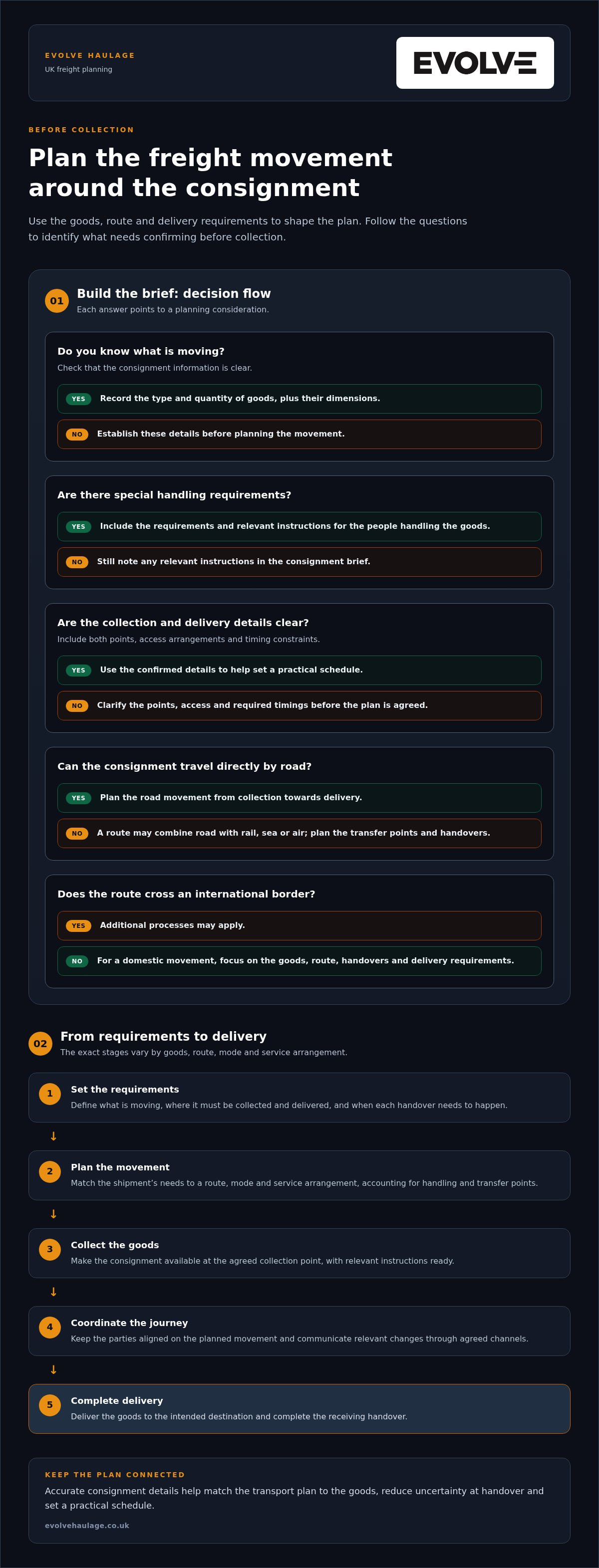
Before collection, the sending business and transport coordinator establish what is moving and what the delivery needs to achieve. Useful details include the type and quantity of goods, their dimensions, any special handling requirements, collection and delivery addresses, access arrangements and timing constraints. Accurate information helps match the transport plan to the consignment, reduce uncertainty at handover and set a practical schedule.
The route and mode also affect the plan. A direct road movement may have a different sequence from a journey that includes rail, sea or air. Where a consignment crosses an international border, additional processes may apply; for a domestic movement, planning can focus on the goods, route, handovers and delivery requirements.
A planned freight movement follows a simple sequence: define the requirements, arrange collection, coordinate the journey and complete delivery.
- Set the requirements. Record what is being moved, where it must be collected and delivered, and when each handover needs to happen.
- Plan the movement. Match the shipment’s needs to a route, mode and service arrangement, accounting for handling and any transfer points.
- Collect the goods. Make the consignment available at the agreed collection point, with relevant instructions ready for the people handling it.
- Coordinate the journey. Keep the parties involved aligned on the planned movement and communicate relevant changes through the agreed channels.
- Complete delivery. Deliver the goods to the intended destination and complete the receiving handover.
Process diagram: Requirements and timing → transport plan → collection → movement and any transfers → delivery handover
What happens between collection and delivery?
During the journey, coordination connects the original plan with the people and stages involved in moving the goods. For direct road freight, the consignment travels by road from collection towards delivery. A multimodal journey involves a transfer between modes, so timings and handovers need to be planned around each leg. The Department for Transport provides information about the UK transport system and its wider policy context.
Communication matters at each handover. Clear instructions help the sender, transport coordinator and recipient understand what is expected. Updates also help businesses respond if the plan changes. The communication arrangement should suit the service and the people responsible for the movement.
In freight transport UK, delivery is the point where the planned movement reaches its intended destination and the goods are handed over. Businesses coordinating regular or time-sensitive road movements can explore Evolve Haulage’s UK road freight transport as part of their wider transport plan.
Which UK freight transport mode fits different shipment needs?
The right mode depends on the whole movement, not simply the distance between two points. Consider where goods need to be collected and delivered, the delivery timing, how the consignment must be handled and whether suitable connections are available. These factors help businesses compare road, rail, sea and air without assuming that one mode is always the quickest, cheapest or most suitable.
| Mode | Typical role | Planning considerations |
|---|---|---|
| Road | Collection, delivery and movement between business locations | Route, access, load arrangement and delivery window |
| Rail | Movement along suitable rail freight routes, often as one leg of a wider journey | Access to rail terminals and arrangements for onward transport |
| Sea | Movement by vessel, including shipments routed through ports | Port access, sailing schedules, handling and connections at either end |
| Air | Movement by aircraft through cargo facilities | Airport access, cargo handling, route availability and transfer arrangements |
When does road freight suit a UK business movement?
Road freight can connect collection and delivery points across the UK and can also link businesses with rail terminals, ports or airports. It may be arranged as a dedicated load for one consignment or as a partial load. The goods, collection and delivery requirements, access at each location and required schedule all shape the road transport plan.
For example, a business moving goods between a supplier and a distribution site may use road for the full journey. If another mode forms part of the route, road can provide the collection or final delivery leg. A freight transport UK plan should account for these connections, rather than treating the main journey in isolation.
How do rail, sea and air fit into freight planning?
Rail can be considered for journeys that connect with suitable freight routes and terminals. Sea transport involves ports and vessel schedules, while air freight moves through airports and cargo handling facilities. Each mode has its own access points and transfer needs, so a business should consider how goods reach the relevant terminal and continue to their final destination.
Some consignments use more than one mode. This is known as multimodal transport. Goods might travel by rail or sea for one part of the journey, with road transport handling collection, delivery or the connection between facilities. Each transfer adds a coordination point, so the plan needs to align timings and handling across the separate legs.
To compare options, start with the delivery requirement and work through the practical constraints: where each mode can access the consignment, how many transfers are involved and whether the schedules fit the business operation. Then assess the complete route, including its first and final legs. This gives a more useful comparison than judging a mode by one characteristic alone.
What should a business prepare before planning UK freight transport?
A clear consignment brief gives the transport plan a practical starting point. It helps the people arranging, collecting and receiving the goods understand what is moving, where it needs to go and what could affect the handover. For freight transport UK, accurate details support a schedule that reflects the shipment and the receiving business’s needs, rather than relying on assumptions.
What shipment information helps build a practical plan?
Gather the information that affects the load, route and collection or delivery arrangements. If details are incomplete or change, flag this early so the plan can take them into account.
- Goods and quantity: Describe the goods and state the number of items, pallets or units being moved.
- Dimensions and load details: Provide the size and, where available, weight of the consignment, along with how it will be presented for collection.
- Handling requirements: Note any instructions relevant to loading, unloading or keeping the goods in suitable condition during the journey.
- Collection and delivery points: Give complete addresses and explain any site-access arrangements, such as the delivery entrance or booking procedures.
- Timing and dependencies: Set out preferred collection and delivery windows, plus anything that could affect readiness, loading or receipt.
- Operational contacts: Name the people responsible at each end and provide the best way to reach them during the movement.
For example, if goods can only be loaded after production is complete, that dependency could affect collection timing. Similarly, a restricted delivery window or a specific access arrangement needs to be clear before the schedule is set. The more precise the brief, the easier it is to plan a movement around real operational constraints.
If you’re preparing details for a haulage enquiry, the guide to requesting a clear UK haulage quote explains what information helps make the request useful. For broader partner-selection considerations, see the UK road haulage company guide.
How can businesses keep freight plans coordinated?
Agree who is managing the collection and delivery handovers, and make sure each contact understands the planned timing and their role. Internally, align the transport schedule with stock availability, production requirements and customer commitments. If any of these change, promptly update the people coordinating the movement so they can consider the effect on the plan.
For businesses managing recurring movements or several operational requirements, transport management can provide broader oversight of day-to-day coordination. The UK transport management guide explores how that function fits into business operations.
Need to plan a commercial road movement? Discuss your UK haulage requirements with Evolve Haulage.
How can Evolve Haulage support freight transport across the UK?
Once a business understands its goods, delivery priorities and transport requirements, the next step is coordinating a workable road-freight movement. Evolve Haulage provides commercial road freight transport across the UK, with dedicated full and partial loads, time-critical delivery options, transport management and logistics consultancy. These services connect the physical movement of goods with the planning needed to support business operations.
Which Evolve Haulage services support business freight movements?
For consignments that need dedicated transport, a full load can be planned around that shipment. Partial-load services provide an option for consignments that need road transport without requiring a dedicated full load. In either case, the goods, collection and delivery requirements, handling needs and schedule help shape the transport arrangement.
For urgent commercial requirements, Evolve Haulage provides same-day delivery solutions, alongside 24/7 delivery options for time-critical consignments. These services are designed for shipments where timing is a central planning factor. Share the required collection and delivery timings, together with any operational constraints, to help define the movement.
Transport management supports the coordination of day-to-day transport activity, including schedules and operational requirements. This can be useful when a business needs oversight that connects individual freight movements with wider plans for stock, production or customer commitments. Logistics consultancy can also help businesses evaluate their transport arrangements and consider improvements to operational efficiency, compliance guidance and transport strategy.
The service that fits depends on the consignment and what the business needs the movement to achieve. A dedicated load, a partial load or time-critical delivery each addresses a different transport requirement. With transport management and consultancy alongside road haulage, Evolve Haulage can support both individual movements and broader coordination. A practical freight transport UK plan brings shipment details and business priorities into the same discussion.
What is a practical next step for a freight requirement?
Prepare a short outline of the consignment before discussing the movement. Include:
- The goods: A description, quantity, dimensions and any relevant handling instructions.
- The journey: Collection and delivery points, plus any access or handover requirements.
- The timing: Preferred collection and delivery dates or windows, and any fixed operational deadlines.
- The business context: Whether the movement is a one-off requirement, part of regular transport activity or time-critical.
Clear information helps focus the discussion on the load, schedule and service arrangement that best match the requirement. If a detail is still being finalised, identify it as an open point so it can be included in the planning conversation.
For dedicated or partial loads, urgent delivery needs or wider transport coordination, discuss your UK freight transport requirements with Evolve Haulage.
Make your next freight plan work for your business
Strong freight planning is an ongoing business practice, not a one-off decision. As supply needs shift, review whether transport arrangements still support the way your business operates, from stock replenishment to production schedules and customer commitments. Keeping freight decisions connected to those priorities helps teams make informed choices as requirements evolve.
A useful next step is to consider the movements that create the most pressure for your operation. Are timings difficult to coordinate? Do changing consignment needs call for a more adaptable approach? Thinking through these questions can turn your understanding of freight transport UK into practical improvements, whether you’re planning a single movement or reviewing transport coordination more broadly.
Evolve Haulage works with businesses on commercial road freight and transport planning. Share the priorities behind your next consignment to start a focused conversation about the right approach for your operation.
Start a conversation about your next freight movement. A clear first step can make planning ahead more straightforward.
Frequently Asked Questions
What does freight transport mean in the UK?
Freight transport means moving commercial goods from one point to another, within the UK or as part of a wider journey. It covers business consignments such as components going to a manufacturer or finished stock moving to a retailer. Freight transport UK can involve road, rail, sea or air, depending on the route and shipment requirements. The term refers to goods movements, not passenger travel.
Is freight transport the same as haulage?
Not exactly. Haulage usually refers to carrying goods by road, while freight transport can describe goods movements by road, rail, sea or air. The terms are sometimes used loosely in everyday business conversations, so it helps to clarify the movement being discussed. For instance, a consignment may travel by rail for one leg, then rely on road haulage to reach its final delivery point.
What is the difference between freight transport and logistics?
Freight transport is the movement of goods; logistics covers the wider planning and coordination around that movement. This can include organising orders, aligning stock availability and making sure the receiving team is ready. For example, a business replenishing production components needs to plan both their transport and when the factory can receive and use them. Transport is one activity within the broader logistics process.
Can a freight shipment use more than one transport mode?
Yes. A shipment can use a combination of modes, often called multimodal transport. For example, goods might travel by sea between ports, then continue by road to a business delivery point. Each change of mode introduces a handover, so the plan should account for where goods transfer, who is responsible at each stage and how the schedules connect. The shipment’s handling needs also matter at transfer points.
What information is needed to plan a freight consignment?
Start with a clear description of the goods, the quantity and their dimensions. Include how they’re packaged, any handling instructions, and whether they can be stacked or need particular care. Add collection and delivery addresses, preferred timings, site access details and the names of operational contacts. If loading depends on a production run or a site booking, flag that dependency early so it can inform the schedule.
What happens if a freight delivery is delayed?
A delay can affect the receiving business as well as the journey. Share the known change with the relevant contacts, assess its effect on receiving arrangements and agree how to manage the revised plan. A business might need to adjust staff cover, production sequencing or customer communications. Clear, timely updates help teams make decisions based on the latest information rather than assuming the original schedule still applies.
How can a business understand whether its freight plan is working?
Review performance against the business outcomes the plan is meant to support. Compare actual delivery against agreed windows, check whether consignments arrive in the expected condition and record disruptions or handover issues. Then consider their operational impact, such as changes to production or stock availability. Looking at patterns over time can reveal where schedules, information or coordination need adjustment. Use measures that reflect the shipment’s priorities, rather than relying on one indicator alone.


