

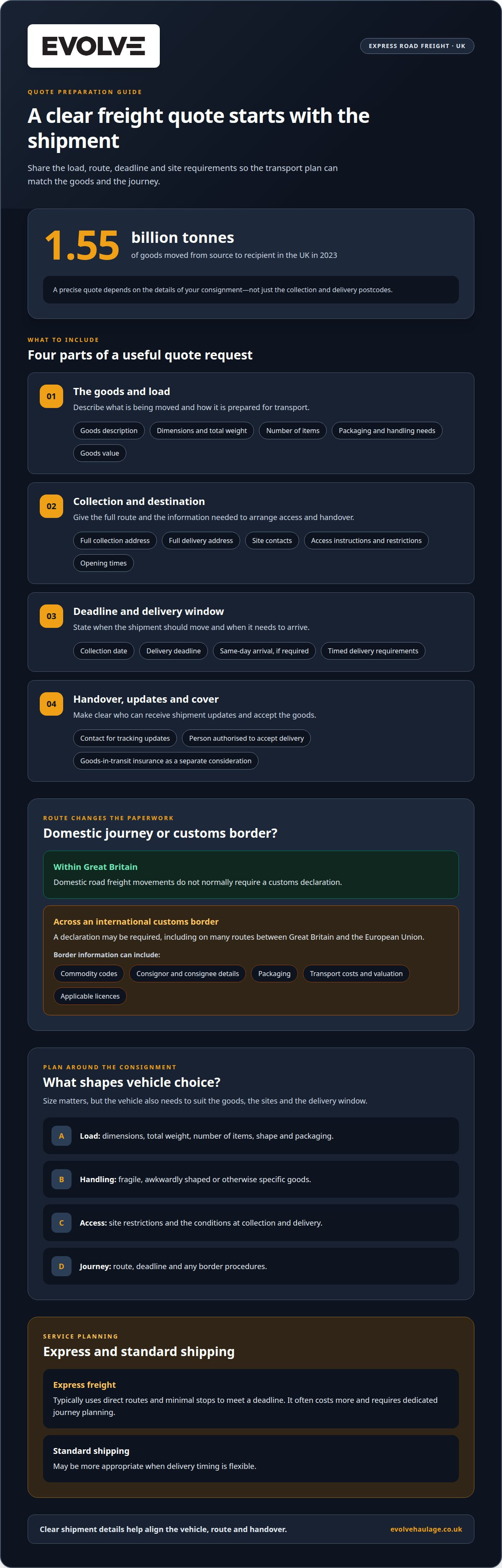
A fast freight quote starts with clear shipment details, not just collection and delivery postcodes. For express road freight in the UK, provide a description of the goods, their dimensions and weight, both addresses, the required timings, and any access or handling needs. This helps match the load to a suitable vehicle and plan the journey.
When a delivery is time-critical, it’s natural to want a quick answer. However, missing details can make it harder to assess the job accurately. If the route crosses an international customs border, the movement may also require customs information, so the destination matters as much as the collection point.
This guide explains what to include in a quote request, how freight size and vehicle choice affect the plan, and what changes between UK and international routes. It also explains how express transport differs from standard shipping, helping you choose a service that suits the shipment and deadline.
Key Takeaways
- Prepare the shipment’s dimensions, weight, collection and delivery details, and timing to help shape a clear quote.
- Match the vehicle to the goods, loading requirements and delivery location rather than choosing on size alone.
- Allow for additional information on international routes, where crossing a customs border can affect the shipment plan.
- Set out your deadline and route when arranging transport so the service can be aligned with the delivery requirement.
What information is needed for a road freight quote?
A precise quote starts with the goods, collection point, destination and required delivery time. In 2023, 1.55 billion tonnes of goods moved from source to recipient in the UK, according to the UK Department for Transport.
Door-to-door collection and delivery
Door-to-door transport means collecting a shipment at its origin and delivering it to the named destination. Provide both full addresses, site contact details, access instructions and opening times. A delivery to a city centre, for example, may need different arrival planning from one to an industrial estate. Clear instructions help coordinate collection and handover.
For a quote, describe the goods, their dimensions and weight, how they are packed, and any loading or handling needs. Include the collection date and delivery deadline, and say whether the shipment must arrive the same day. Urgent business deliveries can keep production moving when a component is missing or get time-sensitive stock to its destination without waiting for a standard schedule.
UK road freight requirements
UK road freight must account for applicable driver-hours rules and vehicle weight limits. Goods-in-transit insurance is a separate consideration, based on the consignment and the cover arranged. Include an accurate description and value of the goods when requesting a quote, so the shipment and its handling requirements can be considered together. The vehicle must suit both the load and the journey.
Tracking and proof of delivery make the journey from collection to delivery easier to follow. Express freight providers use tracking and monitoring systems to keep shipments visible in transit. Share the details of someone who can receive updates, and identify who is authorised to accept the goods. Proof of handover at delivery records that the shipment reached its destination.
Vehicle options for different freight sizes and locations
Vehicle choice depends on the consignment’s size, contents, collection point and destination. Matching the transport to these details helps ensure the vehicle can meet the shipment’s practical needs.
Matching vehicles to consignment sizes
Express freight can carry anything from small parcels to larger consignments, with the transport method shaped by the load. Include the number of items, their dimensions and total weight in your quote request. A compact, single-piece consignment has different loading needs from several bulky items. These details help determine a suitable vehicle for the journey.
Vehicle options for shipment requirements
Size is only one consideration. The goods’ handling needs, access at collection and delivery, and required delivery window also affect vehicle choice. A narrow access road, for example, may affect how a vehicle reaches a site, while a timed delivery requires a transport plan that fits the agreed window. Share site restrictions and handling instructions early.
Freight vehicles and cargo types
Freight vehicles carry varied cargo, from packaged goods to large consignments. The load’s shape, packaging and handling requirements help determine the right option. Specialised vehicles may suit particular shipment needs, but the goods and journey should guide the choice. Describe fragile or awkwardly shaped items clearly, so their transport needs are considered alongside their weight.
Direct vehicle allocation can keep an urgent shipment focused on its collection and destination, rather than treating it as part of a broader load. It also makes the route and handover plan easier to align with a delivery window. Include the exact addresses, access details and deadline so these can inform the allocation. For support aligning vehicle choice with a shipment, explore the haulage service.
UK and international express road freight
Domestic and international express journeys differ most at the border. Domestic road freight movements within Great Britain do not normally require a customs declaration. An international customs border may require one, including on many routes between Great Britain and the European Union.
Express freight typically uses direct routes and minimal stops to meet a deadline. This can suit a production line waiting for a component or an aviation operation needing an urgent part. When timing is flexible, standard shipping may be more appropriate: express services often cost more and require dedicated journey planning.
For an international shipment, establish the destination and route first, then prepare the information needed for the border process. HMRC says customs declarations can require commodity codes, consignor and consignee details, packaging, transport costs, valuation and applicable licences. Accurate details help align the paperwork with the consignment and reduce avoidable complications.
Plan the route to account for border procedures as well as road travel. A delivery deadline should reflect the requirements of the international movement, not just the distance between addresses. For a UK journey, planning focuses on collection, direct routing and delivery arrangements. Crossing a customs border adds declaration requirements.
Express road freight also involves operational risks. Traffic or weather disruption can affect a planned arrival, while inadequate packaging or unclear handling instructions can increase the risk of damage. Share the goods’ handling needs and delivery constraints, and build contingency plans into the route.
To reduce those risks, use suitable protective packaging, provide accurate shipment details and agree clear collection and handover arrangements. Tracking and monitoring can keep a shipment visible in transit, while proof of delivery records the handover. For international consignments, prepare customs information early and ensure it matches the goods and route. The key distinction is simple: domestic movements within Great Britain usually do not need customs declarations, while international border crossings may require them.
How to book express road freight in the UK?
Booking express road freight in the UK starts with a clear collection plan, destination and deadline. Send complete shipment details with your quote request, then agree the service and delivery arrangements before collection. For a cross-border journey, include the destination country because customs requirements can affect preparations.
Use this sequence to organise the request:
- Describe the goods. Give the item count, dimensions, total weight, packaging and any handling requirements. For example, state if a load is fragile or awkwardly shaped.
- Set out the route. Provide full collection and delivery addresses, site contacts, access instructions and opening times. Include both ends, even when a site uses a separate goods entrance.
- State the deadline. Give the collection date, required arrival time and any delivery window. Explain the operational reason for urgency, such as a production component needed to resume work.
- Share route documents. For an international shipment, prepare relevant customs information, including commodity codes and consignor and consignee details. These are among the details HMRC says a customs declaration can require.
The quote can reflect the shipment, route, vehicle requirements and timing. The price depends on the individual job and is provided after you request a quote. Agree the collection and delivery arrangements, including who will hand over and receive the goods. Clear contact details help coordinate both ends of the journey.
During transit, tracking and monitoring systems can keep shipments visible. Make sure the receiving contact is reachable and ready for the agreed handover. Proof of delivery records the completed delivery. If traffic or weather affects the planned route, contingency planning helps address disruption and keep communication clear.
For a time-critical shipment, discuss your express freight requirements and provide the details needed to plan its movement.
Evolve Haulage
Evolve Haulage helps businesses plan urgent road movements by bringing haulage, transport management and consultancy together. Turn to the team when a shipment has a tight deadline, when you need to coordinate collection and delivery, or when the route and vehicle requirements need careful planning. For time-critical UK deliveries, Evolve Haulage provides same-day delivery solutions, alongside 24/7 delivery services. The right details, including the goods, addresses, access requirements and delivery timing, help shape a practical transport plan. Whether you need support with one urgent consignment or wider day-to-day logistics, the focus is on aligning transport arrangements with your operational needs. Contact Evolve Haulage to discuss your freight requirements.
Put your next urgent shipment in motion
The next step is to turn your delivery requirement into a workable transport plan. Define what the deadline means in practice, what the delivery needs to support, and which details will help shape the movement. For express road freight in the UK, a clear brief gives you a practical starting point, whether the priority is a single urgent consignment or better-coordinated logistics.
Evolve Haulage supports transport planning through haulage, transport management and consultancy, helping align the approach with your business needs. Share the shipment’s purpose and the outcome you need to discuss the most suitable way forward. Get in touch to turn an urgent requirement into an organised transport plan.
Contact Evolve Haulage about your freight and start planning your next delivery with confidence.
Frequently Asked Questions
NEED URGENT ROAD FREIGHT SUPPORT?
Evolve Haulage provides time-critical same-day delivery and 24/7 delivery solutions across the UK. This can help when a delayed component is holding up production or a business needs a consignment moved promptly. Share the operational deadline and shipment details to set out the requirement. Transport management and consultancy are also available for wider logistics planning needs.
Will I need a customs declaration for road freight?
Domestic road freight movements within Great Britain do not normally require a customs declaration. A declaration may be needed when a route crosses an international customs border, including on many movements between Great Britain and the European Union. For example, an international consignment’s customs paperwork may need details such as commodity codes, sender and recipient information, packaging and valuation.
What is express road freight in the UK?
Express road freight is transport arranged to move goods quickly, typically using a direct route with minimal stops. Businesses may use it when a delivery deadline matters more than the flexibility of standard shipping, such as when moving an urgently needed production component. Larger consignments may need more planning than a standard courier parcel, including vehicle allocation and coordination at collection and delivery.
Which UK express road freight services are available, including same-day and overnight delivery?
Available arrangements depend on the shipment’s deadline and route. Evolve Haulage provides 24/7 and time-critical same-day delivery solutions across the UK. For a delivery planned overnight, state the required collection and arrival times when describing the job. That helps establish the timing requirement alongside the freight’s size, handling needs and destination, rather than assuming every urgent movement follows the same schedule.
How much does express road freight cost in the UK, and what affects the price?
The price depends on the individual shipment and is provided after a quote request. Key factors include journey distance, consignment size and weight, vehicle requirements, collection and delivery arrangements, and the urgency of the deadline. International routes can require additional planning when customs processes apply. Complete details help produce a quote that reflects the actual transport requirement.
What are typical UK express road freight delivery times and coverage areas?
There is no single transit time for every express shipment: distance, collection timing, route and delivery deadline shape the journey plan. Evolve Haulage provides same-day and 24/7 delivery solutions across the UK. For a practical schedule, give the collection address, destination and latest acceptable arrival time. These details help distinguish a feasible delivery window from a general estimate.


