

A transport manager keeps the daily operation moving safely, compliantly and efficiently. Knowing what a transport manager does means looking beyond dispatch: the role includes overseeing vehicles and drivers, monitoring driver hours, planning routes and maintaining accurate records. For UK businesses with goods vehicles over 3.5 tonnes, the Driver and Vehicle Standards Agency says a professionally competent person must be in charge of compliance.
Keeping deliveries on schedule is only part of the job. Sound planning can also help control fuel use and make better use of fleet capacity. This article explains what a transport manager does, from organising daily work and checking driver hours to overseeing vehicle maintenance and route planning. You’ll also learn how transport management can help businesses keep logistics running smoothly as needs change.
Key Takeaways
- Understand how tachograph reviews can help identify driver-hours issues and support timely follow-up.
- See how vehicle maintenance records and driver oversight contribute to safer, more compliant operations.
- Learn how coordinated planning helps keep transport work organised and fleet capacity aligned with demand.
- Explore how route choices and driving practices can support more efficient fuel use across daily journeys.
Tachograph analysis and driver-hours infringements
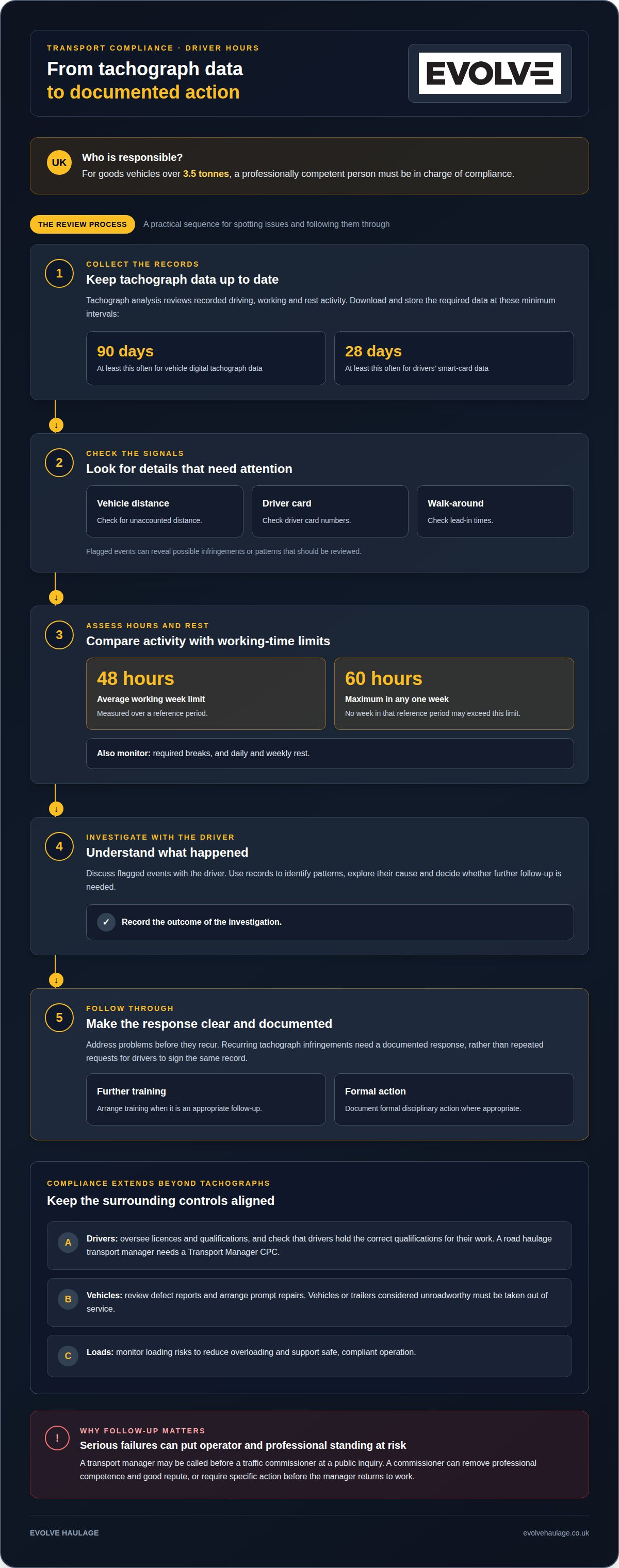
Transport managers review driver records to identify hours breaches and keep haulage operations compliant. They also oversee licences and qualifications, check vehicle defects and manage loading risks.
Tachograph monitoring
Tachograph analysis reviews recorded driving, working and rest activity to identify possible infringements. It helps managers address problems before they recur and maintain accurate records. Where appropriate, vehicle digital tachograph data must be downloaded and stored at least every 90 days, and drivers’ smart-card data at least every 28 days. Checks can include unaccounted vehicle distance, driver card numbers and walk-around lead-in times. Managers should investigate flagged events with the driver and record the outcome.
Road transport working time rules limit the average working week to 48 hours over a reference period, with no week in that period exceeding 60 hours, according to The National Archives (legislation.gov.uk). Managers monitor hours alongside required breaks and daily and weekly rest. They can use tachograph records to identify patterns, discuss the cause with drivers and arrange further training when needed.
A road haulage transport manager needs a Transport Manager Certificate of Professional Competence (CPC) and must effectively manage transport activities; relevant experience supports this work. Yes, a UK transport manager must obtain a CPC. Managers also keep qualifications up to date. In England, Scotland and Wales, EU drivers must register their driving licence with DVLA within 12 months of becoming resident. Managers check that drivers hold the correct qualifications for their work.
Vehicle oversight includes reviewing defect reports and arranging prompt repairs. Vehicles or trailers considered unroadworthy must be taken out of service. Managers also monitor loads to reduce overloading risks, which can compromise safe operation and compliance.
Non-compliance risks and penalties
Non-compliance can put an operator’s licence and a transport manager’s professional standing at risk. When compliance has seriously failed, a manager may be called before a traffic commissioner at a public inquiry. Traffic commissioners can remove professional competence and good repute, or require specific action before a manager returns to work. Recurring tachograph infringements need a documented response, such as further training or formal disciplinary action, not repeated requests for drivers to sign the same record.
What does a transport manager do?
A transport manager coordinates vehicle safety, compliance records and daily operational controls. In the UK, companies with goods vehicles over 3.5 tonnes must have a professionally competent person in charge of compliance, according to the Driver and Vehicle Standards Agency.
Vehicle safety and maintenance records
Vehicle maintenance records document inspections, defects, repairs and planned servicing. They help an operator track whether vehicles remain safe and identify overdue work. Traffic Commissioners for Great Britain say a UK road transport manager must keep vehicle maintenance records for at least 15 months. Preventative maintenance inspection dates should be planned in advance, giving the vehicle operator time to organise checks and address emerging issues.
Loading and vehicle payloads
Safe loading means securing goods properly and keeping the vehicle’s gross weight within its permitted limit. A transport manager oversees loading procedures and monitors payloads to reduce overloading risks and protect vehicle stability. For example, dispatch planning should account for the combined weight of goods, packaging and equipment, rather than treating available space as available payload. Clear instructions help drivers and loading teams follow a consistent process.
Vehicle documents and insurance
Document control brings vehicle records, operator licence details and insurance information together for operational use. Managers keep vehicle details up to date on the Vehicle Operator Licensing system and organise records so relevant information can be retrieved when needed. A historical light-vehicle exemption required at least ten years of continuous management of national or international transport operations, ending on 20 August 2020. This is distinct from current vehicle administration.
Transport and fleet manager roles
A transport manager focuses on coordinating transport activity and meeting operator obligations, whilst a fleet manager typically concentrates on the vehicles as assets, including their use and maintenance. The responsibilities can overlap, depending on the organisation. In the UK, transport manager salaries vary with experience: newly trained managers can start at £28,000, whilst experienced trained managers can earn up to £65,000.
Where vehicle oversight and operational coordination need to work together, transport management support can help align records, planning and compliance.
Managing transport operations effectively
Effective transport management links licence compliance with daily decisions about people, vehicles and delivery schedules. The manager coordinates activity continuously; the role is not just occasional paperwork.
In Great Britain, a transport manager must effectively and continuously manage an undertaking’s transport activities. Standard National and Standard International operator licence holders must have a transport manager; restricted operator licence holders are an exception. The manager needs a genuine link to the undertaking, such as being an employee, director, owner, shareholder or administrator. They must ensure the operator meets its obligations, including those overseen by the traffic commissioner.
Passenger transport has its own operator requirements. A standard passenger transport operator licence authorises its holder to engage in road transport operations, which must be effectively managed. The responsible manager coordinates transport activity and ensures compliance with relevant obligations. The same core principles apply: appropriate professional competence, an active management role and oversight of the operation.
Freelance work can support more than one operator, but it has defined limits in Great Britain. An external transport manager may act for no more than four operators and be responsible for no more than 50 motor vehicles, unless a traffic commissioner sets a lower limit. These limits do not replace the expectation of effective, continuous management. A short site visit every few weeks may make it harder to demonstrate meaningful oversight.
Day-to-day control means matching driver resources to operational demand. Managers plan strategically, tactically and operationally, then coordinate schedules, teams and records. For example, they can compare planned work with available drivers and vehicles, resolve clashes and keep operational information up to date. Regular contact with relevant teams helps turn decisions into workable transport plans.
Professional competence is central to the role. Transport managers must obtain a Certificate of Professional Competence, commonly called the CPC. A relevant course builds the knowledge needed to manage transport activities, but the role also requires ongoing involvement in the operator’s work.
Fuel efficiency and route planning
Route planning helps a transport operation balance delivery commitments, vehicle suitability and fuel use. Before assigning a vehicle, a manager can review the journey’s destination, load, timing and likely traffic. A route with frequent stops, for example, may suit a different vehicle from a direct national journey. Matching the vehicle to the work supports practical logistics planning.
Fuel use depends on more than distance. Managers can compare fuel records with route conditions, delivery patterns and vehicle use to identify opportunities to improve planning. A repeated journey involving avoidable detours, extended waiting or poorly coordinated loads may need a revised schedule. Reviewing these factors together helps an organisation make informed adjustments instead of treating fuel use as a standalone figure.
Useful planning covers the whole journey, from collection to final delivery. The manager can map delivery windows, account for traffic and road access, and coordinate stops to avoid unnecessary mileage. If a delay changes the plan, dispatch teams can update the delivery sequence and tell drivers. Clear instructions help drivers follow a workable route and keep to the service schedule.
- Match vehicle and load: choose a suitable vehicle for the goods and planned route.
- Review journey patterns: compare fuel records with routes, waiting time and delivery stops.
- Adjust plans: revise schedules when traffic or delivery conditions change.
Driver behaviour also affects fuel efficiency. Consistent route briefings, sensible scheduling and feedback on recurring journeys can help teams identify inefficient practices. Drivers are key members of the operation, so practical feedback should connect route decisions with conditions on the road. Managers can then refine plans using operational experience as well as records.
A certificate of professional competence supports a transport manager’s wider role, but route planning depends on applying operational judgement to each job. For support coordinating haulage logistics and delivery planning, discuss transport planning support.
Evolve Haulage: Transport Management
Evolve Haulage provides transport management to support smooth, compliant day-to-day logistics operations. This is a practical option for businesses that need professional oversight of transport activity alongside delivery work. Consultancy can also help when operational processes need a focused review.
If you need to move goods rather than manage the operation, Evolve Haulage also provides road haulage services across the UK, including time-critical same-day delivery. The right service depends on the task: transport management supports ongoing logistics operations, while haulage meets a delivery need.
If you’d like to discuss transport management or haulage for your business, contact Evolve Haulage.
Put your transport priorities into action
Understanding what a transport manager does can help you decide where your operation needs stronger coordination. Start by identifying pressure points, such as changing delivery demands, gaps in oversight or processes that need better alignment. Use those priorities to guide a practical discussion about support for your day-to-day operation.
Transport requirements can shift as customers, routes and workloads change. A considered plan gives your business a clearer basis for operational decisions and responding to new demands. You don’t need to solve every challenge at once: start with the issue that most affects the smooth running of your logistics, then consider what support fits.
Contact Evolve Haulage to discuss your transport requirements and explore a suitable next step for your business.
Frequently Asked Questions
What are the main duties of a transport manager in the UK?
A transport manager coordinates the people, vehicles and records needed to run a compliant transport operation. This can mean matching driver availability to planned work, responding when a vehicle becomes unavailable and keeping operational records organised. If a vehicle defect disrupts a delivery plan, for example, the manager coordinates the response and updates the schedule so teams have clear instructions.
What are the legal responsibilities of a transport manager under a UK operator's licence?
A transport manager is responsible for effectively and continuously managing the undertaking’s transport activities and supporting compliance with its operator licence obligations. This means taking an active role in decisions, not simply holding a qualification without managing the operation. The manager is also accountable to the wider public through the traffic commissioner, so unresolved compliance problems can lead to scrutiny at a public inquiry.
How does a transport manager ensure vehicle roadworthiness and maintenance compliance?
A transport manager oversees a process that connects inspection findings to action: recorded defects need assessment, repairs must be arranged, and vehicles that are not roadworthy must be taken out of service. For example, a vehicle reported with a safety-related defect should not simply remain on the schedule. Maintenance records create an audit trail, and Traffic Commissioners for Great Britain require them to be kept for at least 15 months.
What are a transport manager's responsibilities for drivers, working hours and tachographs?
A transport manager checks drivers’ hours records and tachograph data for possible breaches, then follows up on discrepancies with the driver. For example, repeated signs of missed rest or inconsistent journey records call for investigation and a documented response, such as further training where appropriate. Managers also organise tachograph data downloads and ensure drivers understand the hours, breaks and rest requirements that apply to their work.


