

Dangerous goods compliance is not just a paperwork task. Transport managers need to coordinate it with operator licensing, vehicle maintenance, driver oversight, workplace safety and accurate records. Effective haulage compliance guidance brings these responsibilities together as part of a consistent operation.
Keeping vehicles moving and meeting delivery commitments are important, but compliance also depends on the controls behind each journey. These include suitable vehicle checks, safe loading and procedures that account for the goods being carried.
This guide explains transport managers’ core duties, key UK transport and workplace safety requirements, and how to organise records for an audit. It also covers why dangerous goods need specific attention, how everyday processes fit together and when a focused compliance review can help.
Key Takeaways
- Understand how transport managers bring licensing, driver oversight and vehicle upkeep into a consistent compliance routine.
- Learn how workplace transport safety includes vehicle visibility, safe operations and attention to DVSA enforcement.
- See how organised records and audit preparation help demonstrate that compliance processes are being followed.
- Recognise why dangerous goods require specific procedures and ongoing attention to relevant training.
What Are the Core Compliance Priorities for Transport Managers?
Transport managers coordinate licensing, driver oversight and vehicle compliance across daily operations. Their decisions affect whether an operator meets traffic commissioner standards and manages enforcement risks effectively.
Operator Compliance Risk Scores
Operator Compliance Risk Scores (OCRS) indicate an operator’s recorded compliance risk. Transport managers can use score information to identify where closer oversight may be needed and address operational weaknesses. Reviewing OCRS information regularly can help managers spot patterns and focus on recurring issues. Treat the score as a monitoring tool, not a substitute for sound compliance systems.
Operator Licensing Requirements and Responsibilities
An operator’s licence is generally required for UK businesses using goods vehicles over 3.5 tonnes gross vehicle weight commercially on public roads. The licence type and its conditions shape the operator’s responsibilities, including maintaining vehicles and meeting the authorised financial standing requirements. For a standard HGV operator licence, financial standing is £8,000 for the first vehicle and £4,500 for each additional vehicle. UK drivers must complete 35 hours of periodic training every 5 years, according to the Driver and Vehicle Standards Agency.
Licence Changes, Reporting and Costs
Operators must report major changes to their licence details to the Traffic Commissioners of Great Britain within 28 days. Changes can affect the accuracy of the licence and the operator’s ability to work within its conditions, so transport managers should maintain a clear record of amendments. Application and licence costs depend on the application and licence requirements; there is no single cost that applies to every haulage business.
Drivers’ Hours, Rest and Tachograph Rules
Drivers’ hours rules govern driving, breaks and rest, while working-time requirements also apply. HGV drivers can take no less than 9 hours’ daily rest within a 24-hour period, up to three times a week. They can work a maximum of three 15-hour days a week if other working-time rules are met; the weekly average limit is 48 hours under the Working Time Directive. Operators should download driver card tachograph data every 28 days and vehicle unit data every 90 days. These records help managers oversee compliance and identify issues for follow-up.
What Are the Key Transport Compliance and Safety Requirements for UK Workplaces?
Roadworthiness controls combine scheduled inspections, driver checks and reliable maintenance records. Before a vehicle enters traffic, operators also need to consider load security and visibility.
Roadworthiness Checks and Prohibitions
Roadworthiness checks assess whether vehicles and trailers are safe to use. Prohibition notices identify defects that prevent or restrict operation. Linking checks to prompt repairs helps stop known defects from carrying over into later journeys.
Vehicle and trailer inspections should follow the frequency stated on the operator licence. Commercial vehicles must also pass an annual MOT, with preventative maintenance inspections scheduled between tests. Operators should carry out at least one walkaround check every 24 hours while a vehicle is in service.
Each check needs a clear record of defects and their rectification. Internal maintenance inspection sheets should follow section 4.4 of the Guide to maintaining roadworthiness. Brake performance evidence should be available at every safety inspection, and inspection intervals should be justified for the operation.
For roadside checks, accurate maintenance records help managers track defects and repair history. External maintenance contracts should be suitable with reference to annex 5 of the Guide to maintaining roadworthiness. Internal maintenance facilities should also have photographic evidence showing compliance with section 5.1.
Vehicle Markings, Loads and Weight Limits
Conspicuity markings help other road users see vehicles. Include their condition in routine checks and address damage or deterioration before dispatch. During roadside scrutiny, DVSA enforcement may examine vehicle condition and supporting maintenance records.
Load security means choosing restraint methods suited to the cargo and vehicle, then checking that the load remains stable. No single load-securing system suits every situation. The 100 / 50 / 50 load-restraint standard is a reference for UK operators, while the load itself and its distribution shape the practical restraint choice.
Vehicle weight and axle loads must stay within the applicable limits. Permitted figures depend on the vehicle’s plated limits and axle configuration, so check both total weight and its distribution. These checks support safe operation and reduce the risk of an overloaded vehicle entering service.
For coordinated logistics processes, haulage compliance support can complement workplace controls.
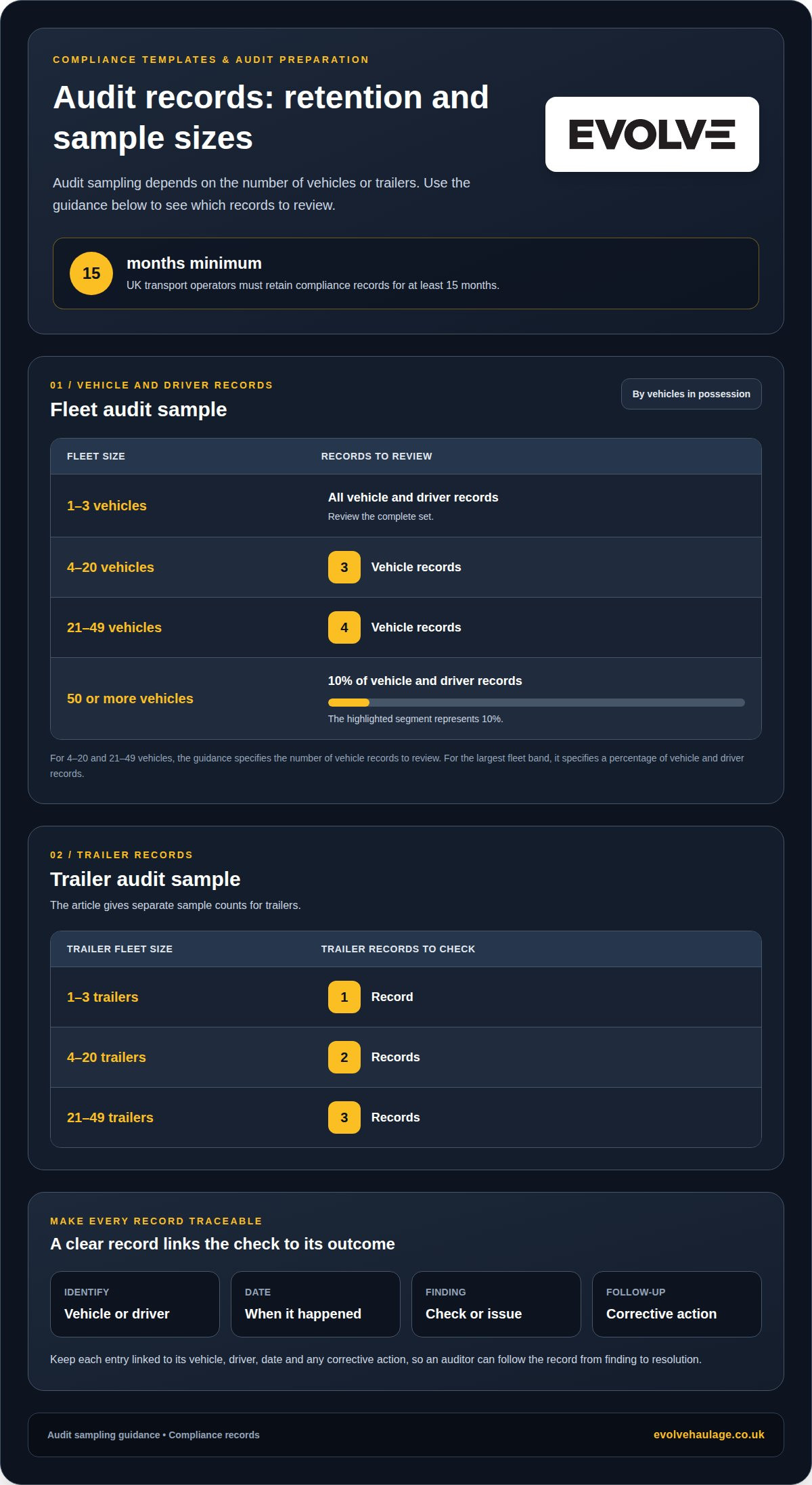
Compliance templates and audit preparation
Clear templates help operators organise evidence for drivers, goods vehicles and transport activities. A consistent record structure also makes audit preparation easier.
Compliance Templates and Records
Compliance templates provide a repeatable way to record checks, training, maintenance and follow-up actions. Their purpose is to make evidence easy to find and review, not simply to accumulate forms.
UK transport operators must retain compliance records for at least 15 months. Keep each entry linked to its vehicle, driver, date and any corrective action, so an auditor can follow the record from finding to resolution.
Audit sampling depends on fleet size. For operators with 1-3 vehicles in possession, the audit guidance recommends checking all vehicle and driver records. For 4-20 vehicles, it recommends reviewing 3 vehicle records; for 21-49, 4 records. With 50 or more vehicles, the sample is 10% of vehicle and driver records.
Trailer records have separate sample guidance: check 1 record for 1-3 trailers, 2 for 4-20, and 3 for 21-49. For 50 or more trailers, review 10% of records. This helps focus preparation on the relevant fleet evidence.
Transport Audits and Regulator Inspections
A transport audit reviews whether an operator’s processes and records support compliance with regulations and licence conditions. Regulatory inspections can examine similar evidence, so consistent record-keeping matters beyond internal reviews.
Independent compliance audits can provide a structured assessment of fleet and driver records. ISO 9001:2015 certification can indicate an audit provider’s qualifications, but it is not mandatory. The useful outcome is a clear account of gaps, evidence and actions, not a certificate alone.
Prepare by organising operator licence documents, goods vehicle maintenance files, driver records and relevant training evidence. Record each finding, assign responsibility for follow-up and track its status. Keep the completed audit with its supporting documents. For international transport, organise operation-specific records just as carefully so they are accessible during a review.
Dangerous goods compliance
Dangerous goods require controls suited to the consignment and journey. Practical haulage compliance guidance connects load information, handling arrangements and staff responsibilities before dispatch. First, establish what goods are being carried and what information is needed to handle them safely. If the consignment changes, review the arrangements against the updated details.
Keep consignment information accurate and accessible to everyone involved. It should support clear communication between the person arranging transport, loading staff and the driver. For example, check that the details used to plan the vehicle and handling arrangements match the goods presented for collection. Consistent information helps prevent confusion during handovers.
Plan loading and delivery as one process. Give staff practical instructions for handling and securing the load, and provide the driver with relevant journey information and a clear way to raise concerns. At delivery, record any issue or change and pass it to the responsible person. This creates a traceable record from collection to handover.
Training and refresher activity help keep responsibilities understood. Transport managers should complete refresher training or continuing professional development within 5 years of their certificate or last training. Keep evidence of this activity with relevant role records. A transport centre can make current procedures accessible, helping staff refer to consistent instructions during routine work.
Integrate dangerous goods controls with wider transport processes instead of treating them as isolated paperwork. Tachograph information supports driver-hours oversight, while consignment records document the load and its handling. Use haulage compliance guidance to define who reviews records, handles reporting and tracks corrective actions. Documented responsibilities make follow-up clearer when an issue arises.
For support aligning transport operations and compliance processes, discuss your transport management requirements.
Evolve Haulage
Evolve Haulage helps businesses coordinate day-to-day transport operations and compliance responsibilities. Its transport management and consultancy services support operators who need practical help coordinating logistics, reviewing processes or managing ongoing transport requirements. Its haulage service can also support businesses arranging goods movements alongside these operational needs.
Consider support when compliance processes are difficult to coordinate with delivery demands or your operation needs additional management input. The right approach depends on your requirements and the work you need to deliver.
Contact Evolve Haulage to discuss your transport requirements.
Make compliance part of every operational decision
Make compliance part of operational decision-making rather than a separate administrative task. Use haulage compliance guidance to assign responsibilities, keep procedures current and make emerging issues visible before they affect a journey. Clear ownership helps teams respond consistently when vehicles, people or loads change.
Build a review routine around operational changes. A new type of load, a revised route or changed working arrangements can affect how procedures are applied. Keep the relevant people informed so practical controls stay aligned with the work being carried out. This also gives managers a clearer basis for deciding when processes need attention.
For support with transport operations and compliance planning, contact Evolve Haulage. A considered next step can help turn compliance priorities into workable routines for your operation.
Frequently Asked Questions
What Statutory Duties and Operator Licensing Rules Apply?
UK businesses generally need an operator’s licence to use goods vehicles over 3.5 tonnes gross vehicle weight commercially on public roads. A goods vehicle without a gross plated weight may also require a licence if its unladen weight exceeds 1,525 kg and it carries goods for business. Operators must meet the relevant licence conditions, including financial standing, and keep their operation aligned with traffic commissioner standards.
Do I need a Transport Manager Certificate of Professional Competence (CPC)?
A Transport Manager CPC is required for anyone managing a company that operates vehicles over 3.5 tonnes. The qualification supports a transport manager’s role in overseeing compliance and the operation of the licence. For example, managing vehicle maintenance, driver oversight and transport records calls for clear operational control. The requirement relates to managing the operation, not simply owning or driving a goods vehicle.
Do holders of a CPC need to do ongoing training and testing?
Transport managers should complete refresher training or continuing professional development within 5 years of their certificate or last training, according to the audit guidance. This supports current knowledge as operating practices and responsibilities evolve. That recommendation is distinct from Driver CPC: professional drivers must complete 35 hours of periodic training every 5 years, according to the Driver and Vehicle Standards Agency. These requirements do not mean the same thing.
How Do You Create a Safe Site, Vehicle, and Driver Combination?
Plan site movements so vehicles, pedestrians, loading activity and visitors can be managed safely. The Health and Safety at Work etc. Act 1974 and Management of Health and Safety at Work Regulations 1999 govern UK workplace transport operations. Match each journey with a roadworthy vehicle and a suitably qualified driver, then coordinate safe loading and clear site instructions. Review the arrangements when the site layout or work changes.
What records must UK haulage operators keep, and for how long?
Keep organised evidence covering vehicle maintenance, driver activity, training and compliance checks. UK transport operators must retain compliance records for at least 15 months. Tachograph analysis documentation has a separate minimum retention period of 12 months. For a practical example, link a maintenance defect record to its repair evidence, so the sequence can be followed during an audit without relying on staff recollection.
What are the UK rules for driver training, Driver CPC and licence categories?
Professional drivers must complete 35 hours of periodic training every 5 years, according to the Driver and Vehicle Standards Agency. Driving licence categories C and CE cover large goods vehicles, respectively without and with trailers over 750 kg. Match the driver’s entitlement to the vehicle and trailer combination assigned. A practical control is to review licence entitlements periodically and record any follow-up needed.


