

What if two haulage quotes cover different services, even when they appear to move the same freight? A useful haulage quote UK businesses can compare starts with accurate details about the cargo, collection and delivery requirements.
It’s understandable to focus on the headline price, but a figure on its own won’t show whether the proposed arrangement fits your shipment. Cargo dimensions and weight, collection and delivery postcodes, preferred dates, site access and loading arrangements all help define the job. Leaving out key information makes it harder to understand what a quote covers or compare it fairly with another.
This guide explains what to prepare before requesting a quote, how to describe your delivery needs and which service details to review before making a decision. You’ll also see how your freight requirements can relate to dedicated full or partial loads, time-critical delivery and transport management. With the right information from the outset, you can assess the service as well as the price and choose an arrangement suited to your delivery requirement.
Key Takeaways
- Understand which cargo, route, timing and service details shape a clear haulage quote UK businesses can assess.
- Prepare accurate consignment information, including the cargo description, quantity, dimensions and weight.
- Tailor your request to the load and deadline, including whether a dedicated full or partial load is more relevant.
- Compare quotes against the same shipment details, then review the scope, timing, communication and stated conditions.
- Organise your shipment facts and service requirements before submitting an enquiry to Evolve Haulage for a tailored commercial freight arrangement.
What a UK haulage quote should explain before you commit
A haulage quote is an offer to move a specific consignment, based on the cargo, route, timing and service requirements provided. It should give you enough detail to understand the proposed transport arrangement, not just a figure to approve. For a general overview of the term, see What is Haulage?
For a business shipment, the quote should reflect your actual operating need. A tailored commercial freight quote considers the information supplied about the load and delivery, whereas a generic price-comparison result may show headline offers without making the scope behind each one equally clear. The important point is to compare what each offer covers.
A useful haulage quote states what is being moved, where and when it needs to travel, and which transport service is proposed, alongside any relevant assumptions or exclusions. A clear scope makes it easier to assess whether the arrangement fits your consignment and compare it with another quote.
What should a haulage quote make clear?
Read the service description alongside the shipment details you provided. Check that the proposed collection and delivery points, required dates or timing, and any delivery constraints reflect your request. If you specified a load size or handling need, the quote should make clear how the proposed service relates to that consignment.
Pay attention to wording that sets boundaries around the offer. Assumptions, exclusions and stated terms can affect how you interpret the service, so note them before deciding. For example, if a collection point has restricted access or delivery must fit a specific time window, those details need to be represented in the agreed scope rather than left implicit. Resolve unclear details before treating the figures as comparable.
A practical review can focus on three questions:
- Are the collection and delivery requirements described accurately?
- Does the stated service match the cargo and requirements in your enquiry?
- Are any assumptions, exclusions or conditions clearly set out?
Why the lowest headline figure may not be the best fit
Two figures can relate to different transport arrangements. One quote may reflect the timing or access requirements you specified, whilst another may be based on a simpler scope. If the cargo details, route or delivery conditions differ, the headline amounts aren’t a like-for-like comparison. The difference may reflect a different service, rather than indicate that one offer is better.
Assess value against the job you need done. Consider whether the proposed arrangement aligns with your delivery requirement, how communication will support the movement and whether the stated terms suit your operation. A lower figure may not serve your needs if the scope doesn’t match your deadline or site constraints; a higher one isn’t inherently preferable either. The useful choice is the arrangement whose stated service best fits the consignment and makes its scope clear.
How to prepare the details for a UK haulage quote
A little preparation helps turn a general request into a clear commercial freight enquiry. The more accurately you describe the consignment and collection and delivery arrangements, the easier it is to understand the transport requirement. For a haulage quote UK businesses can assess against their needs, gather the information below before submitting a request.
Describe the consignment and handling requirements
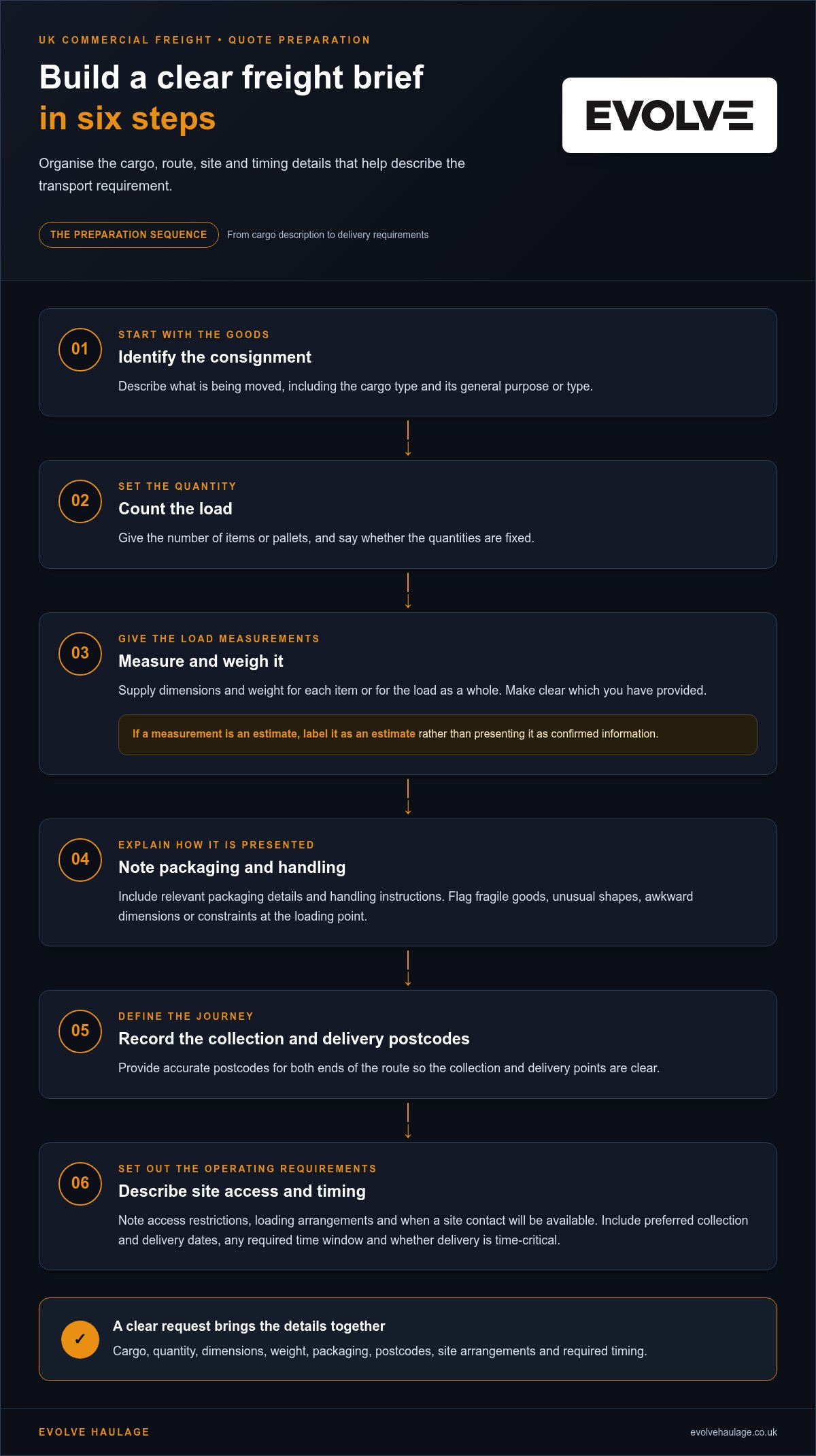
Start with what is being moved. Record the cargo type, number of items or pallets, and the dimensions and weight of each item or the load as a whole. State how the goods are packaged and note any handling instructions relevant to their transport. If you’re estimating a measurement, label it as an estimate rather than presenting it as confirmed information.
Be specific about anything that could affect loading or movement. Unusual shapes, fragile goods, awkward dimensions or constraints at the loading point are useful to flag. Describe the requirement plainly without assuming that specialist equipment will be needed.
Set out collection, delivery and timing information
Provide the collection and delivery postcodes, then describe practical site details that may affect the movement. Note access restrictions, loading arrangements and when a site contact will be available. State the preferred collection and delivery dates, any required time window, and whether the delivery is time-critical. These details explain how the job needs to operate, not just the distance between two postcodes.
Use this numbered checklist to organise your request:
- Identify the consignment: describe the goods and their purpose or general type.
- Count the load: specify the number of items or pallets and whether quantities are fixed.
- Measure and weigh it: give item-by-item or combined dimensions and weight, making clear which you’ve supplied.
- Explain packaging and handling: include relevant instructions and flag fragile, unusual or awkward cargo.
- Record the route: provide accurate collection and delivery postcodes.
- Describe site and timing constraints: note access, loading arrangements, contact availability, dates, time windows and urgency.
A clear commercial freight request names the cargo, quantity, dimensions, weight, packaging, collection and delivery postcodes, site access arrangements, contact availability and required timing. Keeping these facts together also makes it easier to update your enquiry if a quantity or delivery requirement changes. The Road Haulage Association’s UK Road Haulage Industry Overview offers wider context on the sector, whilst your request should focus on the specifics of your consignment.
Before sending, check that the measurements use consistent units and both postcodes are correct. If a detail is not yet final, mark it clearly as provisional so it isn’t mistaken for a confirmed instruction. With the shipment facts organised, you can discuss a tailored commercial freight requirement with Evolve Haulage and explain the service your delivery calls for.
Match the haulage quote request to your load and deadline
The right transport arrangement depends on what you’re moving and what the delivery needs to achieve. A haulage quote UK businesses can act on should reflect both: describe the load clearly, then state whether the priority is a dedicated vehicle arrangement, a partial load or a time-critical delivery. Use the comparison below to shape your request, rather than choosing an option based on its label alone.
| Shipment circumstance | What to make clear in your request |
|---|---|
| The consignment needs a dedicated vehicle arrangement | Explain why the load needs a dedicated vehicle and state the collection and delivery requirements. |
| The consignment is less than a full vehicle load | Give the load’s quantity, dimensions and weight, then describe the delivery need and any handling constraints. |
| The delivery is time-critical | State the reason for urgency and provide the required collection and delivery windows. |
| The preferred date is flexible | Separate the preferred date from any firm deadline and indicate where timing can be adjusted. |
Explain whether the load needs dedicated or partial transport
Dedicated transport is a request for a vehicle arrangement dedicated to your consignment. Partial freight describes a load that uses less than a full vehicle load. These are high-level distinctions, not a substitute for describing your shipment: load size, handling needs and delivery requirements all help define the appropriate arrangement. For a fuller discussion of the differences, read the dedicated haulage and shared freight comparison.
Don’t assume that one approach is always more suitable. Explain whether the consignment needs a dedicated vehicle or whether a partial-load arrangement fits the shipment and delivery requirement. Evolve Haulage provides dedicated full and partial freight loads, with the arrangement tailored to the commercial transport need.
Make urgent delivery requirements explicit
If timing is critical, state why. A production requirement, scheduled site activity or another operational dependency can help explain the consequence of missing the required window. Give the earliest practical collection time and the delivery deadline or time window, and say which parts are fixed. This distinguishes a time-critical need from a preferred date that has room to move.
Evolve Haulage provides 24/7 and same-day delivery solutions for time-sensitive consignments. Set out the urgency in your request so the requirement is clear from the outset, without treating a requested window as a delivery guarantee. For general information about driver and vehicle oversight, consult the DVSA’s UK Haulage Regulations and Standards resource.
Match the request to the consignment and business need: explain the load arrangement you’re seeking, identify what makes the timing important and distinguish firm constraints from preferences. Those details help Evolve Haulage understand the requirement and shape a suitable commercial freight proposal.
How to compare haulage quotes on a like-for-like basis
A useful comparison starts by checking whether each quote is based on the same job. A lower headline amount may reflect a different service scope, delivery window or set of assumptions, rather than a better fit for your business. Before weighing up the figures, line up the details each quote uses and identify any differences that could affect the transport arrangement.
Check that each quote covers the same job
Compare the cargo description and load arrangement, along with the collection and delivery details. Check whether each quote reflects the same handling requirements and timing. Even a change to site access information can alter the practical scope: a quote based on straightforward loading may not be equivalent to one that accounts for a restricted access point.
Look for stated assumptions, exclusions and conditions that shape what is being offered. An omission doesn’t prove that a service is unsuitable, but missing or different information makes direct comparison harder. If the requests weren’t identical, note where they differ before deciding what the quoted amount means.
Assess delivery fit and working communication
Next, compare the delivery expectations with your actual business requirement. A stated date or time window describes the proposal, not necessarily a guarantee. Consider whether the arrangement fits your operational deadline and how clearly the service and next steps are explained. Clear communication helps you understand what has been proposed and what information is needed to progress the enquiry.
For a broader framework, explore questions to ask a haulage company and the reliable haulage partner guide. These cover wider provider discussions and partnership considerations beyond comparing the scope of individual quotes.
Use this checklist to keep the comparison focused:
- Scope: Does each quote describe the same cargo, load arrangement and handling requirements?
- Route and access: Are the collection and delivery details, including relevant site constraints, consistent?
- Timing: Do the proposed collection and delivery expectations align with your requirement?
- Communication: Is the service described clearly, with understandable next steps?
- Conditions: Have you identified assumptions, exclusions or stated terms that differ?
- Operational fit: Could the proposed arrangement meet the needs of your consignment and business?
This process puts a haulage quote UK businesses receive into context: the quoted amount matters, but so does the service it represents. If an important shipment detail differs between quotes, compare the scope carefully rather than treating the figures as directly equivalent.
Once you’ve organised the requirements and comparison points, review Evolve Haulage’s commercial haulage services in relation to your freight requirement.
Request a tailored UK haulage quote from Evolve Haulage
A clear enquiry gives Evolve Haulage a practical starting point for understanding your commercial transport requirement. Prepare the shipment facts, state the service you need and submit your enquiry. This keeps the discussion focused on the consignment, its delivery needs and the transport arrangement that may suit your operation.
A haulage quote UK businesses can assess depends on a brief that reflects the real job. If a detail is provisional, label it as such. If the requirement changes, update the information so the proposed service can be considered against the latest shipment plan.
Send a concise and complete freight brief
Keep the brief organised and to the point. Include the cargo description, quantity, dimensions and weight, then set out the collection and delivery requirements. State whether you’re seeking a dedicated full load, partial freight or time-critical delivery. Add relevant access restrictions, handling instructions and contact availability so practical delivery considerations are included in the enquiry.
Before submitting, check that the information is consistent. A mismatch between the stated load and its dimensions, for example, can make the requirement harder to interpret. Accurate details help Evolve Haulage understand the consignment and consider a tailored commercial freight arrangement.
- Organise the shipment facts: bring the consignment details and route information together.
- State the service requirement: explain the load arrangement and whether timing is urgent or flexible.
- Submit the enquiry: include access, handling and contact details relevant to planning the movement.
Move from quote to a workable transport plan
When you receive a proposed service, review its scope against the requirement you submitted. Clarify any detail that affects the load, timing or delivery arrangement before deciding how to proceed. This keeps the discussion centred on whether the proposal fits your operation, rather than relying on the headline figure alone.
For a single movement, focus on the needs of that consignment. If your requirements extend across multiple movements or involve broader coordination, Evolve Haulage’s transport management support can form part of the discussion. Its UK commercial road freight, dedicated full and partial loads, and time-critical same-day delivery solutions address different transport needs, depending on the requirement.
A concise, complete brief gives the conversation a sound basis, and relevant planning details can be considered as the requirement is discussed. To outline your consignment and discuss a UK haulage requirement with Evolve Haulage, submit an enquiry with the shipment facts and service need. This gives you a clear starting point for discussing the transport arrangement your business requires.
Turn your freight brief into a confident next step
A well-prepared haulage quote UK request can do more than support a transport decision. It gives your operations and procurement teams a shared reference point for agreeing the requirement, reviewing the proposed arrangement and recording changes before the movement is planned. Keep the final brief with your shipment records so key details stay consistent if the consignment or delivery plan changes.
For your next enquiry, focus on clarity rather than length. State what the business needs to move and the outcome the delivery must support, then use the discussion to resolve any remaining scope questions. This creates a practical starting point for planning without committing to an arrangement before it fits the requirement.
Have a freight requirement to discuss? Discuss your freight requirements with Evolve Haulage and take the next step towards a transport plan that works for your business.
Frequently Asked Questions
What information do I need to get a haulage quote in the UK?
To request a haulage quote UK businesses can assess, provide a clear description of the goods, how they’re packaged and the quantity being moved. Include dimensions and weight, collection and delivery postcodes, preferred dates and any site constraints. If a shipment has several item sizes, list them separately rather than giving only a combined measurement. This helps the transport requirement be understood without guesswork.
How much does a haulage quote depend on the size and weight of a load?
Size and weight can affect the vehicle arrangement and space needed for a consignment, so both matter when a quote is prepared. Two loads with the same weight may take up very different amounts of room, whilst an unusually heavy item may affect how the movement is planned. Provide measurements and weights in consistent units, and distinguish individual item figures from total load figures to avoid ambiguity.
Can I request a UK haulage quote for a partial load?
Yes, you can request a quote for a partial load. Give the quantity, dimensions and weight of the freight, along with collection and delivery requirements, so the consignment can be considered as less than a full vehicle load. If the shipment is part of a larger or recurring movement, mention that context too. Evolve Haulage handles dedicated full and partial freight loads for commercial clients.
How long does it take to receive a haulage quote?
There isn’t one fixed timeframe that applies to every haulage quote. The information supplied and the complexity of the transport requirement can affect how much assessment is needed. A complete brief is easier to interpret than one with missing measurements, uncertain postcodes or unclear delivery constraints. Include any firm deadline in your enquiry, but don’t assume that submitting a request means a quote will arrive instantly.
What happens if my collection or delivery details change after requesting a quote?
A change to the route, collection access or delivery timing may alter the transport requirement the original quote was based on. Share the revised information before proceeding, especially if a postcode, site restriction or delivery window has changed. Keep a record of which details were updated and review any revised quote against the new plan. This helps avoid arranging transport around outdated instructions.
Do haulage quotes include loading and unloading?
Don’t assume loading and unloading are included in the quoted amount. Check whether the quote states who is responsible for each activity and describes any handling requirements. A collection where goods are ready at a loading point, for example, may differ from a site where access or loading arrangements need coordinating. Make responsibilities clear in the agreed transport scope before the movement is arranged.
Is a haulage quote the same as a confirmed delivery booking?
No. A quote sets out a proposed service and its stated terms; it isn’t automatically confirmation that a delivery has been booked. Review the scope and any conditions, then follow the acceptance and booking process provided for the arrangement. Keep the written confirmation with your shipment records, including the agreed collection and delivery details. This gives your team a clear reference when coordinating the consignment.


