

“Haulage contractor” is pronounced “HAW-lij kun-TRAK-tuh”. A haulage contractor is a person or company that transports goods for others by road or rail. The term describes who carries the freight.
It’s easy to focus on the vehicle and overlook the wider delivery process. Timing, the type of goods and the collection and delivery arrangements all shape how freight reaches its destination. When choosing a haulage contractor, consider how these details affect the movement.
This article explains what haulage contractors do and how haulage relates to freight logistics, distribution and storage. You’ll learn how delivery windows can support changing business needs, what to consider when arranging a movement, and how transport management and time-critical delivery fit in. Understanding the contractor’s role helps clarify which parts of the delivery process need to work together for goods to arrive as planned.
Key Takeaways
- Understand who arranges the physical movement of goods and how that role differs from other parts of freight planning.
- See how flexible delivery windows can help align collections and arrivals with changing operational needs.
- Learn how transport, distribution and storage fit together, and what factors shape a haulage quote.
- Explore how Evolve Haulage’s transport management, haulage and time-critical delivery services can support your requirements.
Definition of a haulage contractor
A haulage contractor is a person or company that transports goods for others by road or railway. It may own or lease the vehicles, equipment and resources used to move a shipment. The term describes the transport role, not a single vehicle type or load size.
The contractor’s role in moving goods
A haulage contractor carries goods between collection and delivery points. For example, a manufacturer may arrange transport for machinery between its factory and another facility. Depending on the job, the service may also include loading or unloading. When planning a movement, consider the goods, route, vehicle suitability and shipment volume. These details define the task and its practical requirements.
Alternatives include using your own vehicles and drivers or arranging rail transport directly. A freight forwarder can coordinate transport as an intermediary, rather than physically carrying the goods. The key distinction is whether your business needs carriage itself or broader coordination.
Licences and vehicle maintenance
Licence and permit requirements depend on the vehicle and operation, so arrangements should reflect the planned movement and goods. Vehicle maintenance also affects operational readiness: the vehicle must suit the load and be maintained for its transport role. A machinery shipment, for example, may require different equipment from a routine commercial delivery, while dedicated roadside assistance providers such as Dependable Towing & Recovery Services illustrate how 24-hour recovery support helps fleets manage unexpected transit delays.
Insurance should provide suitable cover for the transport activity, including relevant liability and goods risks. When comparing haulage contractors, consider their experience with your goods and route, available capacity, vehicle suitability and insurance arrangements. Before booking, provide the cargo details, collection and delivery points, volume and timing needs. Clear arrangements help reduce common problems such as delays, unsuitable vehicles and damage during handling or transit.
A contractor’s asset arrangement can vary with its operation; haulage contractors may own or lease the vehicles, equipment and resources used to move cargo.
Flexible delivery windows
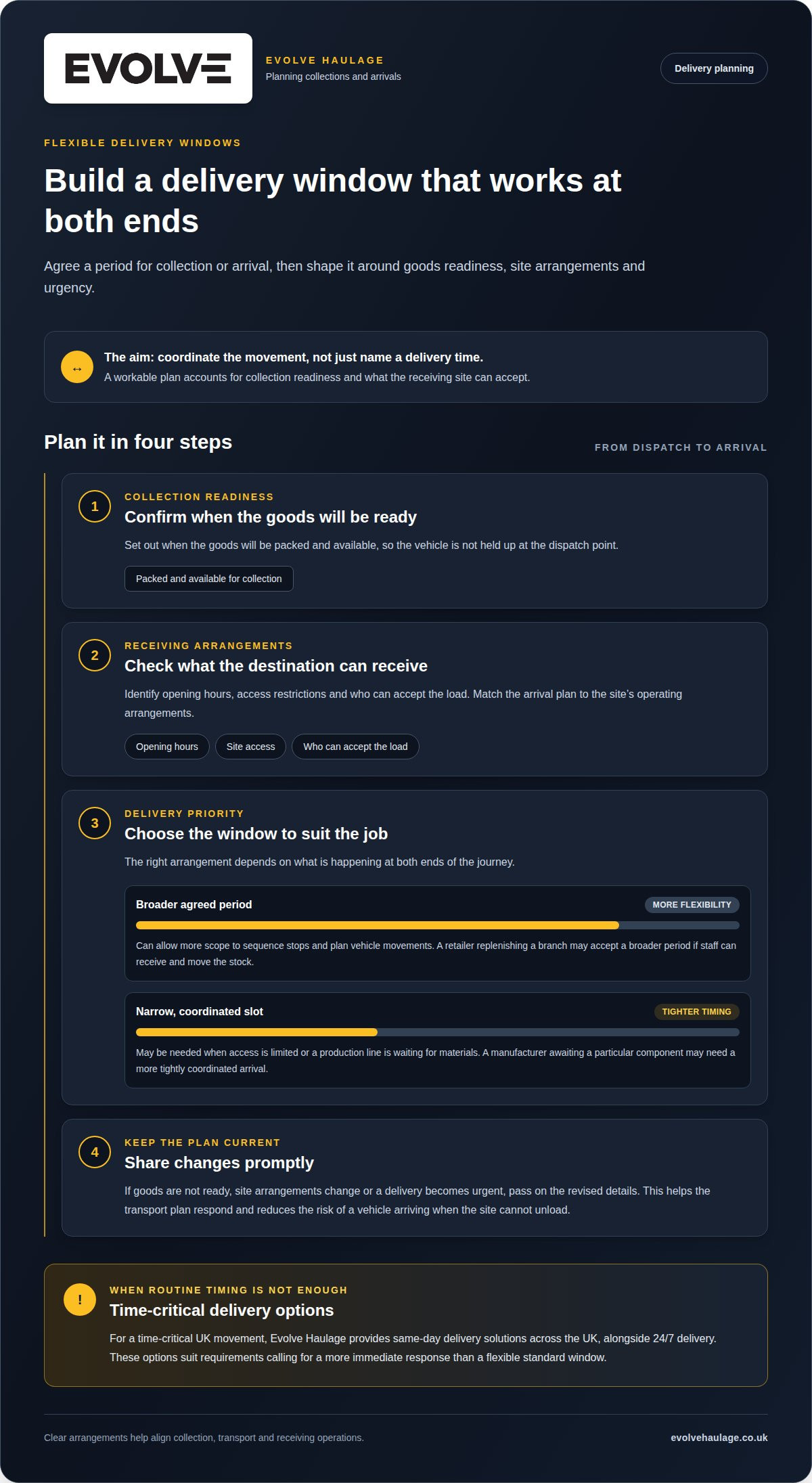
A flexible delivery window sets an agreed period for collection or arrival instead of a single fixed time. For a UK business receiving stock, a morning or afternoon slot can help coordinate staff, unloading space and incoming orders. Choose a window that suits the receiving site’s operating arrangements and the shipment’s urgency.
Flexibility works best when the delivery plan sets clear boundaries. A wide window can allow more scope to sequence stops and plan vehicle movements. A narrow slot may be necessary when a site has limited access or a production line is waiting for materials. The right arrangement depends on what is happening at both ends of the journey.
To shape a workable window, set out:
- Collection readiness: confirm when the goods will be packed and available, so the vehicle is not held up at the dispatch point.
- Receiving arrangements: identify opening hours, access restrictions and who can accept the load at the destination.
- Delivery priority: distinguish routine replenishment from urgent materials needed to keep a production schedule moving.
A retailer replenishing a branch, for example, may accept delivery over a broader period if staff are available to receive and move the stock. A manufacturer waiting for a particular component may need a more tightly coordinated arrival. Sharing these details helps align the vehicle schedule with the receiving operation, rather than treating delivery time as an isolated instruction.
Changes can affect the plan. If goods are not ready, site opening arrangements change or a delivery becomes urgent, share the revised details promptly. Clear communication helps the transport plan respond and reduces the risk of a vehicle arriving when the site cannot unload.
For a time-critical UK movement, same-day delivery support may suit goods that cannot follow a routine schedule. Evolve Haulage provides time-critical same-day delivery solutions across the UK, alongside 24/7 delivery. These options are relevant when the delivery requirement calls for a more immediate response than a flexible standard window.
Freight logistics, distribution and storage
Freight logistics connects the decisions involved in moving goods from dispatch to destination. Transport is the physical journey, distribution organises how shipments reach customers or sites, and storage means holding goods before or after a movement. Keeping these roles distinct helps a business plan each stage and identify where handovers occur.
A haulage contractor carries goods, while a freight forwarder acts as an intermediary between the shipper and transport services. Forwarders may coordinate transport, consolidate cargo, prepare documentation or arrange customs clearance. A business may need physical carriage, wider coordination or both. Understanding the distinction helps clarify responsibility for each part of the journey.
What types of goods and loads can haulage contractors transport? They can carry general commercial goods, perishable products, heavy machinery and hazardous materials. The load’s characteristics determine the vehicle and handling arrangements required. A contractor moving machinery, for instance, needs a plan suited to that cargo and its destination.
Consider a manufacturer sending machinery from a factory to another facility. The movement involves collecting the equipment, arranging suitable road transport and unloading it at the destination where required—work often handled by specialist contractors such as Silver Knight Haulage & Machineries Ltd for heavy plant and machinery. A perishable consignment has different planning needs because its time sensitivity affects delivery coordination and handling. Accurate cargo information helps match the transport plan to the job.
Distribution adds another layer when shipments serve several destinations. A business delivering to multiple sites needs a sequence that accounts for each location’s access and receiving arrangements. A haulage contractor can plan and optimise routes to support timely deliveries, while the distribution plan determines how goods are allocated and sent onwards.
- Transport: carrying goods between collection and delivery points.
- Distribution: organising how shipments reach their intended destinations.
- Storage: holding goods as a separate activity before or after transport.
When planning a movement, specify the cargo, origin, destination and receiving requirements. This connects transport with the wider logistics plan and clarifies where distribution or storage fits into the business’s process.
Contractors may provide loading and unloading at the origin and destination. Assess their experience with the goods and routes involved, insurance and liability coverage, capacity for the shipment volume, and vehicle suitability.
How are UK haulage rates calculated per mile, load or hour?
UK haulage quotes may be based on mileage, load or time. Each method reflects a different part of the transport job, so the appropriate structure depends on the route, cargo and collection arrangements. A direct delivery between two sites may be assessed differently from a multi-stop journey involving waiting or handling.
A per-mile calculation ties the charge to the distance travelled. Consider the route, including collection and delivery points and any planned stops. A direct journey between a depot and one customer differs from a route serving several delivery points. The vehicle and load also affect the work involved, so mileage alone may not capture the full job.
A per-load quote treats the shipment as a defined task. The load’s size, weight and type of goods, along with the required vehicle, help determine the transport arrangements. A full-vehicle movement and a smaller consignment may require different arrangements, even when their destinations are close. Clear cargo details help the provider assess the work accurately.
Hourly charging relates the cost to the time needed for the job. It may be relevant when loading, unloading, waiting or several local stops make up a substantial part of the work. A delivery involving restricted site access, for instance, may take longer than a simple drop-off. The expected schedule and operational constraints can affect the calculation.
The price depends on the job and is provided after a quote request. Factors include distance, load characteristics, vehicle requirements, stops, waiting and delivery timing. Provide the collection and delivery points, cargo description, load dimensions and schedule to support a clear assessment. A haulage quote should make the agreed scope clear, including the movement and handling arrangements it covers.
For a UK road movement, request a haulage quote with the shipment details and delivery requirements. This gives the transport plan a defined starting point and helps align the proposed vehicle and service with the job.
Evolve Haulage
Evolve Haulage helps UK businesses organise goods movements through haulage and transport management. Its haulage service covers the physical journey, while transport management supports the coordination of day-to-day logistics. Consultancy helps businesses assess how their transport operations align with changing delivery requirements.
For a routine shipment, start with the collection point, destination, cargo and preferred delivery window. For a more complex requirement, explain the operational challenge and how transport fits into your wider logistics. These details provide a practical basis for discussing the right support, whether you need a movement arranged or help managing transport operations.
If you’re planning a delivery or reviewing your transport needs, contact Evolve Haulage to discuss your requirements.
Turn your delivery priorities into a clear plan
Before your next movement, create an operational brief that reflects how your business works. Identify which arrivals affect production, customer commitments or stock availability, then rank them by business impact. This gives a haulage contractor a clearer basis for aligning transport with your priorities, rather than treating every consignment alike.
Use the brief to align dispatch, receiving and transport planning. Record who owns each decision, how changes in readiness will be communicated, and what alternative could keep work moving if the original plan changes. A shared process can make future bookings easier to scope and internal handovers more consistent.
For a specific movement or broader transport requirement, contact Evolve Haulage. Explain what needs to move and the outcome your team is working towards, then discuss a practical next step. A clear brief is a strong foundation for a delivery plan that supports your business.
Frequently Asked Questions
What is the pronunciation of haulage contractor?
Say “haulage contractor” as “HAW-lij kun-TRAK-tuh”, with the strongest emphasis on “TRAK”. “Haulage” has two syllables, and “contractor” has three. In a planning call, for example, you might say, “We’re arranging a HAW-lij kun-TRAK-tuh to move this consignment.” This pronunciation is useful when discussing road freight with colleagues, suppliers or customers.
What does a haulage contractor do in the UK?
In the UK, a haulage contractor arranges and carries out commercial goods transport by road. A business might use one to move packed orders from its dispatch point to a customer’s premises, coordinating collection and delivery around when the shipment is ready. The contractor’s role concerns freight movements, not passenger journeys. Businesses can also use transport management or consultancy to address wider operational needs.
How do I find and compare haulage contractors near me?
Compare contractors’ experience with your goods and route, available capacity, vehicle suitability and insurance arrangements. Share your cargo details, collection and delivery points, volume and timing needs.


