

The biggest freight savings often come from changing how loads are planned, not simply negotiating a lower rate. To understand how to reduce road freight costs, review invoices for extra charges, match vehicle capacity to shipment size, consolidate compatible loads and plan routes to avoid unnecessary mileage. The right approach depends on your delivery volumes, routes and deadlines.
Fuel, waiting time, unused capacity and administrative errors can all increase transport spend, even when the headline rate looks competitive. Reviewing invoices, delivery schedules and route performance can show where these costs arise.
This article explains how to identify overlooked charges, use combined shipment volumes in rate discussions, select fuel-efficient vehicles and improve route planning. It also shows how transport management can help bring these decisions together, so you can focus on changes that fit your operation.
Key Takeaways
- Review invoices, schedules and route performance to spot charges linked to waiting time, unused capacity or inefficient journeys.
- Combine compatible shipments and use your overall volumes to support more informed rate discussions.
- Match vehicle choice to the load and consider fuel efficiency when assessing transport costs.
- Plan routes around traffic, delivery schedules and mileage to reduce avoidable fuel use and delays.
1. Analysing transport costs and hidden charges
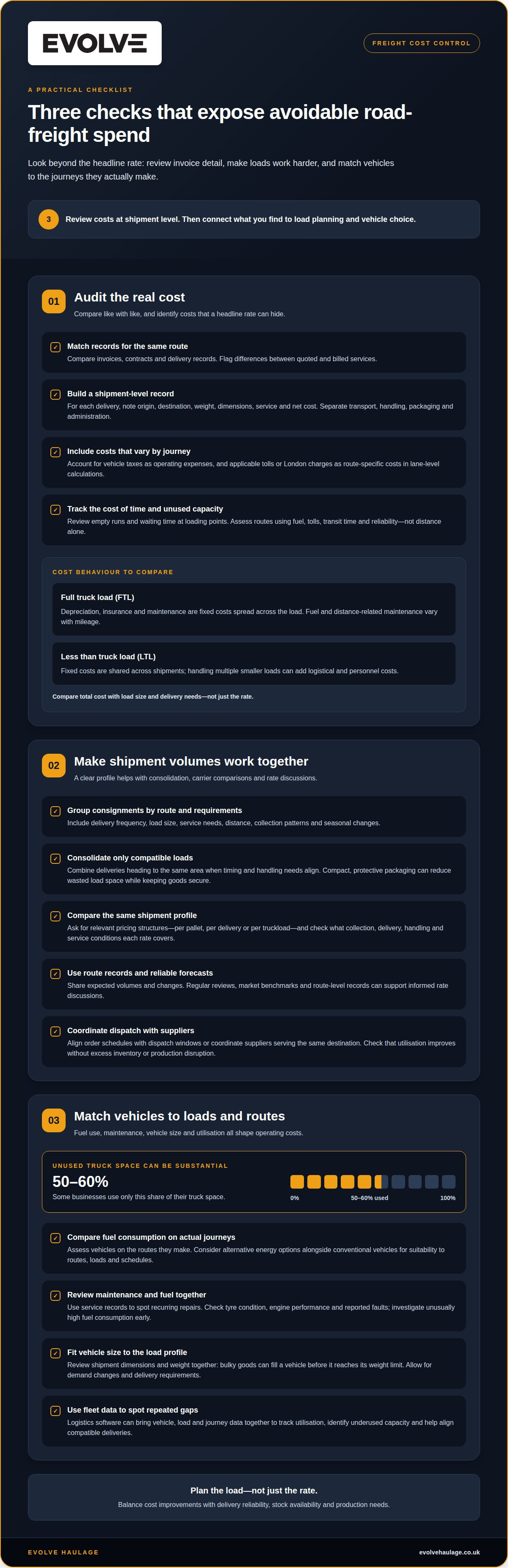
Start with a shipment-level audit: compare invoices, contracts and delivery records for the same route. Separate transport, handling, packaging and administration expenses, then flag differences between quoted and billed services. For each delivery, record its origin, destination, weight, dimensions, service and net cost. This makes recurring charges and costly routes easier to identify.
Classify each expense by how it behaves. In full truck load (FTL) transport, fixed costs such as depreciation, insurance and maintenance are spread across the load, while fuel and distance-related maintenance vary with mileage. In less than truck load (LTL), fixed costs are shared across shipments, while handling multiple smaller loads can add logistical and personnel costs. Compare total cost with load size and delivery needs, not just the headline rate.
UK road freight budgets should account for vehicle taxes as operating expenses and route-specific tolls as journey costs. Tolls and other route-specific charges can affect road freight costs, so include applicable charges in lane-level calculations rather than assuming every delivery faces the same amount. London charges can also affect a journey, so include applicable charges for the vehicle and route in lane-level calculations rather than assuming every delivery faces the same amount.
Compare road with rail or sea freight by shipment volume, urgency and route length. Road can suit short-distance deliveries; rail or sea may suit larger, less urgent volumes, although rail often needs road connections to reach the final destination. Route analysis should include fuel, tolls, transit time and reliability, not distance alone. A shorter route with delays, for example, may cost more than a reliable alternative.
Track empty runs and waiting time at loading points. Efficient scheduling can pair compatible shipments or support collaboration between transport companies, reducing unused capacity. Cutting costs too aggressively can increase delays, stockouts or production disruption, so weigh savings against delivery reliability and sustainability. Professional bodies such as the Council of Procurement & Supply Chain Professionals (CPSCP) emphasise this balance, offering certifications that equip logistics teams to manage freight expenditure without compromising network performance.
2. Using combined shipment volumes to negotiate rates
Build a clear shipment profile before approaching carriers or freight forwarders. Group consignments by route, delivery frequency, load size and service requirements. Include distance, collection patterns and seasonal changes so negotiations reflect the volume you can offer throughout the year. A consistent profile also makes it easier to compare proposals.
Consolidating compatible shipments can maximise vehicle capacity and lower the cost per unit moved. Use compact, protective packaging to avoid wasting load space while keeping goods secure. For example, combine deliveries heading to the same area when their timing and handling needs align. Better load planning can reduce unnecessary trips and make each booking more efficient.
Ask carriers to price the same shipment profile using relevant structures, such as per pallet, per delivery or per truckload. Compare what each rate covers, including collection, delivery, handling and any conditions affecting the service. Use route-level records and market benchmarks to support rate discussions. Regular reviews can reveal where changing volumes or routes may justify revised terms.
Long-term relationships and larger order volumes may create scope for more favourable agreements. Share reliable forecasts, explain expected changes and discuss flexible arrangements that reflect demand fluctuations. For international shipments, include route complexity and delivery requirements in the comparison. Shipment frequency, product type and route data can also help identify avoidable spend when negotiating with freight forwarders.
Supplier discussions can support consolidation too. Align order schedules with dispatch windows, or coordinate deliveries from suppliers serving the same destination. Track whether the revised plan improves vehicle utilisation without creating excess inventory or disrupting production. For a structured review of transport patterns, freight planning support can help connect shipment data with practical decisions.
3. Fuel-efficient vehicles and alternative energy
Vehicle choice affects fuel use, maintenance needs and how effectively each delivery supports your supply chain. Compare fuel consumption on the journeys vehicles actually make, rather than relying only on a model’s general reputation. A modern, energy-efficient vehicle that uses less fuel can help lower operating expenses. Assess alternative energy options alongside conventional vehicles for their suitability to your routes, loads and schedules.
Maintenance affects both running costs and vehicle availability. Use service records to identify recurring repairs, then schedule preventive work around planned deliveries where possible. Reviewing tyre condition, engine performance and reported faults can help address problems before they disrupt a journey. Track fuel consumption alongside repair records: a vehicle using more fuel than usual may need attention, and early investigation can limit avoidable downtime.
Capacity matters as much as vehicle efficiency. Some businesses use only 50-60% of their truck space, leaving unused capacity on journeys that still require a vehicle and driver. Review shipment dimensions and weight together, since bulky goods can fill a vehicle before it reaches its weight limit. Then match vehicle size to the regular load profile, while allowing for changes in demand and delivery requirements; for instance, small-scale transport specialists like Fool Movers regularly share practical guidance on avoiding wasted capacity by tailoring vehicle space directly to smaller volume consignments.
Logistics software can bring vehicle, load and journey data together, helping planners spot underused capacity across the fleet. Use it to track utilisation continuously, identify repeated gaps and align compatible deliveries. Leveraging that information can improve fleet efficiency without adding unnecessary journeys. For UK operators, compare route demands and energy options across regular lanes; vehicle suitability can vary with distance, load and delivery pattern. Connect fuel, maintenance and utilisation reviews, then assess whether the changes support both operating efficiency and sustainability.
4. Fuel-efficient vehicles and route planning
Route planning affects mileage, fuel consumption and delivery timing across every regular route. Map each collection and drop-off, then compare journey distance, expected traffic and delivery windows. A route with fewer miles may still take longer if congestion causes extended idling or missed slots. Review actual journey records to find where planned routes differ from completed journeys.
Route optimisation software can assess distance, traffic patterns and delivery schedules together. Use these inputs to sequence stops, avoid unnecessary backtracking and choose routes that suit vehicle capacity. Grouping nearby deliveries in a logical order, for example, can reduce repeat visits to the same area. Review the plan when traffic conditions or delivery patterns change, rather than treating routes as fixed.
Real-time logistics data can help dispatchers respond to delays and adjust routes. If a road disruption affects one delivery, assess whether another route can protect the remaining schedule without adding excessive mileage. Include driver rest stops and delivery stops in journey timing, as they affect travel time, fuel use and working hours. A realistic plan helps avoid rushed changes that create further inefficiency.
Measure route performance using distance, fuel consumption, transit time and delivery reliability. Compare the same lane over time, then investigate changes in mileage or recurring delays. Route optimisation software can save 10-15% on transport costs, while actual results depend on the routes and operation being optimised. Use this analysis to prioritise lanes where reducing detours or improving stop sequences could deliver practical savings.
For a joined-up approach, Evolve Haulage’s Transport Management service can support the coordination of day-to-day logistics. Bring route schedules and delivery requirements together to assess where transport planning can improve efficiency.
Evolve Haulage: Transport Management
Evolve Haulage provides Transport Management to coordinate day-to-day logistics when freight decisions, delivery schedules and operational requirements need joined-up oversight. If invoice reviews and route planning have highlighted issues, but you need support turning the findings into practical transport arrangements, transport management is a natural next step.
For businesses reviewing how loads move, Evolve Haulage also offers Consultancy Service alongside its Haulage Service. These services can support decisions about transport requirements and arrangements that fit your operation. For time-critical consignments, Evolve Haulage provides same-day delivery solutions.
Share your transport requirements and the challenges you want to address. Contact Evolve Haulage to discuss the next step.
Make your next transport decision count
Use your next planning review to turn cost observations into a clear operational priority. Choose one route, shipment pattern or recurring expense to assess first, then track whether a change improves efficiency without affecting delivery requirements. This measured approach makes it easier to see which adjustments are worth applying across your wider network.
Knowing how to reduce road freight costs is not about choosing the lowest rate in isolation. It means aligning transport decisions with your supply chain’s needs, including the service level your customers rely on. If you need support assessing those requirements, Evolve Haulage offers Haulage Service, Transport Management and Consultancy Service to help businesses plan and manage freight operations.
Contact Evolve Haulage to discuss your freight costs and the transport priorities you want to address. A focused next step can help you build a more efficient operation with confidence.
Frequently Asked Questions
Road freight costs: what affects them and how can they be reduced?
Road freight costs depend on shipment size, journey distance, delivery urgency, vehicle requirements and the service level required. Special handling or restricted delivery windows can also increase the operational effort involved. To understand how to reduce road freight costs, identify which requirements are essential and which can be adjusted, such as allowing a wider delivery window without disrupting customer commitments.
What are the main ways to reduce road freight costs in the UK?
To decide how to reduce road freight costs in the UK, identify the largest controllable expenses, then trial one operational change at a time. For example, adjust dispatch days for a product line with predictable demand, then assess the effect on delivery performance and stock levels. This helps distinguish genuine savings from costs shifted elsewhere, such as higher inventory or additional handling work.
How can businesses improve vehicle utilisation and reduce empty running?
Plan return journeys alongside outbound work, rather than treating each delivery as a one-way movement. For example, align a collection near the final delivery point with the vehicle’s return direction and available capacity. Loads must have compatible timing, handling needs and destinations. Reviewing completed journeys can reveal recurring empty legs and help planners reshape schedules around realistic collection opportunities.
How can route planning and fuel-efficient driving lower road haulage costs?
Combine a practical stop sequence with driving habits that avoid unnecessary fuel use. Dispatch plans should allow time for loading, unloading and expected traffic, reducing rushed decisions and avoidable detours. Drivers can support efficiency through smooth acceleration, steady driving and limiting unnecessary idling. Monitor fuel records by vehicle and route to see whether operational changes improve performance.
How can shippers compare quotes and negotiate better road freight rates?
Give each carrier the same shipment details and operating assumptions, including collection and delivery requirements, load characteristics, frequency and service expectations. Then compare the proposed service scope, not just the quoted rate. If one quote excludes a requirement included in another, the apparent price difference may not reflect the true cost. Use a consistent comparison to guide focused discussions with carriers.
When is pallet network, groupage or full truckload shipping cheapest?
The most suitable option depends on shipment size, frequency, destination and delivery timing. Pallet network or groupage services can suit smaller consignments that share capacity with other freight. Full truckload may suit larger shipments that make better use of a dedicated vehicle. Compare the complete service and any extra handling with your load profile, not the label alone.


