

What makes a reliable haulage partner is not just a promise to deliver on time. It is how well they keep the whole movement on track. For UK businesses, a delay can affect customer commitments and the next steps in an operation, while unclear updates make it harder to adjust plans.
Punctuality matters, but dependability also relies on clear communication, coordination and a service model that fits the freight. A time-sensitive consignment may call for dedicated transport, while wider operational challenges can require more than vehicle capacity alone. Identifying the support you need helps you plan with greater confidence.
This article covers practical signs of dependable haulage, how to match transport support to freight urgency and complexity, and when transport management or consultancy may add value. It also explains how Evolve Haulage’s full and partial load haulage, 24/7 and same-day delivery solutions, transport management and logistics consultancy can support freight movements and wider transport needs.
Key Takeaways
- Look beyond a delivery promise: assess how planning, communication and execution work together to support your commitments.
- Share accurate load, collection, destination and timing details to help coordinate freight from booking through delivery.
- Match full or partial loads and time-sensitive delivery options to the freight requirement, rather than choosing transport by capacity alone.
- Use agreed requirements, delivery records and issue handling to assess whether a reliable haulage partner provides consistent support.
- Consider whether transport management or consultancy could help address coordination needs and reduce operational friction.
What makes a reliable haulage partner valuable to a UK business?
A reliable haulage partner plans each movement around the agreed freight requirements, communicates clearly when circumstances change and carries out the delivery as arranged.
Haulage moves goods by road, but a dependable service involves more than providing a vehicle and driver. For a general overview of the term and its different forms, see What is Haulage? In business, reliability means coordinating the load, collection, destination and timing so the movement fits your operational needs.
That consistency helps protect customer commitments and business continuity. If a delivery feeds into production, retail replenishment or another scheduled activity, uncertainty can disrupt more than the journey itself. Clear coordination gives your team better information to plan around the movement and respond if circumstances change.
Which everyday behaviours show a haulage partner is dependable?
Look for practical behaviours, not broad assurances. A dependable partner confirms the collection and delivery requirements, uses accurate load information to plan the movement and keeps communication open. If a schedule changes, a timely update helps you adjust your plans instead of relying on assumptions.
Load details matter because the freight and its handling requirements can affect how a movement is planned. Clear instructions reduce the risk of misunderstandings between your business and the people coordinating transport. The aim is not to promise that every journey will run without disruption, but to manage the agreed requirements with care and transparency.
Why does reliability mean more than arriving on time?
Arrival is only one part of performance. Businesses also need useful communication before collection, relevant updates during the journey and clear information after delivery. Together, these give your team a fuller picture of what happened and help with planning subsequent movements.
Consistency matters especially for recurring work. When the process is understood and communication is dependable, you can build transport into your schedules with greater confidence. A one-off vehicle-and-load transaction may complete a single movement. An ongoing partner relationship also creates a basis for reviewing how transport fits wider operations and adjusting the approach as needs change.
Assess that relationship through evidence: compare agreed requirements with delivery records, note whether updates were clear and timely, and review how issues were communicated and resolved. This is more useful than phrases such as “always reliable” because it shows what is working and where coordination could improve. A reliable haulage partner earns confidence through repeatable actions, not marketing language alone.
How does a reliable haulage partner manage freight from booking to delivery?
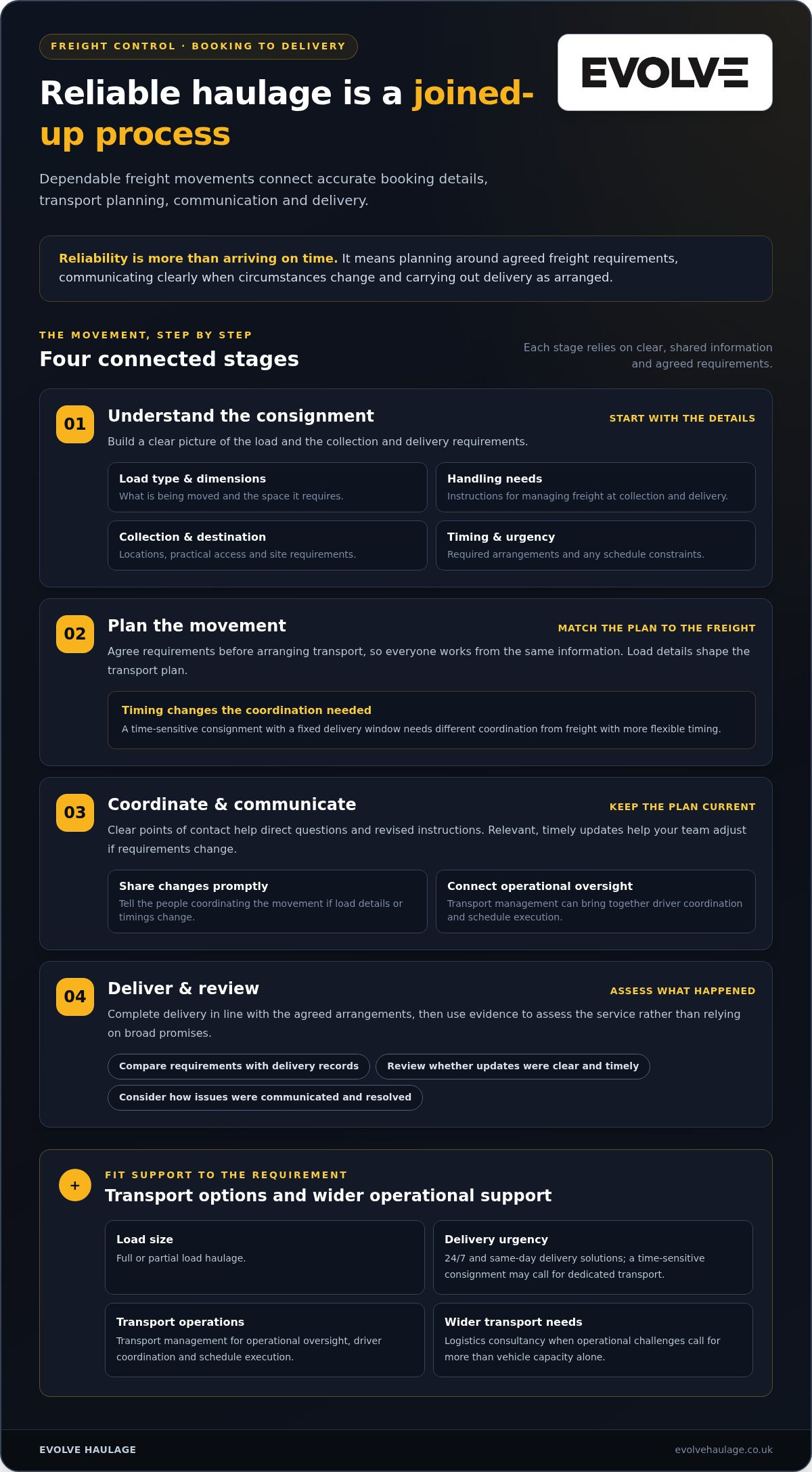
A freight movement is easier to control when each stage connects to the next. A reliable haulage partner first understands the consignment and your requirements, then plans and coordinates the movement, communicates relevant changes and completes delivery in line with the agreed arrangements.
Joined-up coordination connects accurate booking details, transport planning, driver coordination and schedule execution to support reliable freight delivery.
What information helps plan a freight movement properly?
Good planning starts with a clear picture of the load and the collection and delivery requirements. Relevant details may include:
- Load type and dimensions: what is being moved and the space it requires.
- Handling needs: specific instructions for managing the freight during collection and delivery.
- Collection and destination: where the movement begins and ends, including practical access or site requirements.
- Timing and urgency: the required collection and delivery arrangements, and any constraints affecting the schedule.
These details shape the transport plan. A time-sensitive consignment with a fixed delivery window, for example, needs different coordination from freight with more flexible timing. Agree the requirements before arranging the movement so everyone involved is working from the same information. If load details or timings change, share the update promptly so the plan can reflect the new requirement.
How do communication and coordination support delivery control?
Once the requirements are understood, operational coordination puts the plan into practice. Clear points of contact help your team know where to direct questions or revised instructions. Timely updates also give you an opportunity to adjust schedules if a collection, delivery or other requirement changes. Communication should be useful and relevant, without relying on an assumed update frequency or a particular tracking system.
Transport management can provide broader oversight by bringing driver coordination and schedule execution together. This is useful when your business needs support organising transport operations as well as moving an individual load. Evolve Haulage’s transport management covers operational oversight, driver coordination and schedule execution, connecting planning with the day-to-day demands of freight movement.
To keep a movement controlled, make sure the agreed details are accessible to the people coordinating it and that changes are communicated clearly. If you want to connect freight delivery with wider operational oversight, explore Evolve Haulage transport management as part of your transport planning.
Which haulage and transport support best fits your business requirements?
The right support depends on freight volume, delivery urgency and the level of coordination your operation needs. A reliable haulage partner matches the transport approach to those requirements rather than treating every movement in the same way.
| Business requirement | Transport support to consider | Operational fit |
|---|---|---|
| A consignment requiring dedicated vehicle capacity | Dedicated full-load haulage | Useful when the freight needs the capacity of a vehicle for its movement. |
| A smaller consignment that does not need a full vehicle | Dedicated partial-load haulage | Provides a transport option suited to a lower freight volume. |
| A time-critical commercial consignment | Same-day or 24/7 delivery support | Designed to support urgent delivery requirements, with arrangements shaped around the consignment. |
| Ongoing coordination or improvement of transport operations | Transport management or consultancy | Supports operational oversight, efficiency assessment and transport strategy. |
When might dedicated full-load or partial-load haulage be appropriate?
Dedicated full-load transport may suit freight that requires a vehicle’s capacity or where you want the movement planned around a larger consignment. Partial-load haulage may be a better fit when there is less freight to move. The distinction is about matching capacity and planning to the load, not assuming one option is always preferable. Evolve Haulage provides dedicated full and partial freight loads. For more on the considerations involved, read the dedicated haulage versus shared freight comparison.
When do urgent delivery, transport management or consultancy matter?
Same-day and 24/7 delivery support can help with time-critical commercial consignments where timing is central to the requirement. These options are distinct from support for recurring transport needs. If your challenge is coordinating drivers, schedules and day-to-day transport activity, transport management provides operational oversight. Consultancy helps you take a step back and assess efficiency, compliance considerations and transport strategy.
Some businesses need a combination, such as an urgent movement alongside broader support to organise transport operations. Define the load, urgency and level of oversight needed to identify a service model that fits the work instead of relying on a one-size-fits-all approach.
How can businesses assess reliability without relying on vague promises?
Claims such as “dependable service” are difficult to assess on their own. Instead, compare what was agreed for each movement with what happened, then look for patterns across recurring work. This makes reliability something your business can review and act on.
What evidence makes reliability more credible?
Start with the agreed requirements: load details, collection and delivery arrangements, timing and any handling instructions. Compare these with delivery records and operational communications. This helps show whether the service matched the plan and whether any difference was explained clearly.
Review four areas:
- Requirements: Were the load and movement details understood and recorded clearly?
- Communication: Were updates useful, and were changes shared in time for your team to respond?
- Delivery records: Do records reflect the agreed collection and delivery outcomes?
- Issue handling: If a disruption occurred, was responsibility clear and was the response communicated?
Look for repeatable evidence rather than relying on a single positive or difficult movement. For example, recurring confusion over collection instructions may point to an information gap in your booking process as well as a need to improve coordination. A haulage company questions checklist offers a separate resource for structuring a more detailed review.
If you’re assessing how haulage and operational support could fit your requirements, explore Evolve Haulage services.
How should businesses review changing transport needs?
Transport requirements can shift as freight volumes, delivery urgency and operating constraints change. Review them periodically against recent movements. Consider whether loads are becoming larger or smaller, whether more consignments have tight delivery requirements, and whether your team needs greater coordination support.
Recurring issues can reveal avoidable friction. Repeated schedule changes may indicate that timing requirements need clearer agreement; incomplete load information may suggest the booking process needs attention. Use these observations to refine the transport approach, whether that means a different balance of full and partial loads, support for time-sensitive consignments or more operational oversight.
A reliable haulage partner should make this review constructive by keeping requirements, communication and outcomes visible. This gives your business a clearer basis for matching transport support to current needs instead of relying on general assurances or continuing with a process that no longer fits.
How can Evolve Haulage support a more reliable transport operation?
Reliable transport often depends on choosing support that fits both the freight movement and the work around it. Evolve Haulage provides commercial road haulage across the UK, including dedicated full and partial freight loads. For time-sensitive consignments, same-day and 24/7 delivery solutions support urgent requirements, with arrangements shaped around the movement rather than a blanket promise about outcomes.
How does haulage connect with transport management?
Haulage covers the movement of goods; transport management can provide wider day-to-day oversight. This includes driver coordination and schedule execution, helping align planned movements with business requirements. For organisations managing recurring transport activity, that wider view can make responsibilities and schedules easier to coordinate. Not every business needs management support: a focused haulage service may be the right fit for a specific load or delivery.
Evolve Haulage also provides consultancy for businesses reviewing their transport operations. This can include assessing operational efficiency, offering compliance guidance and informing transport strategy. It connects practical delivery activity with broader operational needs, whether your business needs a consignment moved, help coordinating transport or insight into how its approach could be refined.
If you’re exploring the role of oversight in your operation, the UK transport management guide explains how management support can fit into business transport planning.
What is a practical next step for a business?
Start by outlining what you move, the load size, collection and delivery requirements, timing and any operational constraints. Then consider whether you need a one-off movement, an urgent consignment, recurring freight coordination or a wider review of transport efficiency. These details help identify support for the actual requirement instead of assuming one service model fits every business.
A reliable haulage partner connects freight needs with the appropriate level of operational support. Evolve Haulage provides dedicated full or partial loads, delivery solutions, transport management and consultancy. To discuss your freight or transport management requirements, discuss your haulage requirements.
Build a transport approach that fits your business
A reliable haulage partner brings together clear planning, useful communication and delivery execution that meets the agreed requirement. Reviewing delivery records and how changes are handled gives your business practical evidence of reliability. Regular reviews also help keep transport arrangements aligned with changing freight volumes, urgency and operational needs.
Evolve Haulage supports commercial freight movements with dedicated full and partial loads, alongside 24/7 and same-day delivery solutions for time-sensitive consignments. When needs extend beyond moving a load, transport management provides operational oversight and coordination, while logistics consultancy can help assess efficiency and transport strategy.
The right support starts with a clear picture of your freight, timing and wider requirements. Discuss your haulage requirements with Evolve Haulage to explore an approach shaped around your operation.
Frequently Asked Questions
What makes a haulage partner reliable?
A reliable haulage partner plans around agreed freight requirements, communicates clearly and coordinates delivery consistently. Reliability is demonstrated by how movements are organised, not just by a general promise or one successful delivery. Review whether load details were captured accurately, how updates were handled and whether delivery outcomes met operational needs over time. This evidence helps identify consistent performance and areas where coordination could improve.
How do I know whether a haulage company can handle my freight?
Start by setting out the load type and dimensions, collection and delivery requirements, timing, handling needs and any site constraints. These details help shape a transport plan around the consignment. Consider how the movement will be coordinated and how changes will be communicated. For recurring work, assess whether the support also fits your scheduling and operational oversight needs, not just the capacity for a single load.
Is dedicated haulage more reliable than shared freight?
Reliability depends on the freight and agreed arrangements, not the label alone. Dedicated full-load haulage can suit consignments requiring allocated vehicle capacity, while dedicated partial-load haulage can fit smaller freight volumes. Compare each option against your timing, handling requirements and operational priorities. In either case, agree service expectations clearly so the transport plan reflects the load and delivery requirement from the outset.
Can a haulage partner help with transport management?
Yes. Transport management can provide operational oversight beyond arranging individual freight movements. Evolve Haulage’s transport management covers driver coordination and schedule execution, supporting day-to-day transport operations. Its value depends on your requirements: businesses with recurring movements or coordination demands may benefit from broader oversight, while a specific delivery may only need haulage. Transport management can also support processes related to compliance, without replacing a business’s own responsibilities.
When should a business use same-day haulage?
Same-day haulage may suit a commercial consignment that is time-critical and cannot follow a standard planned movement. Before arranging transport, clarify the load, collection and destination details, timing and handling constraints. Evolve Haulage offers same-day and 24/7 delivery solutions for time-sensitive consignments. Share accurate information to support planning, as each urgent load has its own requirements.
What should I share when arranging a haulage service?
Share accurate details about the freight, including its type, dimensions, weight and handling needs, as well as the collection point, destination and required timing. Include any site access or delivery constraints, and explain whether the movement is urgent or part of recurring work. This information helps align the transport plan with the consignment, supports clear collection and delivery coordination, and reduces the risk of avoidable misunderstandings.
Can one haulage partner support both deliveries and logistics improvements?
Yes. A business may use haulage for freight movements and transport management or consultancy for broader operational needs. Evolve Haulage provides commercial road haulage, transport management and logistics consultancy. Management supports operational oversight and coordination, while consultancy can help assess efficiency, compliance processes and transport strategy. The right combination depends on whether your priority is a particular delivery, recurring transport coordination or a wider review of how freight operations work.


