

What if you could outsource transport operations without losing sight of service, compliance or the decisions that matter to your business? Start by identifying which activities are putting pressure on your team, then agree who will handle them, what good performance looks like and which decisions stay with you.
Transport administration, driver coordination and delivery schedules can take time away from core operations. When shipment demand changes, it can be difficult to maintain the right in-house capacity. Handing over tasks without clear boundaries can create fresh problems, though. A sound approach begins with a practical review of the work, followed by clear responsibilities and a way to monitor performance.
This practical UK guide explains how to assess your transport needs, compare outsourced haulage with day-to-day transport management and logistics consultancy, and prepare for a controlled transition. You’ll also learn how to define service measures, assign responsibilities and agree escalation routes. With the right operating model, external support can help manage freight movements and operational demands while keeping customer service and compliance in view.
Key Takeaways
- Assess where capacity, coordination or compliance pressures are affecting operations before deciding whether to outsource.
- When you outsource transport operations, define whether the scope covers day-to-day management, individual haulage movements or both.
- Compare in-house and outsourced models by considering control, internal workload, flexibility and management responsibility.
- Prepare a clear handover by mapping shipments, setting service measures and agreeing how issues will be escalated.
- See how transport management, haulage and logistics consultancy can support different operational requirements.
When does it make sense to outsource transport operations?
Transport creates ongoing demands on people and processes. Shipments need scheduling, drivers need coordinating, and compliance-related activity needs consistent oversight. Outsourcing may help when these demands stretch internal capacity, but it isn’t the right answer for every business. Start with the operational pressure you need to address and decide how much control your team wants to retain.
To outsource transport operations is to transfer agreed activities to an external transport partner, rather than simply buying a freight movement when one is needed. The scope might cover day-to-day management, physical haulage or a combination of the two. This sits within the broader concept of third-party logistics (3PL), where a business uses an external provider for defined logistics activities.
Which transport pressures can outsourcing address?
Look for recurring friction, not just a difficult day. If staff regularly spend time coordinating drivers, adjusting schedules or resolving routine delivery issues, that work can reduce the capacity available for other priorities. Variable shipment volumes add another challenge: internal resources may be underused in quieter periods and stretched when demand rises.
Useful signals to assess include:
- Capacity is inconsistent, making it difficult to cover planned transport requirements reliably.
- Coordination tasks regularly compete with core operational responsibilities.
- Shipment demand changes enough to make internal resource planning difficult.
- The team lacks the time or expertise to manage particular transport activities consistently.
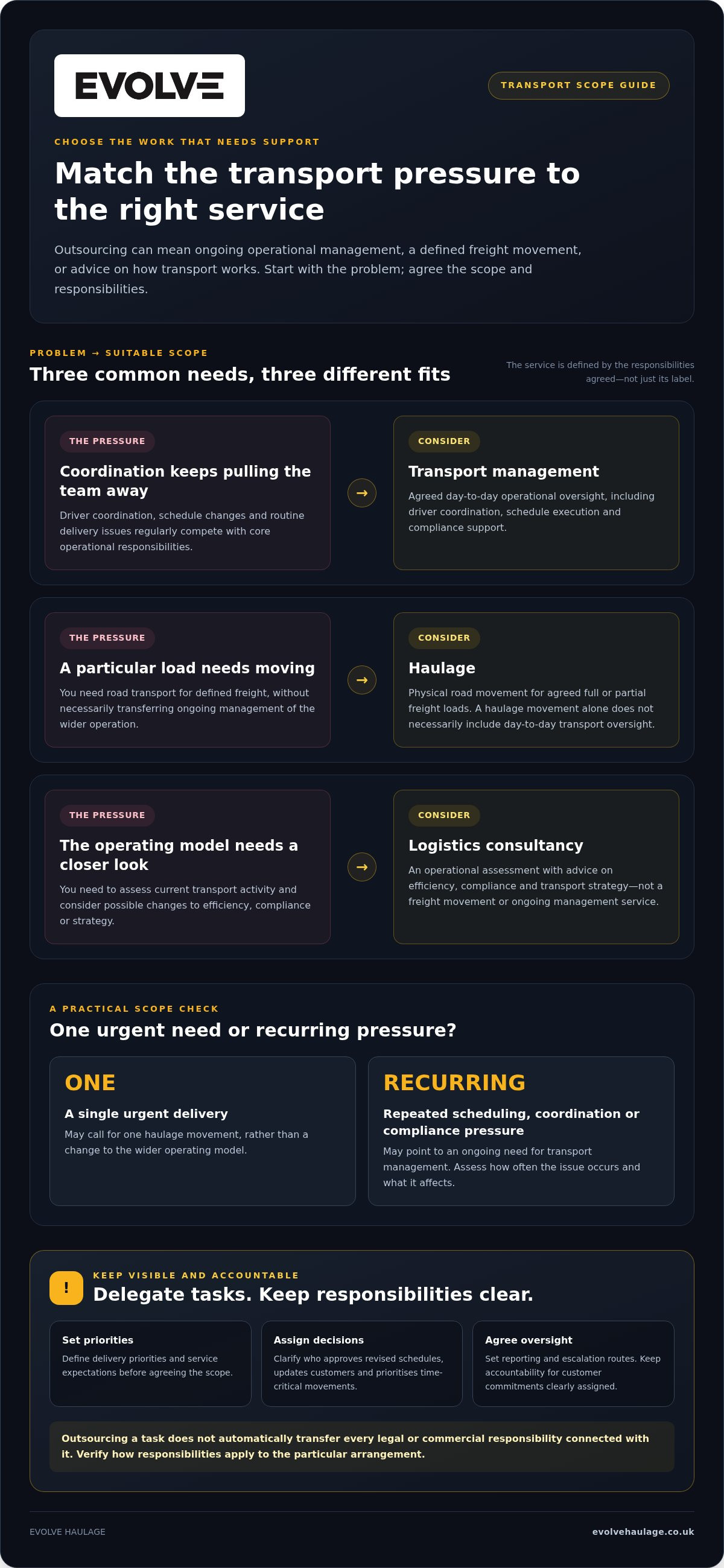
Consider how often each issue occurs and what it affects. A single urgent delivery may call for one haulage movement, not a change to the wider operating model. Repeated pressure with scheduling, driver coordination or compliance support may point to an ongoing need for transport management. Distinguishing between these situations helps you set a proportionate scope instead of outsourcing more than the problem requires.
What should remain visible and accountable?
Delegating operational work doesn’t mean stepping away from the customer commitments that transport supports. Before agreeing a scope, define delivery priorities, service expectations and who can make decisions when plans change. For example, decide who approves a revised schedule, who updates the customer about a service issue and who determines whether a time-critical movement takes priority.
Responsibilities depend on the activities transferred and the working arrangements agreed between the parties. Outsourcing a task doesn’t automatically transfer every legal or commercial responsibility connected with it. Clarify roles, reporting, escalation routes and decision rights, and verify how relevant responsibilities apply to your particular arrangement. Keep oversight of the outcomes your business promises, even when another party handles day-to-day work.
Delegated tasks can move outside the business; accountability for customer commitments and agreed oversight must remain clearly assigned.
This distinction gives both parties a practical basis for working together. Your business sets priorities and retains visibility of performance, while the transport partner manages the activities included in the agreed scope. Clear boundaries help you assess whether outsourcing addresses a persistent capacity or coordination issue without losing control of important service decisions.
What can you outsource across transport operations?
Outsourced transport operations cover an agreed set of activities delivered by an external transport partner. The scope could focus on coordinating schedules, managing day-to-day transport activity, moving freight by road or combining these responsibilities. The distinction matters: buying haulage for a particular load does not necessarily mean you have outsourced the ongoing management of your transport operation.
Scope can be broad or deliberately limited. You might delegate recurring coordination while retaining shipment planning in-house, or arrange transport management alongside freight movements. Similarly, for organisations that require passenger logistics or group travel rather than cargo, providers such as ecminibus.co.uk handle dedicated private and shared transport in and around London. The right arrangement depends on the work your business needs handled and the responsibilities each party accepts.
Outsourcing is defined by the responsibilities agreed, not by the label attached to the arrangement.
Transport management, haulage and consultancy compared
These services address different parts of the transport task. Transport management provides day-to-day operational oversight, including driver coordination, schedule execution and compliance support. Haulage is the physical movement of agreed freight loads by road, whether a full or partial load. Consultancy assesses how transport currently operates and advises on efficiency, compliance and transport strategy.
They can also complement one another. A business may use haulage for defined movements without transferring daily oversight, or use transport management to coordinate recurring activity. Consultancy can help assess the operating model and identify useful changes, without itself being a freight movement or ongoing management service.
- Transport management: agreed operational oversight and coordination.
- Haulage: road transport for agreed full or partial freight loads.
- Consultancy: operational assessment and advice on transport strategy.
Separating these categories makes a brief more precise. For example, specify whether you need a particular consignment moved or want schedules and drivers coordinated as part of a continuing operation. For wider UK transport context, the UK Department for Transport provides information about the government department responsible for transport.
How do 3PLs fit into an outsourcing decision?
Third-party logistics, often shortened to 3PL, describes using an external provider to deliver agreed logistics activities. The term covers a range of arrangements, so it does not describe one standard package. A provider’s scope may centre on freight movements, while another arrangement may include ongoing transport management. State which tasks, decisions and reporting responsibilities are included in your service brief.
When weighing up a 3PL arrangement, focus on the activities your business wants to delegate. Establish whether you need freight movements, day-to-day management, or both, and make sure the roles and reporting requirements are clear.
At Evolve Haulage, transport management, commercial road haulage and logistics consultancy address different parts of that scope. Consider how transport management and haulage support could fit the operational activities you want to organise or delegate.
How does outsourced transport compare with an in-house operation?
Choosing whether to outsource transport operations is a question of capability and governance, not simply who controls the vehicles or schedules. An in-house team may offer direct oversight and familiarity with your processes. Outsourcing can transfer agreed execution and coordination to an external partner, while your business retains visibility through defined service expectations, reporting and decision rights.
Use this comparison to assess the practical trade-offs for your shipment patterns and available internal expertise:
| Consideration | In-house operation | Outsourced operation |
|---|---|---|
| Control | Your team directs day-to-day decisions and processes. | Execution is delegated within an agreed scope; decision rights need to be explicit. |
| Internal workload | Staff coordinate transport and maintain operational oversight. | Some agreed coordination or management activity moves to the external partner. |
| Capacity flexibility | Resources and processes are organised internally around demand. | Capacity may be arranged through the agreed service scope as requirements change. |
| Management responsibility | Your business manages the operation directly. | Responsibilities are shared according to the operating arrangements, with client governance still required. |
The table is a starting point, not a verdict. Outsourcing doesn’t automatically increase flexibility or improve service, just as in-house management isn’t inherently less efficient or compliant. Compare the work each model requires, who makes operational decisions and how you will see service performance. Industry context from Logistics UK can inform your understanding of the wider logistics environment, but the right arrangement depends on your own operating requirements.
When can an in-house model remain the better fit?
Keeping transport in-house can make sense when shipment demand is relatively stable, established processes work well and the team has the experience and capacity to coordinate activity reliably. Direct control may suit operations where transport decisions are closely connected to other internal workflows. Assess the workload in normal and peak periods, including who covers scheduling, driver coordination and oversight when key staff are unavailable.
When can outsourced transport management add value?
Consider outsourced management if recurring coordination or oversight is drawing people away from core responsibilities, or if your team needs additional operational support as requirements change. Delegating day-to-day activity doesn’t remove the need for client governance. Retain clear ownership of priorities, performance reviews and escalation decisions. For a practical assessment, consider the tasks your team handles each day, where delays or repeated follow-up occur, and which responsibilities could be clearly delegated.
Control depends on how the working relationship is designed. Agree which decisions the transport partner can make, what information your team receives, how often performance is reviewed and how urgent issues are escalated. A clear route for reporting missed schedules or changing priorities gives both sides a practical way to respond without blurring accountability.
For businesses weighing these options, Evolve Haulage’s transport management and logistics consultancy can support operational oversight and assessment, alongside commercial road haulage for freight movements. Explore transport management support to consider how delegated execution could fit your operating model.
How should you assess and prepare an outsourced transport operation?
A structured assessment turns an outsourcing decision into a workable operating arrangement. Before you outsource transport operations, build a clear picture of current shipments, delivery requirements and recurring pressure points. This gives you a practical basis for agreeing scope, setting measures and preparing the people who will manage the transition.
- Map shipments. Record recurring movements, shipment patterns, delivery requirements and variations in demand. Note which movements involve full or partial loads, where relevant.
- Identify pressure points. Pinpoint where schedules, driver coordination, communication or issue resolution regularly take time or cause disruption. Separate persistent demands from occasional exceptions.
- Define the scope. State which activities are included, such as transport management, specific freight movements or both. Record operating boundaries and who has authority to make decisions.
- Agree service measures. Define how you will assess service reliability, schedule execution, communication and issue resolution. Set clear terms for each measure so both parties interpret results consistently.
- Plan the handover. Assign owners, prepare operational information and agree how exceptions and performance reviews will be managed once the arrangement begins.
Prepare the information that will help the people taking on the work understand it: current schedules, regular shipment details, delivery requirements, existing processes and escalation contacts. Document responsibilities alongside this information, including who handles customer updates and how changes to planned activity are communicated.
What should a clear service scope include?
Describe the management activities and freight movements covered, the boundaries of the arrangement and which decisions each party can make. Agree how often reporting takes place, who receives it and the route for escalating delays or other exceptions. Separate planned, recurring activity from urgent or time-critical delivery requirements so priorities and handling arrangements are explicit.
Measures should reflect outcomes your teams can observe. For example, define what counts as a schedule executed as planned, what information a useful service update contains and when an issue is considered resolved. Record the definitions and review performance against them regularly. Avoid broad labels such as “good communication” unless you have agreed what they mean in practice.
How can you plan a controlled handover?
Map existing schedules, recurring movements and operational dependencies before responsibilities change. Identify key contacts, explain how exceptions are currently handled and agree how new or changed instructions will be shared. A clear transition plan names the people responsible for each step and establishes when service reviews will take place, without leaving gaps in day-to-day coordination.
For practical preparation, document how dispatch and daily coordination currently work, including who receives instructions and how schedule changes are shared. Evolve Haulage’s transport management covers operational oversight, driver coordination, schedules and compliance support. Discuss your transport management requirements with Evolve Haulage to explore an arrangement shaped around your operational needs.
How can Evolve Haulage support outsourced transport operations?
The right support depends on the work your business needs handled, whether that means regular operational coordination, individual freight movements or advice on how transport is organised. Evolve Haulage provides transport management, commercial road haulage and logistics consultancy. Each addresses a different requirement, so you can define a practical scope rather than treating outsourcing as an all-or-nothing decision.
Match the service to the operational requirement
For ongoing coordination, Evolve Haulage’s transport management service provides day-to-day operational oversight. This covers driver coordination, schedule execution and compliance support, helping keep routine transport activity organised within the agreed scope.
For freight movements, commercial road haulage can support full or partial loads. A full load may suit a consignment planned as a full-load movement, while a partial load may be relevant when the shipment does not require a full load. The appropriate option depends on the movement and its requirements.
Time-sensitive consignments may need a different arrangement. Evolve Haulage provides 24/7 and same-day delivery solutions for urgent transport needs. These services address a time-critical movement, while transport management supports recurring coordination and oversight.
Matching the service to the need helps keep responsibilities clear:
- Recurring coordination: consider transport management for day-to-day oversight, schedules and driver coordination.
- Planned freight movements: consider haulage for agreed full or partial loads.
- Urgent consignments: consider the 24/7 or same-day delivery service where timing is central to the requirement.
Turn the assessment into a practical next step
Before discussing an arrangement, outline your shipment patterns, service priorities and current operational pressures. Note which activities recur, where coordination takes the most time and what matters most to customers. This gives you a useful starting point for discussing whether you need management oversight, freight movements, time-sensitive delivery or a combination.
If you want to improve an existing internal logistics setup, consultancy can provide an operational assessment and advice on transport strategy. It can help focus the discussion on your current processes and priorities, rather than assuming every activity needs to be outsourced. Identify which decisions should remain with your team and where external support could address a specific requirement.
Clear information supports a focused conversation. Bring together the movements you need covered, recurring scheduling or driver-coordination demands, and the service outcomes your business wants to protect. From there, Evolve Haulage can discuss how transport management, haulage or consultancy may fit your requirements.
Discuss your transport requirements with Evolve Haulage to explore a practical approach to outsourced transport operations.
Shape transport support around your next stage
Turn your operational priorities into a clear brief. Note what needs to change, which customer commitments must stay central and where you want your team to retain decision-making authority. This gives any discussion about how to outsource transport operations a practical starting point, focused on the support your business needs rather than a predetermined package.
Evolve Haulage provides UK-wide commercial road haulage and freight delivery, alongside transport management covering operational oversight, driver coordination and schedule execution. Logistics consultancy can assess your current setup and provide advice on transport efficiency, compliance guidance and strategy. The aim is to align support with your shipment patterns and internal capability while keeping responsibilities and service priorities visible.
You don’t need every detail settled before taking the next step. Start with the operational pressure you most want to address, then build a conversation around a workable scope and clear expectations. Explore transport support with Evolve Haulage and take a considered step towards an operating model that fits your business.
Frequently Asked Questions
What does it mean to outsource transport operations?
It means assigning defined transport tasks to an external business under agreed working arrangements. For example, a company might retain responsibility for booking shipments but delegate schedule coordination, or arrange external haulage for selected consignments. The useful distinction is the work transferred, not the terminology used. Set out what the external partner will do, what your team will manage and how changes or exceptions will be handled.
Is outsourcing transport operations suitable for a small business?
It can suit a small business if specific transport tasks are taking time or expertise away from other essential work. You don’t need to transfer an entire operation: a business might outsource selected freight movements while keeping planning and customer communication in-house. Consider how often the pressure occurs, who currently handles it and whether a defined external role would address the issue without adding unnecessary complexity.
Can a business outsource transport management but retain control?
Yes. A business can delegate operational activity while retaining control over priorities and key decisions. For instance, you might agree that the transport manager coordinates routine schedules, but your team approves changes that affect a customer commitment. Define what information is shared, who can authorise exceptions and how issues are escalated. Regular reviews then give your team visibility without requiring it to direct every task.
How do you decide which transport activities to outsource?
Start by identifying tasks that recur, consume internal time or depend on expertise your team cannot readily provide. Then consider the effect of handing each task over: could it affect customer communication, timing or another internal process? To outsource transport operations effectively, choose a clear, manageable scope and distinguish routine work from exceptional requirements. A short trial of a defined activity can help reveal what needs refining before you expand the arrangement.
Does outsourcing transport operations transfer compliance responsibility?
Not automatically. Compliance responsibilities depend on the activity, the parties’ roles and the arrangements governing the work. Delegating a task should not be treated as proof that every related business responsibility has moved elsewhere. Identify which party performs each compliance-related activity, who keeps relevant records and how concerns are raised. For obligations specific to your operation, review the arrangement with an appropriately qualified adviser.
What information is needed to plan outsourced transport?
Prepare a representative picture of the work: shipment types, typical volumes, collection and delivery requirements, recurring schedules and known demand variations. Include existing planning steps, customer communication preferences and the people who handle exceptions. It’s also useful to describe common disruptions and how your team currently responds. This context helps shape a workable scope and avoids assumptions about how the operation runs.
Is a 3PL the same as an outsourced transport manager?
No. Third-party logistics, or 3PL, is a broad term for logistics activities delivered by an external provider. An outsourced transport manager describes a more specific operational role focused on managing transport activity. Depending on the arrangement, a 3PL may handle freight movements, management tasks or other agreed logistics work. The terms can overlap, so clarify the actual responsibilities rather than assuming they describe identical services.


