

Keeping transport in-house can give your business more control, but it doesn’t automatically make deliveries easier to manage. The in-house vs outsourced transport decision is less about choosing an obvious winner and more about matching your freight needs to the resources and management time you can sustain.
It’s reasonable to want clear visibility over deliveries and confidence that capacity will be available when demand changes. Running transport internally also requires ongoing planning and oversight, while outsourcing means agreeing how an external operation will meet your requirements. The right balance depends on your delivery patterns, internal expertise and capacity to manage day-to-day transport.
This article compares the trade-offs in control, capacity, operational workload and resilience. It also explains how a blended approach can add capacity without requiring an all-or-nothing change, and how transport management or consultancy can help you review your current setup before deciding what to adjust.
Key Takeaways
- In-house vs outsourced transport is a decision about who manages resources and how much external support your operation needs.
- Map shipment frequency, delivery windows and load requirements to see where your current capacity fits and where it may fall short.
- Compare the management time involved as well as delivery control when assessing operating models.
- A blended approach can retain control over selected tasks while adding external capacity for suitable freight needs.
- Use a structured review to identify gaps and compare options, including haulage, transport management and consultancy.
In-house vs outsourced transport: what is the real difference?
In-house transport means your business organises and manages its transport resources. Outsourced transport means engaging an external provider to move freight, manage transport activity or provide both types of support. In-house transport is managed by the business, while outsourced transport is delivered or managed by an external provider under an agreed scope. That scope might cover a specific freight requirement, such as selected loads, or include wider support for day-to-day transport operations.
The distinction is not simply about who owns the vehicles. It is about who carries out the work and who makes operational decisions. Your business might keep responsibility for schedules, priorities and delivery requirements while using external haulage for selected loads. An external transport management service can also take on some operational coordination without removing your involvement in key decisions.
What does in-house transport involve?
With an in-house model, the business coordinates the people and resources behind its deliveries. This can involve organising drivers, arranging vehicle use, setting schedules and aligning collections and deliveries with customer requirements. The precise setup varies. A company can manage transport internally without owning every vehicle, for example, by coordinating resources it accesses through other arrangements.
Direct oversight keeps transport decisions close to the rest of the operation. But it also creates a supporting workload. Staff need to plan activity, respond to changes and match delivery requirements to available capacity. The business retains day-to-day responsibility for organising transport, even if individual tasks or assets are provided externally.
What does outsourced transport involve?
Outsourcing can mean asking an external haulage provider to move freight instead of organising that delivery with internal resources. Commercial road haulage can cover dedicated full or partial freight loads, allowing a business to bring in external capacity for suitable consignments. Your team can still set priorities and communicate delivery requirements while the provider carries out the agreed transport task.
External support can also extend beyond carrying a load. Transport management focuses on day-to-day operational oversight, while consultancy can help assess transport efficiency, compliance guidance and strategy. These are distinct forms of support, not automatic parts of every haulage arrangement. The broader category of Third-party logistics (3PL) describes external logistics services integrated into a client’s supply chain. The provider’s level of involvement depends on the agreed scope.
For businesses considering operational support as well as freight delivery, Evolve Haulage’s UK transport management guide explains how transport management can support day-to-day oversight.
In practice, the in-house vs outsourced transport choice is not always a complete handover or a fully internal operation. A business can retain control of decisions that matter to its service while assigning particular deliveries or operational responsibilities externally. Defining those boundaries is the first step towards comparing what each model requires day to day.
How in-house and outsourced transport compare across daily operations
To compare in-house and outsourced transport, look at what happens in a normal working week and how each setup responds when plans change. Regular, predictable freight creates different demands from occasional peaks, urgent consignments or shifting delivery windows. Neither model is automatically more suitable. The best fit depends on the work and the people available to manage it.
| Consideration | In-house transport | Outsourced transport |
|---|---|---|
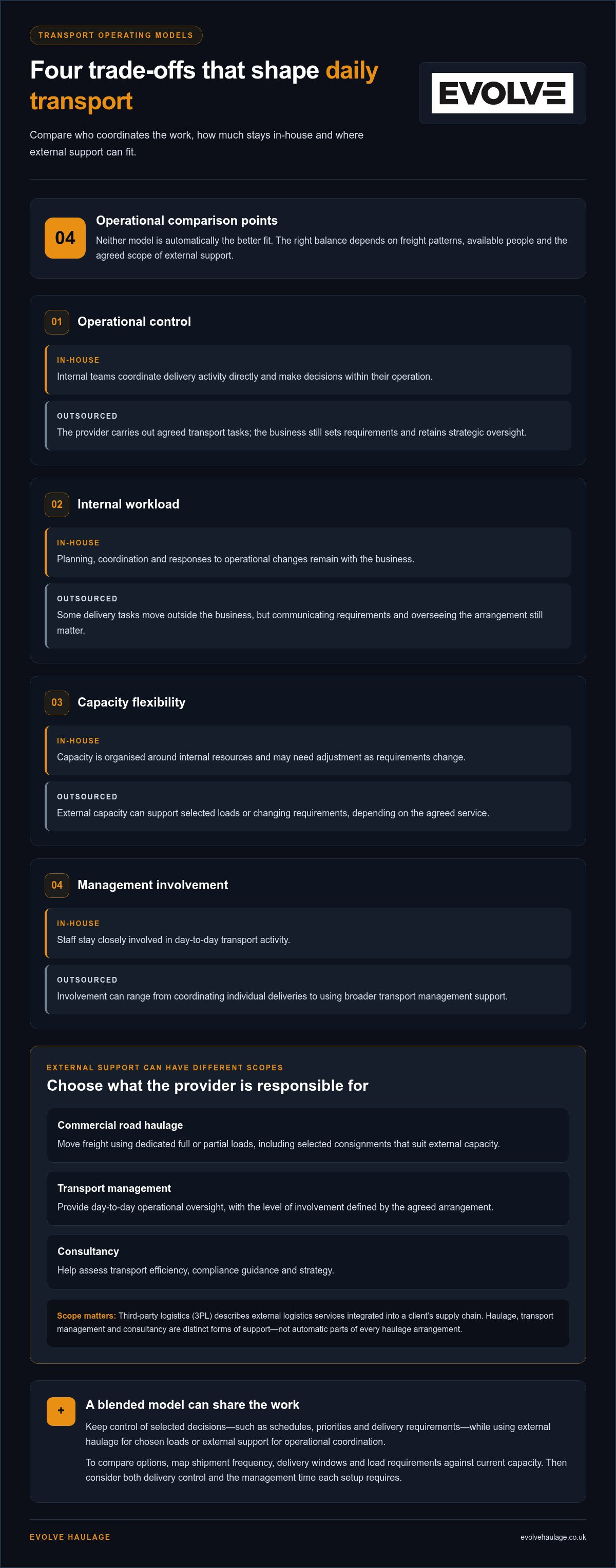
| Operational control | Internal teams coordinate delivery activity directly and make decisions within their operation. | The provider performs the agreed transport tasks. The business still sets requirements and retains strategic oversight. |
| Internal workload | Planning, coordination and responding to operational changes remain with the business. | Some delivery tasks move outside the business, but communicating requirements and overseeing the arrangement still matter. |
| Capacity flexibility | Capacity is organised around internal resources and may need adjustment as requirements change. | External capacity can support selected loads or changing requirements, depending on the agreed service. |
| Management involvement | Staff remain closely involved in day-to-day transport activity. | Involvement can range from coordinating individual deliveries to using broader transport management support. |
Control, visibility and internal workload
Direct coordination gives an internal team immediate involvement in schedules, priorities and delivery requirements. This can suit operations where transport decisions need to sit close to other business processes. It also means staff must organise the work and respond when plans shift.
External delivery support changes who carries out agreed tasks, not the need for oversight. Separate three questions when defining responsibilities: who can see delivery status, who coordinates service issues, and who sets the wider transport strategy? Clear ownership helps preserve useful visibility without expecting internal staff to carry out every task.
Capacity, demand changes and delivery requirements
Regular freight volumes may be easier to plan around when requirements are consistent. Occasional peaks can put internal resources under pressure at busy times or leave them underused during quieter periods. Dedicated full and partial loads are haulage options that may suit different consignments. The right fit depends on the freight and delivery requirements.
Urgent consignments raise a separate capacity question. External same-day delivery may suit a time-critical requirement that internal resources cannot meet. Before deciding how to handle urgent work, note how often it occurs, how much notice is typical and whether the delivery deadline is fixed.
Transport decisions also sit within wider supply-chain planning. The NIST Supply Chain Management resource discusses supply-chain performance and risk, useful context when considering how delivery arrangements affect broader operations. Actual transport costs depend on the operation, its requirements and the management resources involved. Compare the full workload rather than assuming one model costs less. For a practical review of external haulage and operational support, explore Evolve Haulage’s transport services.
The best fit depends on your demand patterns and the management capacity available to coordinate transport, not on a blanket preference for keeping everything in-house or outsourcing it.
What should determine your transport model?
Choose a model by examining the work your transport operation must handle and the management time available to support it. A clear picture of freight demand helps distinguish ongoing capacity needs from occasional pressure. An honest review of internal capability shows which responsibilities your team can manage effectively.
Map freight demand and service requirements
Start with a representative record of consignments. Include how often they move, whether they require full or partial loads, and the delivery windows involved. Separate recurring movements from urgent or irregular requests. This makes it easier to see whether demand is steady enough to plan around internally or whether specific requirements call for additional external capacity.
- Record shipment frequency and predictable busy periods.
- Note load requirements, including whether consignments are full or partial.
- Separate standard delivery windows from time-critical deadlines.
- Identify demand changes that affect capacity or scheduling.
Look for patterns, not just totals. Consistent regular movements may point to an ongoing capacity requirement, while occasional peaks may be better treated as separate needs. Mapping the two separately helps avoid building a permanent arrangement around temporary demand.
Assess internal capability and oversight
Next, identify who coordinates transport activity and how much time that work takes. Consider how the team organises schedules, manages driver coordination and maintains the business’s compliance-related processes. Don’t assume an outsourced arrangement removes the need for internal oversight. Someone still needs to communicate requirements and monitor whether the agreed service fits the operation.
Compliance responsibilities depend on the business’s circumstances and the work involved. Verify specific legal duties against current, relevant UK guidance rather than relying on assumptions. For day-to-day operational context, Evolve Haulage’s day-to-day transport management guide explains the management considerations involved.
Then compare three practical options: retain the activity internally, outsource selected loads, or use external transport management support. Assess each against the same requirements, including delivery windows, load type, coordination effort and the level of oversight your team wants to retain. This keeps the comparison focused on operational fit rather than headline assumptions about savings.
Build a like-for-like review using the same freight requirements, service scope and management responsibilities for each option. Record who will plan and coordinate the work, how much internal time it requires and how you’ll assess whether the arrangement continues to meet operational needs. This gives decision-makers a consistent basis for comparing approaches.
For the in-house vs outsourced transport decision, compare like with like: the same freight requirements, service scope and management responsibilities. That gives you a clearer basis for deciding what to keep, delegate or review as demand changes.
Can a blended transport model balance control and flexibility?
A blended model keeps selected transport responsibilities inside the business while using external support for defined freight needs. It can suit an operation that wants to retain its planning routines but needs additional capacity for particular loads or time-critical consignments. The arrangement isn’t automatically simpler. Its value depends on setting a clear scope, assigning ownership and maintaining effective communication.
This approach avoids treating the in-house vs outsourced transport decision as all or nothing. A business might keep control of customer priorities and regular scheduling, for example, while using an external haulage service for movements that don’t fit its available resources. Added flexibility or reduced pressure on internal teams depends on how well the arrangement matches actual demand. Coordination can also become more complex if responsibilities overlap.
When combining internal and external capacity may fit
Consider a business with established delivery routines but variable shipment volumes. Its team could plan recurring movements internally, then use external support for a peak period, an unusual load or an urgent delivery. Dedicated full or partial load haulage may suit specific freight requirements, depending on the consignment and agreed service.
There’s a useful distinction between outsourcing a task and transferring transport management. Assigning selected loads externally changes who carries out those deliveries. It doesn’t, by itself, hand over wider planning or day-to-day oversight. Transport management support is a broader option for businesses seeking help with operational coordination. Decide which responsibilities need extra capacity before defining the scope.
How to keep responsibilities clear
Before combining approaches, write down who owns each part of the process. This reduces the risk of missed handovers or duplicated work, especially when delivery plans change. Set out how information is shared, who communicates updates and how the arrangement will be reviewed.
- Planning: Decide who sets priorities, schedules movements and shares delivery requirements.
- Coordination: Identify who manages day-to-day communication and responds to changes.
- Review: Agree how both parties will assess whether the service scope still fits the freight pattern.
For example, an internal team could plan regular consignments and share load details and deadlines, while an external provider handles selected full or partial loads and urgent movements. The team remains involved in its customer commitments, while the provider performs the agreed transport work. Clear information-sharing helps both sides work from the same requirements without relying on any particular tracking technology.
As demand or internal capacity changes, review the split rather than assuming the original arrangement must remain fixed. Evolve Haulage’s guide to outsourcing transport operations offers further context for assessing which activities may suit external support.
If you’re considering a blended arrangement, explore Evolve Haulage’s haulage and transport management support for defined freight needs and day-to-day oversight.
Choose your next step: review, outsource or refine transport management
Once you’ve compared operating models, decide what needs to change, if anything. A structured review can show whether to retain the current setup, outsource particular freight movements or refine how transport is managed. You don’t need to commit to a complete change before identifying where the operational gaps lie.
A practical review before changing the model
Start with a clear summary of the current operation. Include recurring freight patterns, delivery priorities, internal workload and known constraints, such as periods when available capacity is stretched. Then identify which decisions and activities need to remain under internal oversight and where external delivery or management support could fit.
Work through these steps in order:
- Document requirements. Record shipment frequency, load types, delivery windows and any time-critical consignments.
- Identify operational gaps. Note where capacity, coordination time or existing processes make requirements difficult to manage.
- Compare model options. Assess internal delivery, outsourced loads and transport management against the same needs and scope.
- Agree review measures. Choose relevant indicators, such as whether schedules meet planned delivery windows, how much internal coordination is required and how often capacity needs change.
These measures provide a basis for reviewing whether the arrangement continues to suit the operation. They aren’t promises of particular results. They help your team identify what is working and where adjustments may be needed.
How Evolve Haulage can support the decision
Evolve Haulage provides UK-wide commercial road haulage for dedicated full and partial freight loads. Same-day delivery supports time-sensitive consignments, while transport management provides day-to-day operational oversight. You can consider these options separately or as part of a wider review, according to the requirements you’ve documented.
Consultancy provides a practical route to assessing transport efficiency, compliance guidance and operational strategy. It can help clarify which activities suit internal management and where external support may fit, without assuming that every business needs the same arrangement. A review can focus on your freight patterns, current responsibilities and the measures you want to use when assessing the model.
The in-house vs outsourced transport decision doesn’t have to result in an all-or-nothing change. A defined review can help you choose whether to keep your existing approach, adjust management responsibilities or bring in haulage capacity for particular needs.
Discuss your transport requirements with Evolve Haulage to explore a practical next step for your operation.
Make your next transport decision with confidence
Your transport model doesn’t need to be permanent. Treat it as an operating choice you can review as freight patterns, delivery priorities and internal capacity evolve. The in-house vs outsourced transport decision becomes more manageable when you identify the responsibilities your business needs to retain and the support that would address a specific gap.
If you’re weighing up a change, Evolve Haulage can help you consider practical options, from UK-wide commercial haulage for dedicated full and partial loads to transport management for day-to-day oversight. Consultancy can also support a review of transport efficiency, compliance guidance and operational strategy. The aim is to identify a suitable next step for your requirements, whether that means refining your current approach or exploring external support.
Discuss your transport requirements with Evolve Haulage and take the next step towards an arrangement that fits your business.
Frequently Asked Questions
Is in-house transport cheaper than outsourcing?
There’s no universal answer. Costs depend on your operation, available resources, shipment patterns and what the comparison includes. For a fair assessment, compare the same delivery requirements and service scope across each option. Include direct transport expenses, but also consider the staff time needed to plan, coordinate and oversee the work. Reviewing your own operating model will show which responsibilities contribute to its overall cost.
Can a business use both in-house and outsourced transport?
Yes. A business can keep internal planning or oversight while using external haulage for selected freight. For example, a team might handle routine, scheduled movements itself and use outside capacity when a temporary peak creates additional demand. Define who owns each task and how updates are shared. Use the blended-model section above to assess whether this arrangement fits your requirements.
What does a transport management service do?
A transport management service supports the organisation of day-to-day transport activity, such as operational coordination and schedule execution. It’s different from haulage, which carries freight by road. A business using management support still needs to share its requirements and retain the responsibilities assigned to it. Evolve Haulage provides transport management for operational oversight, helping businesses organise transport activity while keeping management support distinct from freight delivery.
Does outsourcing transport mean losing control of deliveries?
No. Outsourcing doesn’t automatically remove your oversight; it changes who carries out the tasks included in the arrangement. The level of control you retain depends on how responsibilities, communication and reviews are agreed. For example, specify who approves a change to a delivery plan and who must be informed if a deadline is at risk. Clear ownership and escalation routes help avoid uncertainty without assuming a particular tracking tool is in place.
When should a business consider outsourced same-day freight?
Consider same-day freight when a consignment has a genuine urgent deadline that your existing operation can’t accommodate effectively. A late production component may need different handling from a routine delivery that can follow its normal schedule. Assess the deadline and consignment requirements before choosing the transport approach. Evolve Haulage provides 24/7 and same-day delivery solutions for time-sensitive consignments.
Who is responsible for transport compliance when operations are outsourced?
Responsibility depends on the arrangement and the requirements that apply to the work, so don’t assume outsourcing transfers every duty. Establish who handles each compliance-related process and verify specific UK obligations using current, relevant guidance. This answer isn’t legal advice. Evolve Haulage provides transport management and compliance guidance to support operational oversight, but businesses should understand their own responsibilities and the scope agreed for any outsourced support.
What is the difference between a 3PL and outsourced haulage?
Third-party logistics, or 3PL, is a broad term for logistics services delivered by an external business. Haulage specifically means transporting freight by road. A 3PL arrangement may include different services, so the label alone doesn’t tell you which tasks are covered. Define the scope: is the external business carrying the load, managing transport activity, or providing both? Separating freight movement from operational coordination makes the arrangement easier to understand.


