

A drivers’ hours infringement needs more than a note in the file: review the records and the reasons behind it. A transport compliance consultancy can help establish what happened, identify any wider pattern and shape a proportionate response. HGV operations should also be audited at least annually.
It is understandable to focus first on the individual infringement, but recurring issues can point to problems with processes, scheduling or oversight. A clear review turns a finding into practical corrective action and supports stronger day-to-day compliance.
This article explains what a consultant can do after an infringement, how often to audit an HGV operation and how consultancy can support operator licence compliance. It also covers what the service involves, what shapes the work and when professional support can help you manage compliance with greater confidence.
Key Takeaways
- Use tachograph analysis to identify drivers’ hours patterns, then document the findings and the corrective action taken.
- Structure audits to examine whether compliance processes are working consistently, including any requirements linked to DVSA Earned Recognition.
- Ensure transport activities are managed effectively and continuously, as required of a transport manager by the Traffic Commissioner.
- Consider professional support when infringements reveal wider process gaps or you need help managing operator licence matters.
How Often Should a Transport Compliance Consultancy Audit Your HGV Operation?
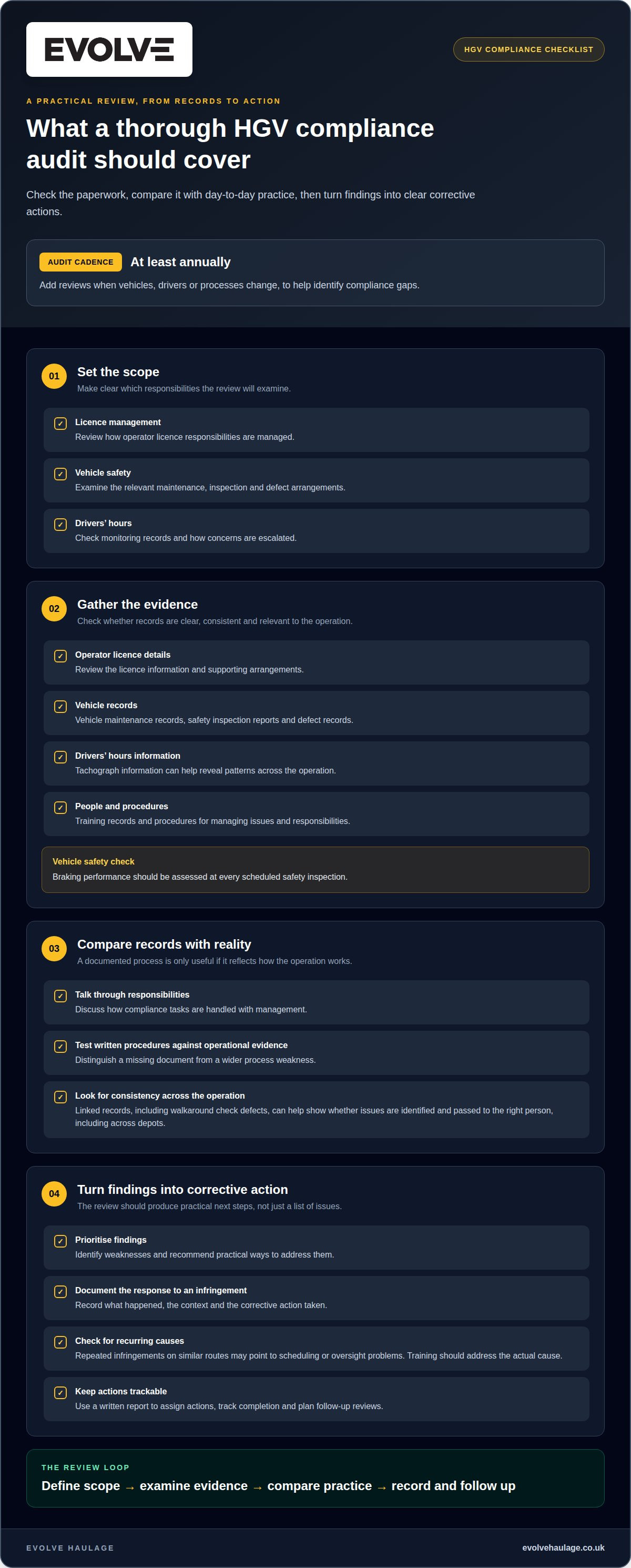
HGV operations should be audited at least annually. Additional reviews can help identify compliance gaps following changes to vehicles, drivers or processes.
DVSA Earned Recognition audits
DVSA Earned Recognition audits assess evidence that an operator’s systems meet the scheme’s requirements. An audit provider reviews records and processes, then identifies gaps to address. When selecting a provider, look for relevant scheme experience and clear reporting. Ask how findings will be prioritised and turned into practical improvements for your operation.
Independent operator licence audits
An independent operator licence audit gives you a structured view of how your operation manages its licence responsibilities. A transport consultant can review compliance arrangements and recommend improvements, adding an external perspective to routine internal checks. The review should compare written procedures with how the operation works in practice. This helps distinguish a missing document from a broader process weakness.
Compliance records and documents
A compliance review can cover operator licence details, vehicle maintenance records, safety inspection reports, defect records and drivers’ hours information. It can also assess training records and procedures for managing issues. Together, these documents help show whether responsibilities are clear and records are consistent. Braking performance should be assessed at every scheduled safety inspection.
Audit and review steps
A professional review typically starts by defining its scope, such as licence management, vehicle safety or drivers’ hours. The auditor examines the relevant records, discusses responsibilities with management and compares documented processes with operational evidence. Findings are prioritised, with practical recommendations for addressing weaknesses. A written report helps the operator assign actions, track completion and plan follow-up reviews.
Operator licence compliance
UK transport compliance support can cover licence applications, ongoing oversight and checks of driver records. The right scope depends on the operation, its vehicles and which responsibilities are managed in-house.
For restricted licence holders and small fleets, practical support can help organise routine obligations and address gaps before they become recurring problems. The Traffic Commissioner states that a transport manager must effectively and continuously manage the organisation’s transport activities. Where a fleet lacks suitable in-house management, a CPC-qualified consultant can act as an external transport manager.
Operator licensing applications and support
For HGV, PSV and LGV businesses, application support can help organise information for an operator licence matter and identify areas that need attention. A specialist can review the application’s scope, explain the responsibilities attached to the licence and help align supporting documents with the operation described. Ongoing advice can also help restricted licence holders and smaller fleets manage regulatory obligations as their work changes. FORS is a voluntary accreditation scheme that recognises best practice, not a substitute for operator licence compliance.
Driver and tachograph-card checks
Checks can cover driver licences, Driver CPC qualifications and tachograph cards, helping fleet managers keep clear records of who is authorised and prepared for assigned work. A professional review assesses whether records are current, complete and consistent with the operation’s procedures. Tachograph information also helps monitor drivers’ hours. If an issue emerges, the consultant can identify the relevant records and recommend practical follow-up, such as training or changes to monitoring processes.
Operator licence applications and ongoing compliance support can also help managers respond to concerns before they develop into wider failures. Serious transport non-compliance can lead to a Public Inquiry before the Traffic Commissioner, with possible sanctions, fines or licence revocation. For practical support with operator licence matters, explore professional transport compliance support.
Drivers' Hours Infringements: What Should Operators Do After Finding Them?
After an infringement, operators should establish what happened, document their response and address any recurring cause. Tachograph analysis can connect an individual event with wider monitoring or scheduling issues.
Tachograph and driver-hours monitoring
Tachographs in commercial vehicles record driving time, speed and rest periods. A professional can analyse the records to check compliance with drivers’ hours rules and identify patterns across the operation. For example, repeated infringements on similar routes may point to scheduling or oversight problems. Document the finding, its context and the corrective action taken.
Compliance audits can also assess how the operation monitors records and escalates concerns. Driver walkaround checks add useful operational evidence: documented defects can show whether vehicle issues were identified and passed to the right person. Linking records helps operators with multiple depots assess whether procedures are applied consistently.
Driver CPC and training
Driver CPC and training records can help show whether a driver needs further support after an infringement. A review can consider the event, previous findings and relevant training, then recommend focused follow-up. For example, if a driver misunderstands an internal reporting process, targeted instruction may clarify how concerns should be raised with the transport manager.
Training should address the actual cause, rather than repeat general information. A consultant can also help managers record agreed actions and assess whether subsequent monitoring shows the process has improved.
Penalties and reducing non-compliance risk
Serious transport non-compliance can lead to a Public Inquiry before the Traffic Commissioner, with possible sanctions, fines or Operator Licence revocation. To reduce risk, investigate each finding, document decisions, correct underlying process gaps and monitor whether the issue recurs.
A clear response matters. The review should distinguish an isolated error from repeated failures, assess relevant tachograph evidence and assign responsibility for follow-up. For instance, an operator could record who will address a scheduling issue and how later monitoring will assess the change. This helps show that infringements are acted on, not left unresolved in the records.
Transport compliance consultancy
Consultancy can provide independent analysis of compliance processes, licence responsibilities and operational records. The right support depends on whether you need a focused review, ongoing guidance or help with an application.
Consultancy services for transport operators
In the UK, a consultant can review transport systems, identify compliance gaps and recommend practical changes. Support may cover operator licence applications, drivers’ hours analysis or advice for a transport manager. The Traffic Commissioner says a transport manager must effectively and continuously manage the organisation’s transport activities. A consultant can help assess whether existing oversight supports that responsibility.
Compare providers by the work they will carry out and the outputs they will provide. Establish whether the scope includes record analysis, written findings, prioritised actions and follow-up support. Clear boundaries show what the review covers and who will manage each action afterwards.
Qualifications and accreditations
Check that the person doing the work has relevant transport qualifications and practical experience. A CPC-qualified consultant may act as an external transport manager for an operator without a suitable in-house manager. Ask how their expertise relates to your vehicle types, licence requirements and operational risks.
Accreditations provide useful context, but do not replace a clear service scope. FORS is a voluntary accreditation scheme that recognises best practice. When comparing consultancies, consider how qualifications, experience and reporting methods fit your needs. An operator seeking application guidance, for example, may need different support from one addressing recurring monitoring failures.
Consultancy costs
The cost depends on the case and is provided after a quote request. Factors include the review’s scope, fleet complexity, records requiring analysis and whether support continues after the initial report. A focused review and ongoing compliance support involve different work, so compare what each proposed scope includes rather than relying on a headline figure.
Set out the issue, the records involved and the outcome you need. This helps define a practical scope before work begins. Discuss transport compliance support for help assessing the next step.
Evolve Haulage: Transport Management
Evolve Haulage can support businesses when audit findings or drivers’ hours issues point to wider operational needs. Its Transport Management service supports compliant day-to-day logistics, while its Consultancy Service helps operators address transport-related challenges. These services suit businesses seeking professional input alongside existing fleet management, rather than only a one-off review.
Consider this support when compliance tasks need closer coordination with daily transport operations or your processes need specialist attention. Evolve Haulage also provides haulage services, including time-critical delivery solutions, for businesses with transport requirements.
For a straightforward conversation about your transport needs, contact Evolve Haulage.
Make your next compliance decision count
Set a clear objective before arranging support. Decide which operational decision needs attention, who will own the follow-up and how progress will be recorded. A focused brief keeps professional input connected to daily work, instead of leaving recommendations as a separate set of documents. It also gives managers a shared basis for prioritising improvements across the operation.
A transport compliance consultancy can help turn that brief into a practical plan, with actions aligned to your operation’s priorities and responsibilities. The next step might be specific advice or support integrated into wider management activity. Keep the process collaborative: operational staff can provide context, while managers retain oversight of decisions and follow-through.
For support tailored to your transport operation, contact Evolve Haulage to discuss support. A considered conversation can help you identify a useful starting point and move forward with confidence.
Frequently Asked Questions
Need a compliance consultant?
Consider consultancy when compliance work is difficult to oversee internally or a problem keeps recurring. If managers are struggling to coordinate transport records alongside daily planning, for example, a consultant can provide focused analysis and recommendations. External support can also add capacity during an application or operational change. It complements management responsibility; it does not remove the need for clear internal ownership.
What are the UK legal requirements for operator licences, drivers’ hours, vehicle maintenance and tachographs?
UK operators must meet the requirements that apply to their licence and transport activities, including relevant DVSA and Traffic Commissioner expectations. Drivers’ hours and tachograph records, vehicle maintenance arrangements and licence responsibilities all need appropriate management. The exact requirements depend on the operation and vehicle use, so assess these details together rather than relying on a general checklist for every fleet.
How can a UK haulage operator find and choose a local transport compliance consultant?
Choose support that fits your operation, not simply the nearest available adviser. Check relevant transport experience, qualifications, the proposed scope and whether findings will include clear actions. An operator with a licence application concern, for example, needs different expertise from one seeking help with operational processes. Discuss how the consultant will work with your team and what information they need to assess the issue.
When should a UK transport business hire a compliance consultant rather than manage compliance in-house?
Use external support when your internal capacity or expertise does not match the work required. A business might seek help after recurring record-keeping problems, a significant operational change or a licence application needing specialist input. In-house managers should retain oversight of decisions and actions. A consultant can add analysis or structured support without replacing the organisation’s management responsibilities.


