

The lowest transport quote isn’t always the lowest-cost option overall. A transport cost assessment for business should compare the full charges and service implications, including freight, fuel surcharges, insurance and handling, with the requirements of each journey. The right choice meets your delivery needs while offering value across the whole movement of goods.
It’s easy to focus on the quoted rate, especially when several options look similar. But trip length, load weight and volume, loading and unloading time, and additional services can all affect the comparison. This guide explains how to assess supplier costs, understand a freight cost breakdown and weigh value for money. It also shows how to account for handling time and route requirements, so your comparison reflects the practical demands of your operation, not just the headline charge.
Key Takeaways
- Compare the full transport cost, including freight, fuel surcharges, insurance and handling, rather than relying on the quoted rate alone.
- Assess how each option supports your business objectives, affordability, operational requirements and commercial planning.
- Weigh value for money by considering service outcomes and trade-offs, not just the lowest cost; shipment consolidation and route planning may help reduce spend.
- Include trip distance and loading or unloading time in your assessment, as handling can affect the cost-effectiveness of shorter journeys.
Transport costs in supplier selection and total cost of ownership
Compare suppliers by the full cost of moving goods, not just the headline freight charge. A sound assessment also accounts for service requirements, operating costs and compliance.
Transport unit costs
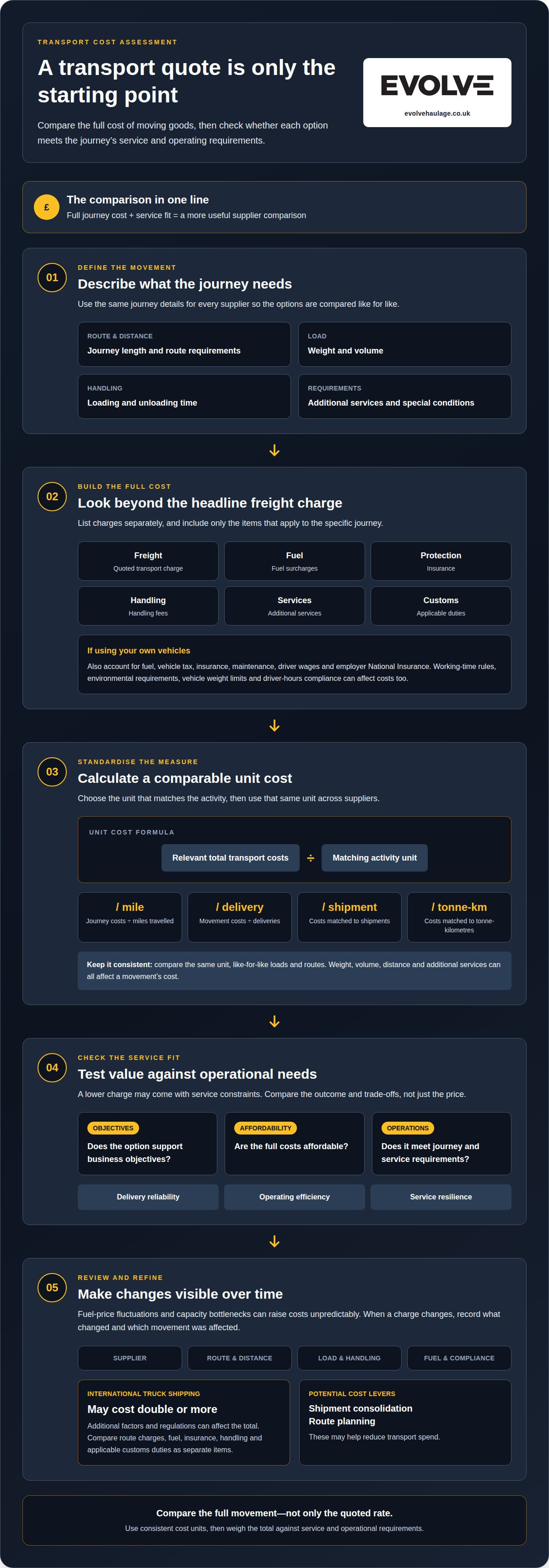
A transport unit cost expresses transport spend per mile, delivery, shipment or tonne-kilometre. Calculate it by dividing the relevant total transport costs by the matching unit of activity. Use the same unit across suppliers, then compare like-for-like loads and routes. This shows how weight, volume, distance and additional services affect each movement, helping you assess supplier value and identify cost drivers.
Typical UK commercial vehicle operating costs in 2026 depend on vehicle type, mileage, load, route and how fully each vehicle is used; one figure would not fit every operation. For a cost per delivery, include the costs attributable to that movement, then divide by the number of deliveries. A per-mile figure uses the relevant journey costs divided by miles travelled.
Domestic and international costs
Domestic transport moves goods within the UK, while international transport crosses national borders and can involve extra cost categories. International truck shipping may cost double or more than domestic shipping because of additional factors and regulations. Compare routes, freight charges, fuel surcharges, insurance, handling and applicable customs duties as separate line items. This makes differences between routes visible instead of hiding them in a supplier’s total.
Check which charges apply to each journey and record them in pounds using consistent assumptions. Longer routes can change fuel and driver costs, while border-related charges can affect the total for international movements. List these items separately so you can assess a lower purchase price against the full cost of getting goods to their destination.
Vehicle operating costs
Vehicle operating costs are the recurring expenses of using business vehicles, including fuel, vehicle tax, insurance and maintenance. Their combined effect matters when deciding whether to operate vehicles directly or buy transport from a supplier. Record actual business expenditure by vehicle and match it to mileage, deliveries or shipments to calculate a comparable unit cost.
Driver wages and employer National Insurance add labour costs. Working-time rules can affect the hours available for journeys and the staffing needed to complete them. Environmental requirements, vehicle weight limits and driver-hours compliance can also affect unit transport costs. Include these obligations in your assessment rather than treating them as separate from the cost of moving goods.
Variable and hidden costs
Variable and less visible costs are charges that change with conditions or sit outside the base freight rate. Include fuel surcharges, insurance, handling fees, additional services, special conditions and applicable customs duties. Fuel-price fluctuations and capacity bottlenecks can also raise costs unpredictably. When a charge changes, log the cause, date, route and affected shipment.
To manage fuel-price exposure, a business can agree a hedging approach and record hedged amounts, periods and resulting costs separately from spot-price expenditure. A simple spreadsheet can track supplier, route, distance, load, fuel, handling and compliance costs, with a formula that divides total costs by miles, deliveries or shipments. This gives your team a consistent template for reviewing changes and comparing options.
Strategic, economic, financial, commercial and management dimensions
A transport decision needs to fit the business strategy as well as its budget. In UK transport business cases, the 2022 Green Book provides the development framework; analysis should connect transport spending to objectives, affordability and delivery.
Assess impacts against each strategic objective rather than presenting one combined score. For example, map a proposed route change to delivery reliability, operating efficiency and service resilience, then show the evidence supporting each outcome. This makes trade-offs clearer and helps decision-makers see which objectives a proposal serves.
Project business cases typically develop through three stages: strategic outline case, outline business case and full business case. At the strategic outline case stage, the strategic dimension should be around 50% complete; it should reach 80% at outline business case and 100% at final business case stage. The economic, financial and management dimensions also develop as the case progresses, so assumptions and costs need to be carried forward consistently.
Commercial analysis considers how procurement and supplier arrangements support a proposal, while financial analysis tests affordability, funding and accounting implications. Management planning addresses delivery responsibilities and risks. A lower transport charge may not support a strategic objective if it creates service constraints or weakens operational resilience.
Strategic spares management is another transport consideration. Decisions about where to position critical replacement parts affect replenishment routes, response planning and the cost of disruption. Assess the consequences of delayed delivery alongside transport costs, particularly when a part supports essential operations.
Keep objective measures, cost assumptions and delivery risks aligned across each business-case stage. For a joined-up review of transport planning and operational requirements, explore coordinated logistics planning.
Transport options appraisal and value for money
Compare options against business objectives, total cost and operational outcomes. The Green Book options framework-filter supports longlist and shortlist decisions.
Freight mode cost comparisons
Comparing road, rail, sea and air freight means assessing each mode’s full journey cost against the delivery requirement. For a UK movement, compare door-to-door charges, transfer and handling needs, route suitability, load characteristics and delivery timing. Where oversized plant, machinery or non-standard cargo is involved, specialised transport operators such as Allout Towing illustrate how dedicated equipment and handling fees must be factored into the overall appraisal. This helps you judge whether a lower transport charge remains good value once the whole movement is considered. Keep shipment assumptions consistent across options to make the comparison meaningful.
Reducing transport costs
Businesses can reduce transport costs through shipment consolidation and route optimisation, while assessing whether these changes affect delivery timing or operational risk. Group compatible consignments when delivery requirements allow, and plan routes to avoid unnecessary movement. Then assess each option against service objectives, including timing and reliability, rather than treating cost reduction as the only measure. This keeps savings decisions tied to practical delivery needs.
For business planning, define the intended outcome before comparing options. The Green Book options framework-filter supports longlist and shortlist selection, helping decision-makers assess which proposals merit further consideration. At the longlist stage, the Department for Transport’s default approach is to rule out options that do not achieve spending objectives. Record why each option is retained or excluded so the decision remains traceable.
A Value for Money statement should explain how an option’s costs and benefits support the spending objectives. UK transport business cases should also report spending objective analysis findings in a Spending Objective Analysis Statement. The statements are complementary, so avoid counting the same findings twice. Set out uncertainty and trade-offs clearly. For example, explain how a lower-cost option compares with an alternative that better meets a delivery objective.
This approach makes each option’s contribution to the business case visible. Weigh cost, objectives and uncertainty together rather than selecting an option solely because its initial estimate is lower.
Trip length and loading or unloading time
Assess delivery costs by recording each route’s distance, journey time, loading and unloading time, vehicle utilisation and empty mileage. These measures show whether handling time makes a short trip more costly than its distance suggests, or whether a longer route carries a load more efficiently.
Short truck trips can cost more than longer ones because loading and unloading add time beyond the drive itself. Include time spent waiting at collection and delivery points alongside journey time when assessing a movement. For example, two routes with similar mileage may have different costs if one involves lengthy handling or repeated stops.
Compare cost per delivery with distance and time for the same type of load. Record loaded and empty miles separately, then examine how much of each vehicle’s capacity is used. A vehicle returning empty adds mileage without carrying a delivery, so return-load opportunities and route sequence can affect utilisation. Keep comparisons consistent across routes and periods to identify practical improvements.
Route planning should also account for the delivery window and the time needed to handle goods safely and efficiently. A faster journey is not automatically better value if waiting, loading or unloading causes delays elsewhere. Compare planned journey time with actual elapsed time, then identify whether the main difference comes from distance, congestion, stops or site handling.
Operational changes can also affect environmental outcomes. In an automotive supplier example, a weekly milk-run system reduced CO2 emissions by 40%. That result illustrates how a planned collection pattern can influence vehicle movements, but each route assessment should measure its own distance, load and handling requirements.
Use these records to identify whether improvements should focus on route timing, vehicle use or handling arrangements. For support reviewing transport requirements and delivery schedules, discuss your route and handling requirements.
Evolve Haulage: Transport Management
Evolve Haulage provides Transport Management for businesses assessing transport costs alongside day-to-day logistics needs. This service can support operations where coordinating transport requirements, service decisions and delivery arrangements takes time away from core business activity.
For companies that need goods moved, its Haulage Service offers a practical next step after comparing routes, handling requirements and value. Evolve Haulage also provides Consultancy Service for businesses reviewing their transport arrangements, and 24/7 or same-day delivery solutions for time-critical movements across the UK.
Share your transport requirements with Evolve Haulage to discuss the right support for your operation.
Make your next transport decision count
A transport cost assessment for business can do more than guide a supplier choice. Use it as a working reference for future decisions, updating assumptions when routes, loads or operational priorities change. This keeps transport planning connected to how your business operates instead of treating each movement as an isolated purchase.
When you’re ready to put your analysis into practice, Evolve Haulage can support your operation through Transport Management, a Haulage Service or a Consultancy Service. Discussing your requirements can help clarify how transport support fits your business and where to focus next.
Discuss your transport needs with Evolve Haulage and take the next step towards a transport approach that works for your operation.
Frequently Asked Questions
What questions can be asked?
Ask questions that reveal whether the transport arrangement fits the consignment and your operating needs. For example: What are the collection and delivery windows? Which load details affect the plan? What charges could change after booking? How are delivery updates and proof of delivery handled? What happens if a route disruption affects the schedule? Clear answers help distinguish an option that suits the job from one that only looks suitable on paper.
What does a business transport cost assessment include?
A transport cost assessment for business brings together the charges, operating assumptions and service requirements for a movement. Add the consignment details, route, supplier quotation and applicable additional charges to one record. Then compare the expected cost with the final invoice and note the reason for any difference, such as a changed collection time or load. This creates a useful audit trail for future budgeting and supplier discussions.
What UK rules and charges affect business transport, including HGV road user levy, tolls, and clean air zones?
Include any applicable HGV road user levy, tolls and clean air zone charges as separate cost lines in your journey assessment. Their relevance depends on the vehicle and planned route, so avoid applying the same assumption to every movement. Record the charge basis used for each journey and keep it separate from the supplier’s transport charge. This makes the effect of route or vehicle changes easier to assess.
What are typical UK commercial vehicle operating costs in 2026?
Costs vary by vehicle type, mileage, load, route and vehicle utilisation, so one figure will not suit every operation. Include costs attributable to each movement and divide by deliveries or miles to calculate a comparable unit cost.
What UK fuel, road tax, insurance, and maintenance costs apply to business vehicles?
Business vehicle operating costs include fuel, vehicle tax, insurance and maintenance. Driver wages and employer National Insurance add labour costs. Record actual expenditure by vehicle and match it to mileage, deliveries or shipments for comparison.
What transport cost assessment tools, templates, or calculators are available for UK businesses?
A simple spreadsheet can track supplier, route, distance, load, fuel, handling and compliance costs. Divide total costs by miles, deliveries or shipments to compare unit costs consistently.


