

A per-mile rate is a useful starting point, but it does not tell the whole story. If you are working out how much haulage costs in the UK, the final quote also depends on the vehicle, load, route and any empty mileage.
Fuel prices matter too. Changes in diesel costs may affect the rate through a fuel surcharge or another pricing adjustment. Comparing mileage rates alone can be misleading, so check what each quote includes before booking.
This guide explains how UK haulage rates per mile are calculated, how fuel price changes can affect a quote and what to check before accepting one. It also covers how load size, vehicle choice, return journeys and timing can influence the total, helping you assess the full scope of a quote rather than focus on one figure.
Key Takeaways
- Match the vehicle to your load: vehicle size and capacity affect the mileage rate and overall quote.
- Understand how fuel price changes feed into the rate, and whether the quote applies a fuel surcharge.
- Provide accurate collection and delivery details, load dimensions, weight and access requirements for a clearer quote.
- Consider flexible dates or a shared-load option to help reduce costs when your delivery schedule allows.
How should haulage rates handle changing fuel prices?
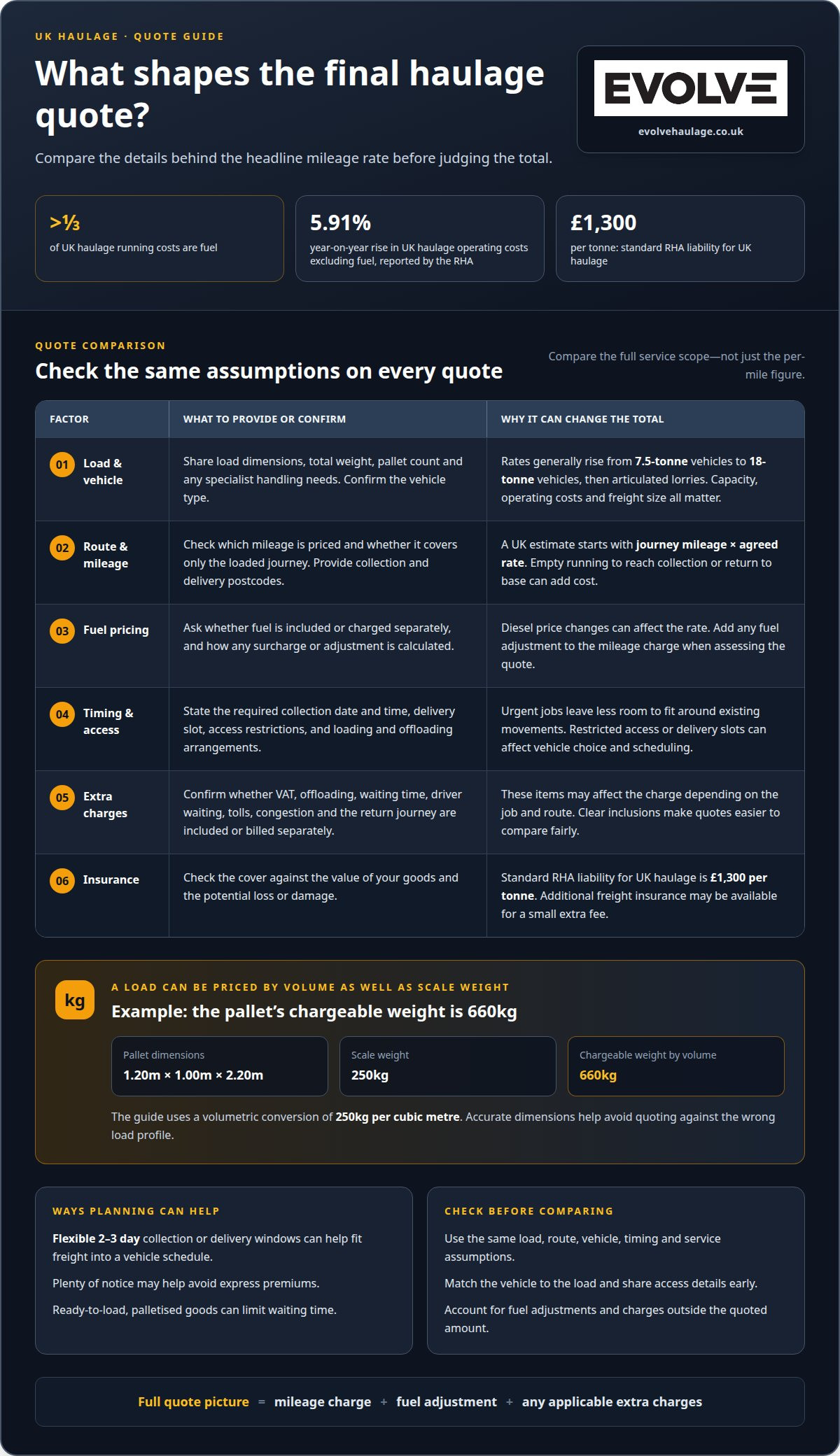
Fuel accounts for over a third of UK haulage running costs, so diesel price changes can affect quoted rates. A clear quote should state whether fuel is included in the charge or listed separately as a surcharge, and explain how mileage and any fuel adjustment apply to the journey.
Vehicle choice changes the rate structure. Guide rates generally rise from 7.5-tonne vehicles to 18-tonne vehicles, then to articulated lorries. A larger vehicle has different operating costs and capacity, so the load’s weight and dimensions help determine the suitable option. Published mileage guides are useful for initial comparisons, but they aren’t a complete quote.
How much does pallet delivery cost in the UK? The price depends on the route, pallet dimensions and weight, vehicle and handling arrangements, and is provided after a quote request. A shared or part-load service may suit a small consignment better than hiring a whole vehicle.
How much does UK haulage cost for same-day or urgent deliveries? The price depends on the route, vehicle, load and required timing, and is provided after a quote request. Urgent timing can affect scheduling, while fuel and the journey’s mileage also influence the charge.
For European haulage, transit time depends on the destination and service arrangement. Near-Continent destinations, including France, Belgium, the Netherlands, western Germany and northern Spain, typically take 4-6 working days. Italy, southern Spain and Portugal typically take 5-7 working days. Transit time helps establish the delivery plan, but it doesn’t set the cost on its own.
For a UK estimate, multiply the journey mileage by the agreed rate, then allow for fuel adjustments and additional charges. Check whether the mileage covers only the loaded journey. Empty running to reach collection or return to base can add cost, so the route plan matters as much as the distance between postcodes. Clarifying these details makes it easier to understand how the quote accounts for fuel prices and vehicle mileage.
Questions to check before accepting a quote
Before accepting a quote, establish what the charge covers and which details could change the final amount. To compare quotes fairly, make sure they use the same assumptions about the load, route, timing and service.
Details needed for an accurate quote
Provide collection and delivery postcodes, load dimensions and total weight, and the number of pallets. Include loading and offloading arrangements, access restrictions, and the required collection date and time. These details help Evolve Haulage select a suitable vehicle and plan the route. Narrow access or a restricted delivery slot can affect vehicle choice and scheduling, so mention both when requesting a quote.
Factors affecting haulage quotes
Distance matters, but so do the load’s dimensions, weight and handling requirements. Unusual freight may need a specialist vehicle or equipment, while access restrictions can affect the vehicle and route. Urgent collection leaves less scope to fit the job around existing movements. Return journeys, driver waiting and loading arrangements can also affect the total charge.
Comparing quotes and insurance
Compare the same collection and delivery details, vehicle type, timing and inclusions rather than choosing on the headline figure alone. Check whether the freight insurance cover is sufficient for the value and potential loss or damage to your goods. Standard RHA liability for UK haulage is £1,300 per tonne; additional freight insurance cover may be available for a small extra fee. You can also check membership of relevant associations, such as the Road Haulage Association or Freight Transport Association. A haulage consultancy review can help clarify the scope and requirements of a transport plan.
Extra charges for waiting and access
Can waiting time, loading, tolls or congestion add to UK haulage costs? They may affect the charge depending on the job and route, so the quote should state whether each is included or billed separately. Also confirm VAT, offloading, waiting time and the return journey. This makes it easier to compare quotes on equivalent terms and identify costs outside the quoted amount.
What is a typical haulage rate per mile in the UK in 2026?
A mileage rate is only one part of the charge. Freight dimensions, vehicle type, fuel and waiting can also affect the total. Control costs by matching the load to the transport plan and reducing avoidable mileage or handling time.
Factors affecting haulage costs
Route length, vehicle capacity and the load’s chargeable weight all shape haulage rates. Freight may be assessed by volume as well as scale weight, so bulky, light goods can affect the vehicle space required. For road freight, a volumetric conversion of 250kg per cubic metre gives a way to calculate chargeable weight.
For example, a 1.20m × 1.00m × 2.20m pallet weighs 250kg on the scale but has a chargeable weight of 660kg by volume. Accurate dimensions help avoid estimates based on the wrong load profile.
Operating costs and fuel surcharges
Fuel price movements can affect a quote through a surcharge or an adjusted mileage rate. Ask how the fuel element is calculated and whether it is included, rather than treating the per-mile figure as the full cost.
The Road Haulage Association reported that UK haulage operating costs excluding fuel rose by 5.91% year on year. This shows why fuel is not the only cost factor; vehicle operation and other running costs also influence rates.
To reduce volumetric costs, provide precise dimensions and keep pallet heights to 220cm where the freight allows. Taller loads may not fit through many standard vehicle doors. Consolidating freight into fewer, efficiently arranged loads can also make better use of vehicle space.
Planning can reduce avoidable expense too. A flexible collection or delivery window of 2-3 days can help a haulier fit freight into its vehicle schedule. Giving plenty of notice may help avoid express premiums, while goods that are palletised and ready to load can limit waiting time. Include access and loading details early, so the vehicle and schedule can be planned around the actual job.
Haulage cost per mile
A per-mile figure helps compare haulage, but it does not represent every cost involved. Distance, vehicle, load and route all affect the rate. Published guides are starting points, not fixed tariffs. A full load travelling a long distance may have a lower mileage rate than a short trip, where minimum charges and repositioning can make up a larger share of the cost.
To estimate the charge, multiply the chargeable journey mileage by the agreed rate, then allow for fuel surcharges and additional charges. Check which mileage the calculation uses: collection-to-delivery distance, all miles travelled, or another route basis. This matters because a vehicle may travel beyond the loaded leg to reach collection or its next assignment.
Return loads can change the economics of a route. A vehicle carrying freight in both directions can spread its running costs across more loaded mileage than one travelling empty after delivery. The availability, timing and suitability of return freight affect whether that saving can apply. For longer full-load journeys, including those over 300 miles, per-mile rates are often reduced.
For journeys to Europe, distance alone still does not determine the charge. The route, load, vehicle requirements and transit plan all shape the quote. A pallet shipment and a full-vehicle movement use different amounts of space and capacity, so compare like with like. Confirm whether the quoted mileage includes the full journey and whether fuel adjustments or other charges are additional.
The price depends on the job and is provided after a quote request; key factors include route mileage, vehicle type, load dimensions and weight, fuel, timing and return-load arrangements. Share those details to support an accurate calculation. If you need a UK haulage quote based on your route and freight, discuss your haulage requirements.
Evolve Haulage
Evolve Haulage helps businesses plan haulage around the route, load, vehicle and delivery timing. Its Transport Management and Consultancy Service can help bring these requirements together, while its Haulage Service supports the movement of goods. For time-critical requirements, 24/7 or same-day delivery is also available.
Bring together your collection and delivery postcodes, freight dimensions and weight, access details, and preferred timing. This information defines the transport requirement and helps clarify how mileage, vehicle choice and any return-load opportunity affect the plan. Evolve Haulage can arrange individual movements and help businesses review how their transport is managed.
For help planning a haulage movement or discussing your transport requirements, contact Evolve Haulage.
Plan your next haulage decision
Understanding how much haulage costs in the UK is most useful when it informs a transport plan, not just a single booking. For regular freight movements, consider how booking patterns, delivery priorities and changing requirements fit your wider operation. A clear view of these needs can help shape transport decisions and make future quotes easier to assess against the work involved.
Evolve Haulage supports businesses with haulage, transport management and consultancy. If you are planning a movement or reviewing how freight is managed, share your requirements with the team to discuss practical options.
Contact Evolve Haulage today to talk through your transport requirements and take the next step with confidence.
Frequently Asked Questions
Should I charge per mile or per day?
Use a per-mile basis when distance is the clearest measure of the work, and a day rate when vehicle and driver time are central. A planned route with known mileage may suit a mileage calculation, while several collections or deliveries may be easier to structure as a daily charge. Either way, account for operating costs, job-specific requirements and your intended margin.
What actually drives haulage costs?
Haulage costs reflect more than distance. Vehicle type, freight weight and dimensions, fuel, driver time, route planning and loading arrangements all contribute. A bulky but lightweight consignment may use substantial vehicle space, while a heavy load may determine the vehicle required. Waiting, access restrictions and urgent timing can also affect the work involved. The quote should reflect the actual movement, not mileage alone.
Why is my cost per mile higher than the haulage rates I find online?
Online rates are guides, while a quote can account for your specific route, load and vehicle. Empty mileage to reach collection or reposition after delivery can raise the effective cost per loaded mile. Short jobs may also have a minimum charge, making the mileage figure look higher when the total is divided by a short distance. Compare what each rate includes before judging the difference.
What is the average cost of haulage in the UK?
To understand how much haulage costs in the UK, start with the vehicle and route, because there is no single average for every movement. Treat any general figures as guides, not a job-specific quote.
How much do UK haulage companies charge per mile or per hour?
To assess how much haulage costs in the UK per mile or hour, distinguish distance-based rates from time-based charges. Hourly pricing reflects time spent driving and waiting. Compare equivalent routes, vehicle types and service requirements.
What are typical UK haulage rates for a full truckload versus a part load?
Full-load and part-load rates are not directly comparable. A full truckload prices the movement of a vehicle load, while a part load uses only some of its capacity. If your freight is small, sharing vehicle space can cost less than booking the whole vehicle. The charge depends on load space and weight, route, collection and delivery arrangements, and how the movement fits the transport plan.


