

What if a schedule could absorb a late change without passing the pressure on to the next driver? Learning how to manage drivers and schedules means balancing delivery commitments with driver capacity, fair workloads and the rules that apply to each operation. When a route changes or a shift runs late, a good plan has enough structure to keep work coordinated and enough flexibility to adapt.
Last-minute changes can make delivery times harder to maintain, especially when managers also need to keep workloads clear and account for drivers’ hours and working-time requirements. The rules vary with the vehicle and type of operation, so compliance needs to be built into planning rather than treated as an afterthought.
This guide explains how to build realistic schedules, communicate changes and review performance. It covers driver availability, route demands, rest and working limits, and delivery windows, then shows how to adjust the plan when circumstances shift. Evolve Haulage’s transport management supports day-to-day driver coordination and schedule execution, while its consultancy helps businesses assess transport efficiency and strategy.
Key Takeaways
- Start with the work to be covered, then match each assignment to a suitable available driver and vehicle.
- Learn how to manage drivers and schedules with a consistent planning sequence that checks each journey against delivery and operational constraints.
- Review planned work regularly and use a separate response process for urgent changes, so decisions and communications stay clear.
- Assess workload patterns and recurring disruption to identify where planning or coordination needs to improve.
- Understand how transport management and consultancy can provide day-to-day oversight and help refine transport operations.
How to manage drivers and schedules without losing control of daily operations
A delivery schedule works when three moving parts align: the drivers available for work, journeys that can realistically be completed, and the times customers expect deliveries. A plan may look straightforward on paper, but an absence, a difficult route or a changed delivery window can affect the assignments that follow. Managers need a process that connects these decisions rather than treating each shift or journey in isolation.
Knowing how to manage drivers and schedules means planning work, communicating assignments, monitoring progress and adjusting when conditions change. Shift planning sets out who is working and when. Driver allocation matches people to available work. Route sequencing organises stops into a workable journey, while delivery-time coordination aligns that journey with customer commitments. Because each decision affects the others, review the schedule as a whole.
Effective schedule management is the ongoing coordination of drivers, vehicles and delivery commitments, with clear decisions whenever the plan needs to change. A published schedule is a working plan, not a substitute for active coordination. It gives the team a shared starting point, while clear responsibility for updates helps prevent uncertainty when the day deviates from plan.
What does managing drivers and schedules involve?
Feasible assignments depend on more than whether a driver appears to be free. Consider the driver’s availability, the vehicle’s suitability for the load and journey, and the workload created by the full sequence of tasks. For example, a driver may have time for another collection, but adding it could make the next delivery window difficult to meet. Route planning can be viewed as a form of the Vehicle Routing Problem, where journeys must be organised around practical constraints, not distance alone.
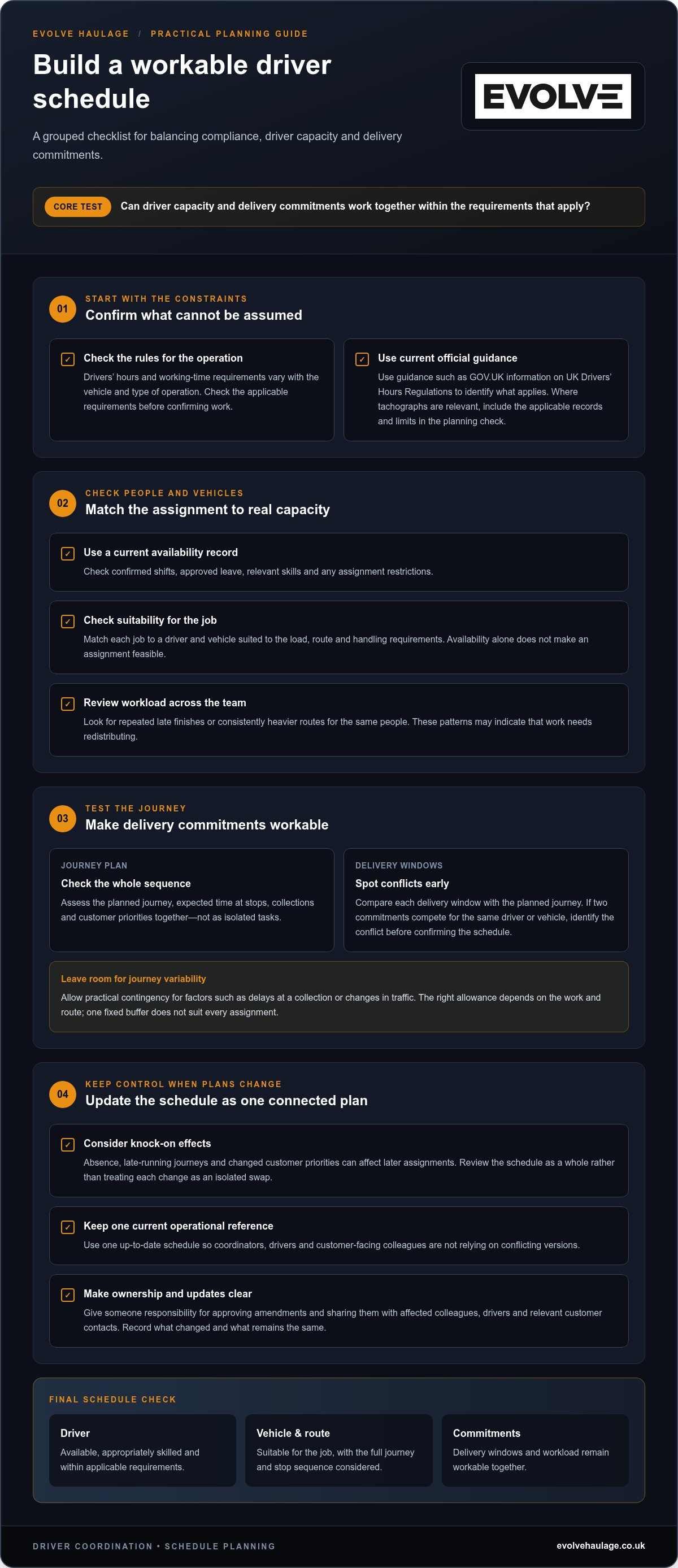
Clear ownership matters when a change is needed. Give someone responsibility for approving amendments and ensuring the updated plan reaches affected colleagues, drivers and relevant customer contacts. This reduces the risk of people acting on conflicting instructions. Record the latest assignment and communicate what has changed, along with what remains the same.
Why do driver schedules become difficult to manage?
Common pressures include driver absence, late-running journeys and customer requests to change a delivery time or priority. A delay at one stop can affect later commitments, while an absence may require work to be reassigned without creating an impractical route or uneven workload. Treating each change as an isolated swap can hide its knock-on effects across the schedule.
Information can also become disconnected. If a coordinator, driver and customer-facing colleague each rely on a different version of the plan, an otherwise sensible update may not reach everyone who needs it. Keep one current schedule as the operational reference and make responsibility for updates clear. Review it when availability, journey progress or customer requirements shift, so assignments reflect operating conditions rather than earlier assumptions.
Build a workable driver schedule around compliance, capacity and delivery needs
Build a workable schedule by separating non-negotiable constraints from choices that can be adjusted. Check the rules that apply and confirmed driver availability first. Then test vehicle suitability and delivery windows before balancing the remaining workload. This order helps prevent a customer priority or preferred route from being treated as feasible when a more fundamental constraint rules it out.
A schedule is feasible only when driver capacity and delivery commitments can be met together, within the requirements that apply to the operation. Allow practical contingency for journey variability, such as delays at a collection or changes in traffic, rather than planning every movement with no room to respond. The right allowance depends on the work and route, so avoid using one fixed buffer for every assignment.
Check driver availability, competence and workload
Start with a current record of confirmed shifts, approved leave, relevant skills and any assignment restrictions. Match each job to a driver and vehicle suited to its demands, including the load, route and handling requirements. Then review the proposed allocation across the team. Repeated late finishes or consistently heavier routes for the same people may indicate that work needs redistributing. This supports fairer planning without assuming every driver can take on every assignment.
Account for UK rules and delivery commitments
Drivers’ hours and working-time requirements vary according to the vehicle and operation. The UK has different regimes, and working-time requirements may apply alongside drivers’ hours rules. Use current official guidance, such as the GOV.UK information on UK Drivers’ Hours Regulations, to identify what applies before confirming an assignment. Where tachographs are relevant, include the applicable records and limits in the planning check rather than treating them as an administrative task after the schedule is set.
Once legal and availability checks are clear, assess the delivery commitments. Compare each delivery window with the planned journey, expected time at stops and any collection or customer priorities. If two commitments compete for the same driver or vehicle, identify the conflict early and decide which assignment can move, be reordered or be covered differently. Don’t solve one late delivery by creating an unrealistic sequence elsewhere.
Use this priority checklist:
- Applicable rules: establish the relevant drivers’ hours, working-time and record-keeping requirements.
- Availability: confirm shifts, leave, skills and assignment restrictions.
- Vehicle suitability: match vehicle capability to the work and journey.
- Delivery needs: test route sequence and customer time windows for feasibility.
- Workload: review the final allocation for capacity, balance and realistic contingency.
Evolve Haulage’s transport management support provides day-to-day oversight of driver coordination, schedule execution and compliance considerations.
How to manage drivers and schedules: a repeatable planning process
A consistent planning cycle turns incoming orders into assignments that can be checked, communicated and updated. It gives coordinators a clear sequence to follow, rather than relying on memory or making decisions in isolation. Use these steps for each planning period, adapting the level of detail to the work involved.
- Collect the work requirements. Bring together each delivery and collection’s locations, time windows, deadlines, load details and handling instructions. Clarify which commitments are fixed and where there may be flexibility. Missing or unclear details at this stage can create avoidable changes after a driver has been assigned.
- Group work into practical journeys. Organise jobs by a sensible route sequence and delivery priority, not simply by the order in which requests arrived or what is easiest to allocate. Consider how collections, delivery windows and the time required at each stop fit together. If one urgent job affects several other commitments, make that trade-off visible before building the rest of the plan around it.
- Match the work to available capacity. Check confirmed driver availability, relevant skills and assignment restrictions alongside suitable vehicle availability. Draft each assignment as a complete journey, then test whether the driver and vehicle can cover its work, timings and instructions. A driver who appears free may not be suitable for a particular job, and a vehicle that can carry a load may not fit the planned route or handling requirements.
- Check the draft before confirming it. Review each assignment against practical constraints: driver availability, workload, vehicle suitability, journey sequence and customer commitments. Look at the combined schedule too. A change that makes one journey workable should not create an impossible overlap or leave another delivery without suitable cover. Resolve conflicts before sending the plan, and note any assumptions that still need following up.
- Issue and maintain one current plan. Share each driver’s relevant jobs, timings, locations and instructions through the established communication channel. Set an expectation for acknowledging assignments and reporting delays or other changes promptly. Keep one current version of the schedule, and record significant amendments, when they were made and who authorised them. This gives everyone a reliable reference if plans shift during the day.
For example, if a collection is added to a route, check its location and timing against the driver’s existing deliveries before confirming it. If it affects a later commitment, revise the sequence or allocation and communicate the updated instructions to everyone affected. This simple check helps stop an unrecorded change becoming a second, conflicting plan.
This repeatable approach is the practical core of how to manage drivers and schedules. It connects planning with clear communication and ongoing oversight. For a wider view of how these activities fit into daily operations, read this day-to-day transport management guidance.
Keep schedules reliable when delays, absence or priorities change
A schedule needs active management once work is under way. A late-running journey, unexpected absence or changed customer priority can affect several assignments, not just the one directly involved. Scheduling software may help organise information, but it can’t decide which commitment should take priority or replace a manager’s judgement. People still need to assess the impact, make a workable decision and ensure everyone acts on the same updated plan.
Use different rhythms for planned oversight and urgent disruption. Routine reviews help spot developing issues, while exception handling is for changes that need a timely decision.
| Routine schedule review | Immediate exception handling |
|---|---|
| Compare planned and actual timings, review workload patterns and identify recurring causes of change. | Check the specific delay or absence, identify affected commitments and decide what needs to change now. |
| Use findings to adjust future planning assumptions, allocations or coordination processes. | Reallocate work only after checking driver availability, vehicle suitability, journey demands and applicable constraints. |
| Share process improvements with the relevant team. | Issue revised instructions promptly and record the decision and updated assignment. |
Respond to late-running work and driver absence
When disruption occurs, pause before moving jobs between drivers. First identify which deliveries, collections, drivers and vehicles are affected, then establish which commitments remain achievable. Prioritise using operational urgency and customer requirements, while checking that any proposed reassignment is feasible. A change that protects one time-sensitive delivery should not create a conflict elsewhere in the schedule.
Once a decision is made, notify the affected driver and colleagues through the established channel. Communicate the revised instruction, what has changed and which original commitments remain in place. Record the reason for the change, who authorised it and the current assignment. This creates a clear reference if further adjustments become necessary.
Use reviews and operational data to improve plans
After resolving an immediate issue, compare planned with actual timings and review the changes made. Look for patterns such as a particular stage of a journey regularly taking longer than planned, repeated clashes around delivery windows or workload consistently falling unevenly. Check for recurring causes before revising the process. One unusual delay may not justify a permanent change, but repeated evidence can help refine assumptions and future schedules.
This review loop turns disruption into useful operational insight rather than treating every delay as an isolated event. It also helps managers distinguish between a one-off exception and a planning issue that needs attention. For wider context on coordinating transport operations, explore this UK transport management business guide.
Evolve Haulage provides transport management support for day-to-day oversight, driver coordination and schedule execution. A consistent approach to how to manage drivers and schedules helps teams respond to change while keeping decisions clear and accountable.
How transport management support can strengthen driver coordination
Good planning gives a transport operation structure, but the plan still needs to be carried out and managed as work progresses. As delivery volumes grow, a small coordination gap can become harder to absorb: responsibilities may be unclear, changes may be frequent, and internal teams may have less time to review assignments carefully. Additional oversight can help connect the schedule with day-to-day decisions.
Consider where pressure is building before deciding what support would be useful. The aim is not to add process for its own sake, but to make ownership clearer and ensure planned work is followed through consistently.
When might a business need additional transport oversight?
Recurring planning bottlenecks, unclear responsibility for approving changes and persistent schedule revisions can all signal that existing arrangements are under strain. Look for practical effects too, such as coordinators spending more time resolving conflicting instructions than planning work, or important updates not reaching everyone involved. These signs are a reason to review how coordination is organised, rather than automatically outsource the whole operation.
Consistent oversight can help bridge the gap between drawing up assignments and executing them. It keeps coordination, schedule changes and relevant compliance considerations within a clearer operational framework.
Connect driver coordination with a wider transport plan
Schedule execution is one part of transport management. It sits alongside day-to-day oversight of road transport activities, driver coordination and compliance support. Considering these responsibilities together can help a business understand whether recurring disruption stems from an individual assignment or a broader issue in its transport strategy. Evolve Haulage’s consultancy can help assess operational efficiency and transport strategy, taking the needs of each operation into account.
Start a review with a few focused questions:
- Are responsibilities for planning, approving changes and communicating updates clear?
- Do recurring schedule changes point to a persistent constraint or an isolated event?
- Is there enough internal capacity for day-to-day coordination and oversight?
- Would an operational efficiency assessment help clarify where the transport strategy could be refined?
Evolve Haulage’s transport management services provide day-to-day oversight and help put driver assignments and schedule execution into a wider operational context. Support can address a defined need, such as coordination, compliance or operational efficiency, without adding unnecessary complexity.
Understanding how to manage drivers and schedules includes knowing when existing processes need more oversight. For an overview of Evolve Haulage’s day-to-day transport coordination, visit Evolve Haulage’s transport management page.
Make your next schedule easier to manage
Start by identifying where coordination currently depends on individual effort: a recurring planning bottleneck, unclear ownership of updates or limited time to review transport efficiency. This gives you a practical starting point for strengthening the process, rather than trying to change everything at once. A consistent approach to how to manage drivers and schedules can develop alongside your operation as its requirements change.
Where additional operational structure would help, Evolve Haulage’s transport management provides day-to-day oversight to support driver coordination and schedule execution. Its consultancy can assess operational efficiency and inform transport strategy, helping you consider improvements in the context of your business needs.
Explore Evolve Haulage’s transport management support to discuss strengthening driver coordination and schedule execution. With clear priorities and operational support, you can keep refining a schedule that works for your team and customers.
Frequently Asked Questions
How do you manage drivers and schedules effectively?
To manage drivers and schedules effectively, use a consistent decision-making process that starts with confirmed work and ends with active follow-up. Check who is available and suitable, then test proposed assignments against relevant rules, journey demands and delivery commitments. For example, if a new collection is added, review its effect on the driver’s other jobs before agreeing to it. Share the plan clearly, monitor exceptions and update affected people when decisions change.
What should be included in a driver schedule?
A useful schedule gives each driver enough information to understand their assigned work and flag a problem. Depending on the operation, include shift or work allocation, collection and delivery details, timings, vehicle suitability and any handling instructions. It should also make clear how to report a delay or request clarification. A business carrying varied loads may need different details from one running repeat journeys, so tailor the format to the work.
How can a transport manager make driver schedules fair?
Review availability, relevant skills and workload patterns across a suitable period, rather than judging fairness from one shift alone. Fairness doesn’t require every driver to receive identical routes or hours. Assignments can differ because of capability, availability or job requirements. Apply the same decision criteria consistently, watch for repeated over-allocation or under-use, and explain the operational reason for an assignment. Give drivers an established way to raise concerns and have those concerns reviewed.
Can software manage driver schedules automatically?
Software can help organise scheduling information, but it shouldn’t be treated as a substitute for operational judgement. A manager still needs to assess whether proposed work fits real availability, vehicle and journey constraints, applicable requirements and customer priorities. Capabilities vary between tools, so don’t assume every system handles the same tasks. Use software to support consistent coordination, with clear responsibility for decisions and a reliable way to communicate changes to drivers.
How do you manage driver schedules when a delivery is delayed?
First establish which delivery commitments, drivers and vehicles could be affected, including later work on the same journey. Then compare feasible options against operational urgency and customer requirements before changing an assignment. For instance, reordering stops may be possible, but only if the revised sequence remains workable. Communicate updated instructions promptly to the people affected and record the decision in the current schedule. This supports an informed response without assuming every original delivery time can be preserved.
What UK rules should be considered when scheduling drivers?
Applicable drivers’ hours and working-time requirements depend on the vehicle and type of work. Managers should identify the relevant rules for their operation and consult current official guidance, such as GOV.UK’s drivers’ hours guidance, before relying on specific limits, exemptions or record-keeping requirements. Build compliance checks into scheduling decisions, and treat general information as a starting point rather than advice tailored to a particular operator or journey.
How often should driver schedules be reviewed?
Review a schedule whenever a change to work, availability or delivery requirements could affect an assignment, and assess operating patterns regularly. The appropriate review frequency depends on the operation’s workload and how much its plans vary. Compare planned and actual work to identify recurring delays or uneven allocations. If a pattern persists, investigate its cause and adjust the planning approach where appropriate, rather than making a permanent change in response to a single unusual event.


